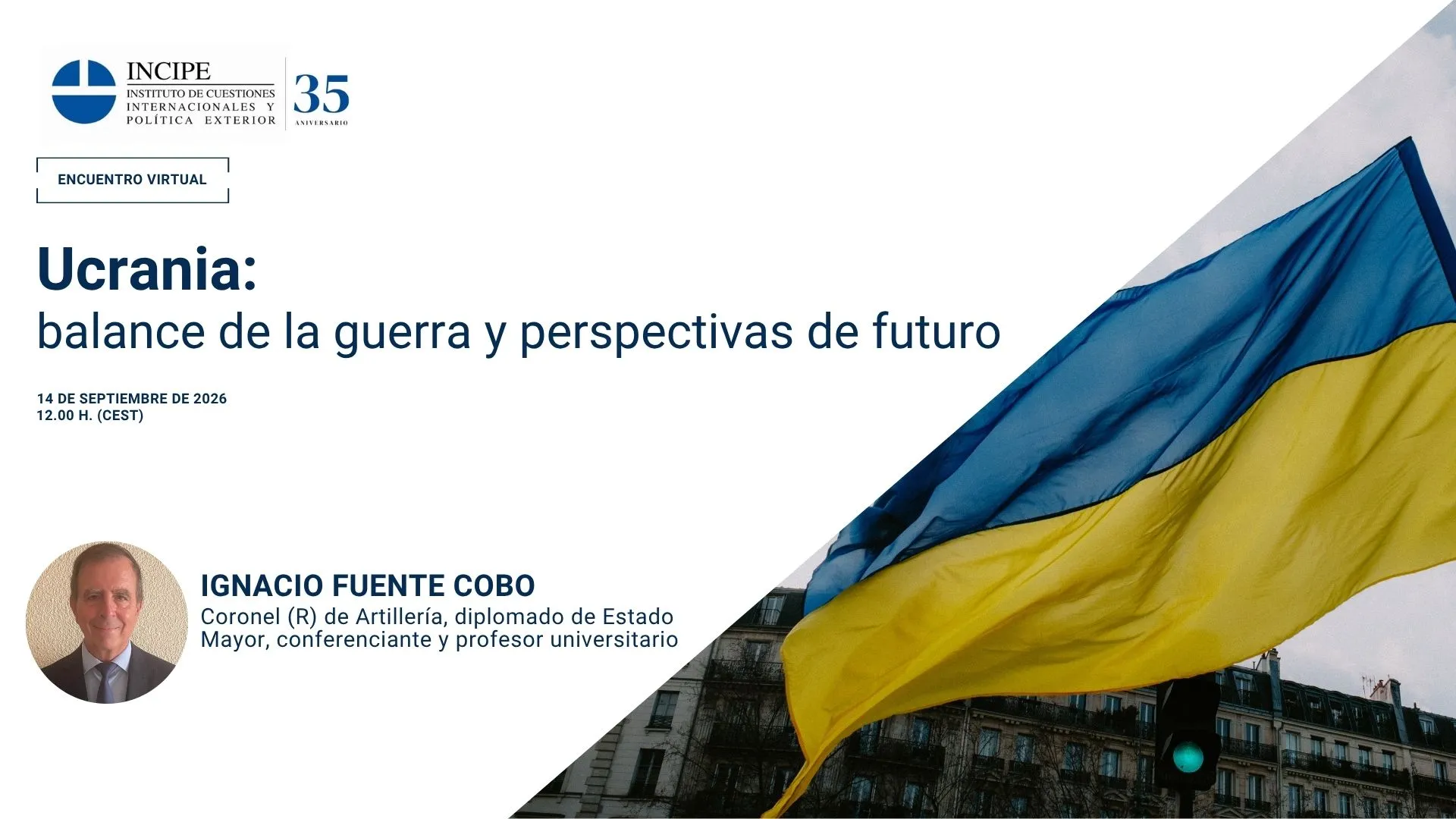
On 14 September, INCIPE opened its 2026–2027 academic year with the virtual session "Ukraine: An Assessment of the War and Future Prospects," delivered by Colonel Ignacio Fuente Cobo, one of Spain's most respected security and defense analysts. The event was introduced by INCIPE's Secretary General, Ricardo Díez-Hochleitner, and moderated by its Director General, Vicente Garrido. It offered a detailed picture of the situation on the ground after four and a half years of war, and of the scenarios that lie ahead as winter approaches.
Ignacio Fuente Cobo is a colonel of Artillery in the reserve, a General Staff graduate, a graduate of the U.S. Army Air Defense School and of the NATO Defense College in Rome, and a specialist in electronic warfare. He holds a master's degree in Peace, Security and Defense from the General Gutiérrez Mellado University Institute at UNED. Over the course of his career, he has commanded the Mistral anti-aircraft missile group in Madrid and the Hawk-Patriot air defense artillery regiment in Seville, and has served as Head of Logistics at the Melilla General Command. He was a senior analyst at the Spanish Institute for Strategic Studies and Spain's national representative at the NATO Defense College in Rome from 2018 to 2021. In the operational field, he was deployed with NATO's SFOR in Bosnia and Herzegovina (1999–2000) and served as Chief of Operations of the European Union force in Operation Althea (2006). He teaches on master's programs at Carlos III University and San Pablo CEU University, has authored more than 150 articles and papers, received the 2004 Defense Award, and is a member of the Academy of Military Sciences and Arts.
Ignacio Fuente Cobo devoted the first part of his presentation to the Donetsk front. Since the failure of the 2023 Ukrainian counteroffensive, he explained, Russia has been advancing westward using attritional tactics: seizing small portions of ground without ever halting the advance, even at the cost of heavy casualties. This is how Bakhmut fell in 2023, Avdiivka in 2024, and Pokrovsk in 2025, bringing Russian troops up against the so-called belt of fortified cities in the Donbas: Kostiantynivka, Druzhkivka, Kramatorsk, and Sloviansk.
Fuente Cobo identified these cities as the place where the war will be decided. Built on commanding terrain, linked to one another, and protected for years by minefields and anti-tank obstacles, they form the lock on the great Ukrainian plains; should they fall, Russia would gain unimpeded access to the Dnipro. Ukraine has concentrated between 45,000 and 65,000 of its best soldiers there, under the command of Denys Prokopenko and Andriy Biletsky, facing two Russian combined-arms armies totaling between 110,000 and 140,000 troops. According to the speaker, Kostiantynivka is already 90% in Russian hands, while Ukraine retains control of Lyman, which is key to preventing an encirclement from the north.
The demographic imbalance, four to one in Russia's favor, weighs decisively in a war of this kind. Moscow manages to replace each month a number of soldiers similar to its losses, around 40,000, while Ukraine, Fuente Cobo warned, faces serious mobilization difficulties.
The war, however, is also being fought far from the front line. Russia has stepped up its attacks on logistics, energy, and communications infrastructure, taking advantage of the fact that Ukraine's air defenses are operating at full capacity, partly because a large share of Patriot missiles is now being directed to the Persian Gulf. Added to this is the blockade of the port of Odesa, the main outlet for Ukrainian wheat: the alternative Danube route, he noted, allows only a third of that volume to be exported. Ukraine, for its part, has responded with long-range strikes of up to 3,000 kilometers against Russian refineries, terminals, and depots, which have hit more than 40% of the country's refineries. Even so, the colonel cautioned that these strikes are unlikely to bring about the collapse of the Russian economy.
On the international front, Fuente Cobo stressed that support for Ukraine is now almost exclusively European. He recalled that European aid already exceeds 200 billion euros, that the allies agreed at the NATO summit in Ankara on a commitment of 140 billion for the next two years, and that the European Union has approved a 90-billion package for 2026 and 2027. He also identified the fight against corruption as one of Kyiv's major outstanding challenges.
Looking ahead, he considered it unlikely that a new front would be opened from Belarus, which would require Russia to carry out a new mobilization, or that the Baltic states would be attacked. The most likely outcome, he concluded, is a continuation of the war: high-intensity fighting in the Donbas, more strikes on the rear areas of both countries, and an increase in hybrid operations against Europe, in a winter that promises to be especially harsh for Ukraine.
The Q&A segment addressed Russia's attrition and the transformation of its economy into a war economy, the hybrid threat to Europe, Ukraine's capacity to hold its positions through the winter, and Moscow's external backers. The session closed with a reflection on the security guarantees Ukraine might receive under an eventual peace agreement and on its future accession to the European Union, which, as the speaker recalled, will have to meet the same requirements as all other Member States.
Aranzazu Álvarez