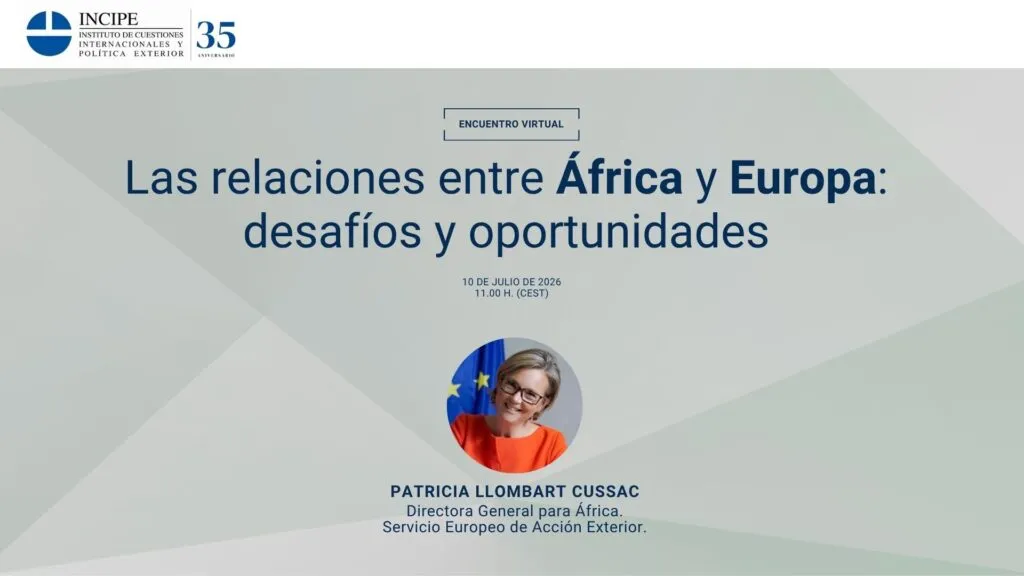
On 10 July 2026, INCIPE held the virtual session "Africa–Europe Relations: Challenges and Opportunities," featuring Patricia Llombart-Cussac, Managing Director for Africa at the European External Action Service. The event was introduced by Ricardo Díez-Hochleitner, Secretary General of INCIPE, and moderated by Vicente Garrido, Director General of the Foundation.
Africa is at once Europe's closest neighbor and one of the least known continents to European citizens. Seven times larger than the European Union, with a young population and an abundance of resources, it has become an indispensable partner for Europe and, very particularly, for Spain, which by virtue of its geography and history is called upon to act as a bridge. The question is no longer whether this relationship should be strengthened, but how to move from an important relationship to a truly transformative one. To address it, INCIPE welcomed the European Union's most authoritative voice on the subject.
Born in Valencia, Patricia Llombart-Cussac holds a law degree from the University of Valencia and master's degrees from the College of Europe in Bruges and the University-Business Foundation of Valencia. She has more than three decades of diplomatic experience in the European institutions, having joined the European Commission in 1993 in the division responsible for Mercosur. Shortly afterwards, she moved to the cabinet of Vice-President Manuel Marín, then in charge of relations with Asia, the Mediterranean, and Latin America, and later to the Planning and Economic Analysis Unit of the Directorate-General for External Relations and to the cabinet of Commissioner Chris Patten. Between 2002 and 2012, she was responsible for the European Union's relations with Iran, Iraq, Yemen, and the Gulf countries, first within that Directorate-General and then at the newly created European External Action Service, where she held two senior positions: Director of Human Resources, Selection and Recruitment, from 2012 to 2015, and Director General for Infrastructure, Security, Budget and Finance, from 2015 to 2018. She then served as European Union Ambassador to Colombia from 2018 to 2021, and to the Kingdom of Morocco from 2021 to 2025. Since last year, she has led European policy towards Africa.
Patricia Llombart opened her presentation with an observation: the international order is changing rapidly, and Africa has moved to the center of the new geopolitical competition. A growing number of actors are seeking to establish themselves on the continent, and Europe cannot afford to look the other way, since developments in the Sahel, the Horn of Africa, or the Red Sea have a direct bearing on its own security and prosperity. She recalled an idea put forward by Javier Solana: without attending to its neighborhood, Europe can aspire neither to security nor to influence. The summit between the European Union and the African Union held last November in Luanda, Angola, confirmed the shared determination to elevate this relationship and, in her view, opened a historic opportunity.
The continent's figures speak for themselves. Africa is home to nearly 18% of the world's population, some 1.4 billion people, and will reach around 2.5 billion by mid-century; in 2025 alone, 47 million children were born there, equivalent to the entire population of Spain. By 2050, one in four human beings will be African. It will be the youngest continent on the planet, with an immense workforce and growing demand for energy, housing, transport, education, and financial services. Added to this is rapid urbanization, which multiplies infrastructure needs. It should be borne in mind, Llombart noted, that Africa is larger than the United States, China, India, Japan, and a large part of Europe combined.
Nor is this only a matter of the future. Twelve African countries rank among the twenty fastest-growing economies in the world, and cities such as Nairobi, Lagos, Kigali, and Cape Town have become digital hubs generating their own solutions in financial services, logistics, and health. Its subsoil adds a further layer of strategic interest: the continent holds around 30% of the planet's mineral reserves, including raw materials critical to the green and digital transitions and to the defense industry. The Democratic Republic of the Congo alone is home to more than 70% of the world's cobalt. And one paradox sums up the challenge: Africa possesses 60% of the world's best solar resources, yet receives barely 3% of global investment in clean energy. For this reason, the speaker insisted, the relationship cannot be extractive. It must create value on the ground, industrialize, and train, in a spirit of equal partnership.
European policy towards Africa, she explained, has changed fundamentally. The almost exclusive emphasis on development aid has been left behind. In its place stands a more mature partnership structured around four pillars: shared prosperity; peace, security, and governance; mobility and migration; and multilateralism. It also rests on solid foundations: the European Union is Africa's leading trading partner, with 90% of African exports already entering duty-free, and remains its leading investor, with a stock of direct investment some six times larger than China's.
The central instrument is the Global Gateway strategy, which aims to mobilize up to 150 billion euros for Africa in infrastructure, energy, connectivity, and digitalization; more than 120 billion are already underway. Patricia Llombart compared it to the transformative effort that accompanied Spain's accession to the European Union, and illustrated it with two projects. The Lobito Corridor, the continent's first transcontinental rail link, will connect Angola, Zambia, and the Democratic Republic of the Congo, shortening transit times to Europe and creating jobs and value chains. The Africa–Europe Green Energy Initiative seeks to add at least 50 gigawatts of renewable capacity and bring electricity to one hundred million Africans, an area in which, she stressed, Spanish expertise would be extremely valuable. This is complemented by European support for the African Continental Free Trade Area, with more than eighty projects to integrate a market of some 1.4 billion consumers.
None of this is possible, she noted, without stability: there can be no lasting development where violence or fragility persist. This is why peace and security have become an essential dimension of the relationship, always guided by a principle she reiterated with conviction, that of "African solutions to African challenges": Africa leads and Europe accompanies. This support draws on African security architectures, on the European Peace Facility established in 2021, and on a significant presence on the ground. Of the twenty-one civilian and military missions the European Union deploys worldwide, eleven are in Africa, with nearly two thousand European personnel working alongside their African counterparts. The ambassador made special mention of maritime security, through Operations Atalanta and Aspides, whose relevance is growing in light of tensions in Hormuz. Migration and multilateralism complete the picture: in the former, a comprehensive, human rights-based approach; in the latter, the defense of the United Nations Charter, which Europeans and Africans reaffirmed in Luanda.
The subsequent discussion addressed the spread of jihadist terrorism in the Sahel and its link to European security; often-forgotten conflicts and the way in which the Union supports mediation and humanitarian aid; financial and de-risking instruments for companies; and the growing competition from China, Russia, and other powers for African resources. In response, Llombart championed the European offer as comprehensive, reliable, and designed for the long term, while highlighting the importance of African youth as an investment in the future.
In conclusion, Patricia Llombart noted that the partnership between Europe and Africa is at a decisive moment, and that Spain, by virtue of its geography, history, and business fabric, is particularly well placed to act as a bridge. The choice, she summarized, is clear: to build a closer, more balanced, and more ambitious relationship, or risk missing opportunities in an increasingly fragmented world.
Aranzazu Álvarez