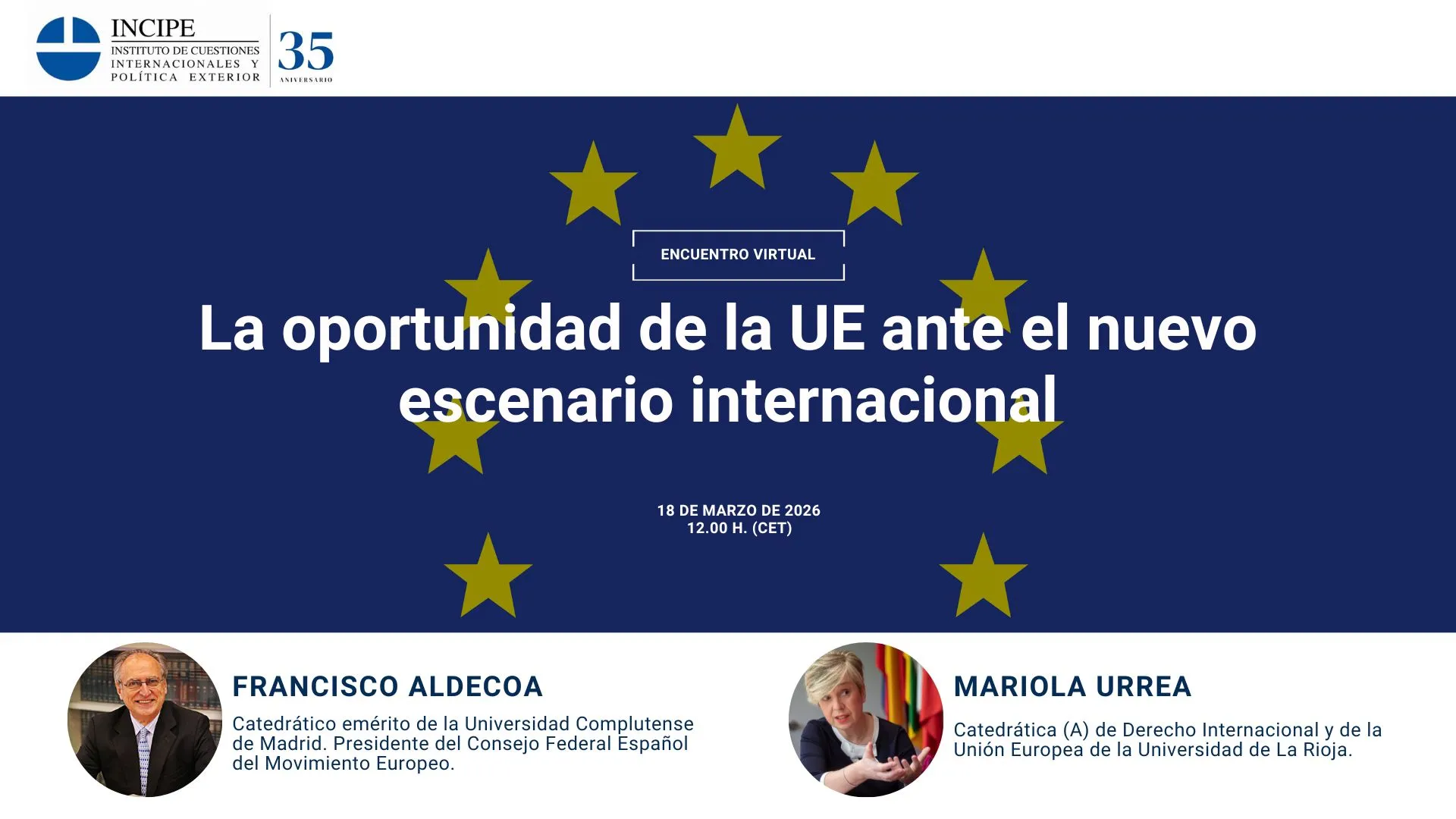
On 18 March 2026, INCIPE held the virtual session "The EU's Opportunity in the New International Landscape," featuring Francisco Aldecoa, Professor Emeritus at the Complutense University of Madrid and President of the Spanish Federal Council of the European Movement, and Mariola Urrea, accredited Full Professor of International Law and European Union Law at the University of La Rioja. The event was introduced by Ricardo Díez-Hochleitner, Secretary General of INCIPE, and moderated by Vicente Garrido, Director General of the Foundation.
The session brought together an audience interested in understanding how the current international landscape affects the European Union and what opportunities are opening up for its political, institutional, and security development. To address these questions, INCIPE welcomed two specialists with extensive experience in the study of the European Union. Francisco Aldecoa is Professor Emeritus at the Complutense University of Madrid, has chaired the Spanish Federal Council of the European Movement since 2018, and has devoted much of his academic career to analyzing European integration and the Union's role in the international system. Mariola Urrea is an accredited Full Professor of International Law and European Union Law at the University of La Rioja and Vice-Rector for International Affairs at the Menéndez Pelayo International University. She is also a regular media contributor and the author of numerous publications on differentiated integration in Europe and on the Common Security and Defence Policy.
In his remarks, Francisco Aldecoa addressed the need to move towards greater European integration in light of current international challenges. He noted that, although the international context is increasingly unstable and tensions between the major powers are intensifying, these circumstances may also become an opportunity to strengthen the EU's capacity for action and its global leadership.
He highlighted recent examples illustrating the EU's resolve and cohesion, such as its handling of the Greenland crisis. He also stressed the importance of strengthening the European Political Community and responding to the growing interest of new states in joining, as well as of making progress towards the implementation of the digital euro. All of this, according to Aldecoa, requires greater coordination among Member States and in-depth reflection on the future of the European project in order to adapt it to a more competitive international environment.
For her part, Mariola Urrea focused her remarks on the limits and possibilities of the European Union's legal framework for advancing integration, particularly in the areas of security, defense, and foreign policy. She noted that the ordinary procedures for revising the Treaties are excessively rigid and lengthy, which hinders swift and coordinated action, while the instruments of differentiated integration do not offer sufficient solutions for making progress on security and defense without undermining cohesion among the Member States as a whole.
Urrea stressed that this situation calls for exploring alternative legal avenues and considering innovative mechanisms of cooperation among countries willing to deepen integration, always within the limits permitted by the Treaties. Finally, she emphasized that strengthening the EU as an actor capable of guaranteeing its own security and projecting influence internationally depends not only on political will, but also on making strategic use of the existing legal framework.
The virtual session concluded with a discussion in which, prompted by questions from the live audience, topics such as European sovereignty, the possibility of developing new forms of defense cooperation, the role of the Common Foreign and Security Policy (CFSP), and the prospects for the evolution of the Treaties were addressed. The debate reflected participants' interest in the options available to the European Union to adapt to a more demanding international environment and in the avenues that could strengthen its capacity for action in the years ahead.
Aranzazu Álvarez