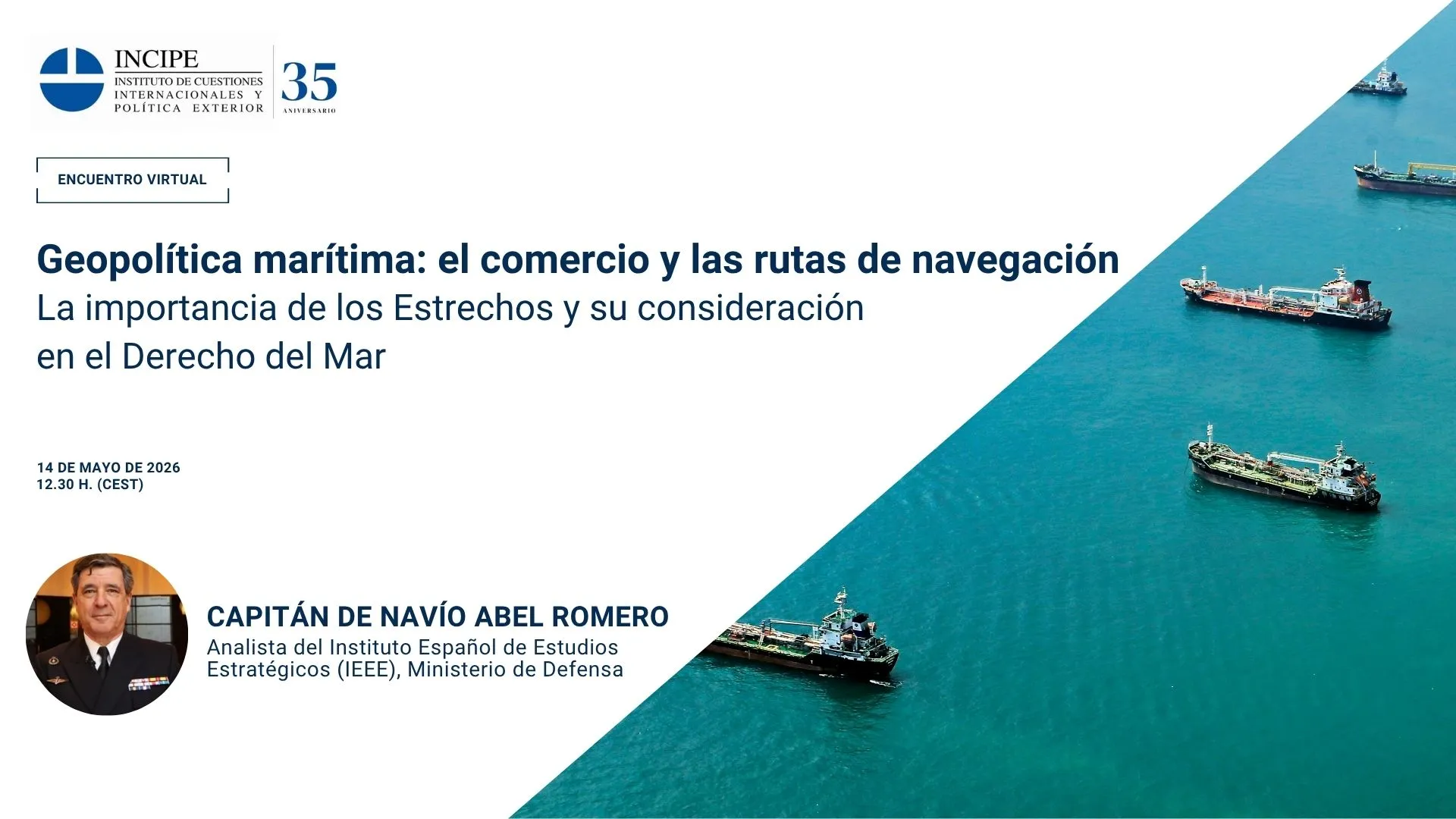
On 15 May 2026, INCIPE held the virtual session "Maritime Geopolitics and Shipping Routes: The Importance of Straits and Their Treatment under the Law of the Sea," featuring Captain (Navy) Abel Romero Junquera, Senior Analyst at the Spanish Institute for Strategic Studies (IEEE), Ministry of Defense. The event was introduced by Ricardo Díez-Hochleitner, Secretary General of INCIPE, and moderated by Vicente Garrido, Director General of the Foundation.
The session addressed one of the most pressing debates in contemporary geopolitics: the balance between state sovereignty and freedom of navigation through international straits. World trade, energy security, and the rivalry between the great powers depend to a large extent on that balance today. To address it, INCIPE welcomed one of Spain's most experienced officers in maritime security and international relations.
Captain Abel Romero Junquera trained at the Naval Academy in Marín, from which he graduated in 1988, and holds a master's degree in Peace, Security and Defense from UNED. He has taken part in international peace operations, including Operation SIERRA JULIETTE in Iraq in 2003 and the EU's EUNAVFOR Operation SOPHIA in 2015, dedicated to combating human trafficking on the high seas. Twelve years of his career have been devoted to European security and defense, eight of them in Brussels, where his postings included Deputy Defense Counsellor to Spain's Ambassador to the EU Political and Security Committee (PSC) and Maritime Security Analyst at the EU Operations Centre of the European External Action Service. He also served as Military Advisor to Spain's Representative to NATO. He is the author of numerous publications on the geopolitics of defense, maritime hegemony, and European security.
Between 80% and 85% of international trade is carried by sea. The speaker took this figure as his starting point to stress that the seas are not merely the stage of the global economy but its physical foundation. And straits, where that foundation narrows and becomes vulnerable, are today first-order arenas of geopolitical contention.
To explain the underlying logic, Captain Romero Junquera drew on Admiral Mahan's triad. Becoming a great global power, Mahan argues, requires being a maritime power, which in turn demands three interlinked elements: a manufacturing base capable of production, a merchant fleet to distribute that output around the world, and a navy to protect the sea routes. All three links are tied to trade as the ultimate source of wealth and power. The history of the great powers, from Spain in the fifteenth and sixteenth centuries to the United Kingdom in the nineteenth and the United States in the twentieth, confirms this without exception.
The analysis placed the competition between the United States and China at its center. China is already the world's largest manufacturing power, builds 55% of the world's merchant ships, and its state-owned shipping company COSCO now ranks fourth worldwide. Seven of the ten busiest container ports are located in China. In the first two links of the triad, therefore, the West is losing ground, although the United States retains undisputed naval hegemony, with eleven nuclear-powered aircraft carriers permanently deployed in different parts of the world, compared with China's three. Nevertheless, studies by the Pentagon itself suggest that China could have six or seven large aircraft carriers, most likely nuclear-powered, within a decade.
The session included an analysis of the three straits of greatest strategic importance. The Strait of Malacca, through which 25% of world trade and 40% of Chinese exports pass, was described as one of the most geopolitically critical points on the planet. Unlike other maritime chokepoints, it has no real navigational alternative: its closure could jeopardize the Chinese economy within a matter of weeks. Bab el-Mandeb has dominated headlines over the past two years as a result of attacks by Houthi militias, which at one point halved traffic through the Red Sea and forced major shipping companies to sail around Africa via the Cape of Good Hope, with the resulting increase in transport costs and transit times. Hormuz, at the forefront of current affairs due to the conflict between Iran and the United States, accounts for around 20% of the oil and liquefied natural gas consumed globally each day. To this must be added close to a third of global fertilizer volumes, with direct consequences for food security in regions such as the Horn of Africa. Its blockade operates mainly through rising maritime insurance costs rather than a physical interruption of traffic, illustrating how geography can become an asymmetric advantage for a middle power against a naval superpower.
The speaker also devoted attention to the legal framework governing these spaces. The United Nations Convention on the Law of the Sea, adopted in Montego Bay in 1982 and ratified by 90% of states, establishes the right of transit passage through international straits and the right of innocent passage in the territorial sea. However, countries such as the United States and Iran have not ratified the Convention, and international law lacks a coercive enforcement mechanism. Its effectiveness depends on states' willingness to respect it and, ultimately, on the power of those who have historically acted as guarantors of the maritime order.
The session concluded with a discussion that addressed, among other issues, the possibility of a simultaneous crisis in several strategic straits, the impact of low-cost drones and missiles on naval powers' ability to ensure freedom of navigation, the distinct legal regime of the Suez and Panama Canals compared with natural straits, the Bosphorus under the Montreux Convention, and the growing role of the Arctic as a future strategic alternative to Malacca. With regard to the European Union, the speaker pointed to the lack of a common external position on maritime affairs and the inadequacy of the naval resources available to exert influence in areas where 40% of European maritime trade transits through contested waters.
Aranzazu Álvarez