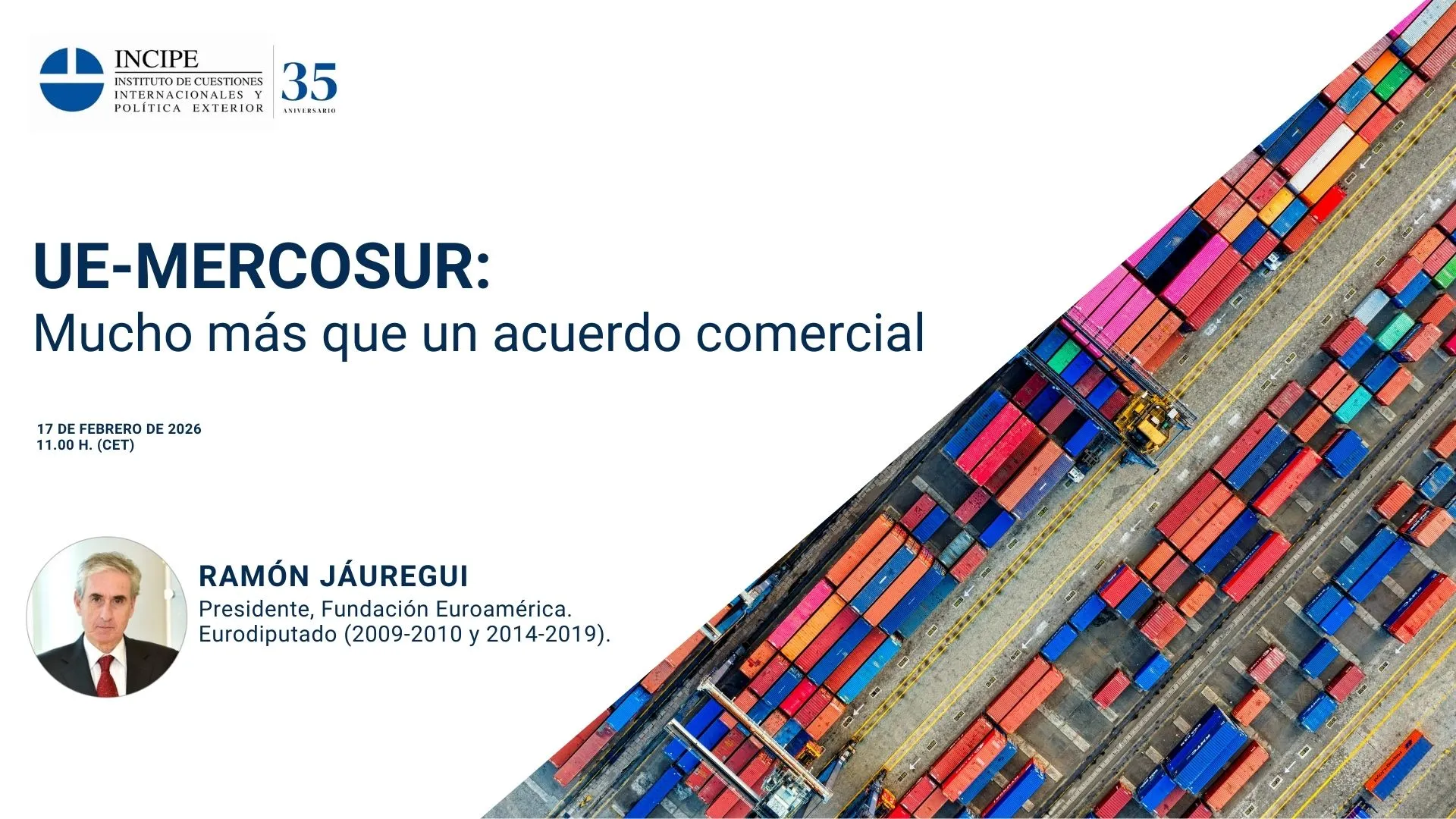
On 17 February, INCIPE held a virtual session devoted to the association agreement between the European Union and Mercosur, following 25 years of negotiations launched in late 1999. The keynote was delivered by Ramón Jáuregui, President of the Euroamérica Foundation. The session was introduced by Ricardo Díez-Hochleitner, Secretary General of INCIPE, and moderated by Vicente Garrido, Director General of the Foundation, who led the discussion.
Ramón Jáuregui is an engineer and law graduate with an extensive political and institutional career. He has served as Mayor of San Sebastián, Member of the Basque Parliament, Government Delegate in the Basque Country, Vice-President and Minister of Justice of the Basque Government, Member of the Spanish Congress of Deputies for three consecutive legislative terms and, subsequently, Member of the European Parliament on two occasions: 2009–2010 and 2014–2019. In 2010, he was appointed Minister of the Presidency of the Government of Spain. Since June 2019, he has chaired the Euroamérica Foundation, an institution established 25 years ago to foster cooperation and understanding between Europe and Latin America.
The EU–Mercosur agreement was signed on 17 January 2026 in Asunción, Paraguay, in the presence of the President of the European Commission and the President of the European Council. Regarded by both sides as strategic from a political, economic, and commercial standpoint, it aims to create one of the world's largest free trade areas, encompassing some 750 million people (270 million in the Mercosur countries and more than 450 million in the European Union), around 10% of the world's population. Thanks to the progressive elimination of tariffs, it is estimated that it could increase European exports by around 39% annually.
During the session, Ramón Jáuregui structured his presentation in three parts: the historical background to the agreement, the core content of the treaty, and its geopolitical implications.
Regarding its origins, he placed the agreement in the context of late twentieth-century globalization, marked by processes of offshoring and commercial expansion following the Cold War. He recalled that the first European Union–CELAC Summit, held in Rio de Janeiro in 1999, opened the door to major political and trade association agreements between Europe and Latin America. Although formally launched at that time, negotiations with Mercosur did not make real progress until 2016. The agreement reached in 2019 did not go ahead due to political resistance from several Member States, linked mainly to agricultural and environmental concerns, particularly regarding Brazil's deforestation policy. Between 2023 and 2025, following new negotiations and changes in the political context, the agreement signed in December 2024 was finally reached.
Jáuregui explained that the treaty takes the form of a political association and trade cooperation agreement, and that its legal architecture is based on the so-called "split," which assigns exclusive competence for trade matters to the European Commission, while the political component requires ratification by national parliaments.
From an economic standpoint, the agreement provides for the progressive liberalization of approximately 91% of tariffs, allowing for a transition period and sectoral adjustment. The European Union's annual exports to Mercosur amount to some 100 billion euros and currently face high duties: 35% on cars, 20% on manufactured goods, 18% on chemicals, and between 20% and 30% on agricultural products. Around 30,000 European companies produce in or trade directly with Mercosur, so the elimination of tariffs will free up approximately 4 billion euros a year in duties.
The agreement provides for the protection of 59 European geographical indications, the opening of services and public procurement markets, including at sub-national level in countries such as Brazil and Argentina, and the incorporation of labor, social, and environmental standards aligned with the commitments of the Paris Agreement. It also sets out sanitary and phytosanitary clauses requiring imported products to comply with European standards.
In Spain's case, exports to Mercosur are expected to increase by between 35% and 40%, which would translate into a rise in Spanish GDP of close to 0.25% and the creation of more than 20,000 jobs, according to estimates from the Ministry of Economy. More than 10,000 Spanish companies, approximately 90% of them SMEs, could benefit from preferential access to the Mercosur market.
In his remarks, Jáuregui also analyzed the difficulties that arose after the agreement was signed. In October 2025, the European Commission adopted a safeguards regulation to protect the European agricultural sector, establishing longer transition periods, annual review clauses, and an initial fund of 5 billion euros under the CAP, with the aim of overcoming the reservations of several Member States. Following further negotiations, the agreement was approved by the Council on 8 January 2026, with France, Poland, Hungary, Ireland, and Austria voting against and Belgium abstaining. However, on 21 January 2026, the European Parliament requested an opinion from the Court of Justice of the European Union (CJEU) on the treaty's compatibility with EU law, a decision adopted by a narrow margin.
In his political assessment, Jáuregui stressed that the agreement completes the framework of economic relations between the European Union and Latin America, filling an outstanding gap in economic and demographic terms. He highlighted that, in a context of fragmentation in international trade and growing geopolitical competition, the treaty goes beyond trade to become a fundamental instrument of European strategic autonomy, facilitating access to critical raw materials, energy, and diversified supply chains. He also underlined Brazil's central role as a regional and global actor, and the importance of the agreement in strengthening the European Union's international credibility.
The session closed with a Q&A segment addressing the ratification process, opposition from the European agricultural sector, the role of France, and possible scenarios in the event of delays. Jáuregui warned that a prolonged delay could erode the confidence of the Mercosur countries and weaken the European Union's negotiating position in other international agreements.
Aranzazu Álvarez