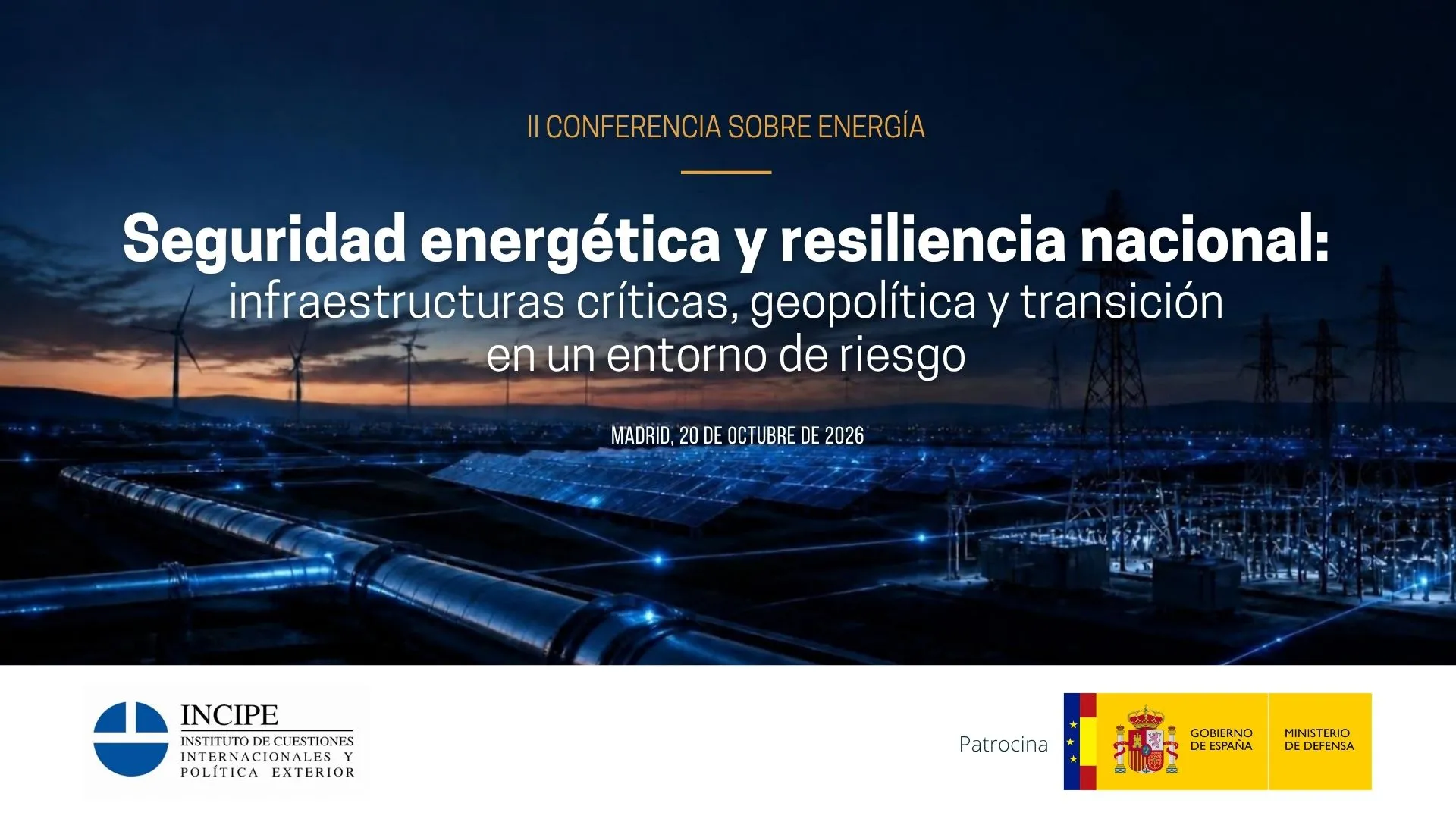
On 20 October 2026, INCIPE held its Second Conference on Energy, entitled “Energy Security and National Resilience: Critical Infrastructure, Geopolitics, and Transition in a Risk Environment.” The event, organized jointly with the Spanish Ministry of Defense, forms part of a collaboration spanning more than two decades between the two institutions to promote knowledge of the geostrategic environment and defense culture.
Energy is no longer understood solely in economic or environmental terms; it has become a central component of security and defense. The war in Ukraine and the crisis surrounding the Strait of Hormuz, with their effects on supply routes, have highlighted its role as a first-order geostrategic lever. The conference was built around this idea and structured into a keynote address and two round tables.
The opening was delivered by Ricardo Díez-Hochleitner, Ambassador of Spain and Secretary General of INCIPE, and Lieutenant General (Ret.) Luis Cebrián Carbonell, Director General of Infrastructure (DIGENIN) at the Ministry of Defense. Lieutenant General Cebrián framed the current international landscape as one of “gray-zone conflict” and reviewed the lines of action needed to ensure a secure and resilient energy supply, from diversifying sources and routes to protecting critical infrastructure, with a reference to the Ministry’s own progress in energy self-sufficiency.
Pedro Miras, President of WPC Energy (World Petroleum Congress), delivered the keynote address, having just returned from the latest World Petroleum Congress in Riyadh. He provided an overview of global energy supply and recalled that the world’s energy mix still relies to a large extent on fossil fuels. He championed security of supply as a priority and advocated technological neutrality and regulatory stability. He also warned of tensions in the refined products market and of the growing electricity demand associated with data centers and artificial intelligence.
The first round table, National Resilience and Critical Infrastructure in Transition, was moderated by Silvia Iranzo, Vice President of INCIPE, and brought together Juan Luis López Cardenete, Board Member of ACCIONA and former Chairman of Unión Fenosa Internacional; Marina Serrano, President of the Spanish Association of Electric Power Companies (AELEC); and Carlos Solé, Senior Energy Advisor at KPMG Spain. López Cardenete called for a review of a European energy strategy designed for a world that no longer exists and defended the principle of technological neutrality, while warning against excessive concentration in gas supply. For Marina Serrano, electricity grids are today critical infrastructure and a lever of strategic autonomy, and their saturation is the main obstacle to connecting the new industrial, housing, and data center demand that the country could attract. Carlos Solé framed the challenge around three priorities: planning, optimizing, and anticipating, and called for making better use of existing infrastructure before building new facilities. The discussion also took up a recurring debate: the risk of replacing dependence on hydrocarbons with dependence on critical materials and components, as the new face of strategic autonomy.
The second round table, Geopolitics of Supply and Energy Coercion: Risks, Routes, and Dependencies, was moderated by Colonel Francisco José Marcos, Head of the Geopolitical Analysis Area at DICOES/SEGENPOL, Ministry of Defense, with the participation of Jorge Segrelles García, former Chairman of Repsol Petróleo and Petronor; Ignacio Urbasos, Coordinator of the Technical Secretariat of the Spanish Energy Club; and Captain Miguel Golmayo (Ret.), Spanish Navy, Director General of the Defense Department at the Foundation for Development and Technological Innovation (FUNDITEC). Their contributions covered the geopolitics of oil and its use as an instrument of pressure, the implications of the Fourth Industrial Revolution for security of supply, and the maritime and port dimension of energy security.
Jorge Segrelles argued that the real crisis lies not in crude oil, whose price has not reached historic highs in real terms, but in refined products, with refining margins and diesel crack spreads at unprecedented levels following damage to refining capacity in the Middle East and Russia. Ignacio Urbasos linked this reality to the ongoing technological transformation: artificial intelligence, satellite imagery, and digitalization have lowered the threshold for non-state actors to carry out precision strikes on energy infrastructure located thousands of kilometers away, a risk that, he warned, also extends to Spanish facilities. Miguel Golmayo recalled that most of the world’s oil is transported by sea and identified onshore port facilities (refineries, regasification plants, and storage) as the most vulnerable point, increasingly exposed to cyberattacks and drones, and called for greater investment in their protection.
The closing address was delivered by Joaquín Pérez de Ayala, Director General for Decarbonization at Técnicas Reunidas. PPérez de Ayala recalled that fossil fuels will remain part of the energy landscape for decades. In his view, decarbonization will come, albeit more slowly than expected and in a necessarily selective manner, concentrated in the value chains capable of sustaining it. He made it conditional on three requirements: speed in project execution, a shared effort by society as a whole, and a sustained long-term commitment.
The full conference is available on demand on INCIPE’s YouTube channel, where the presentations and discussions can be followed in their entirety.
Aranzazu Álvarez