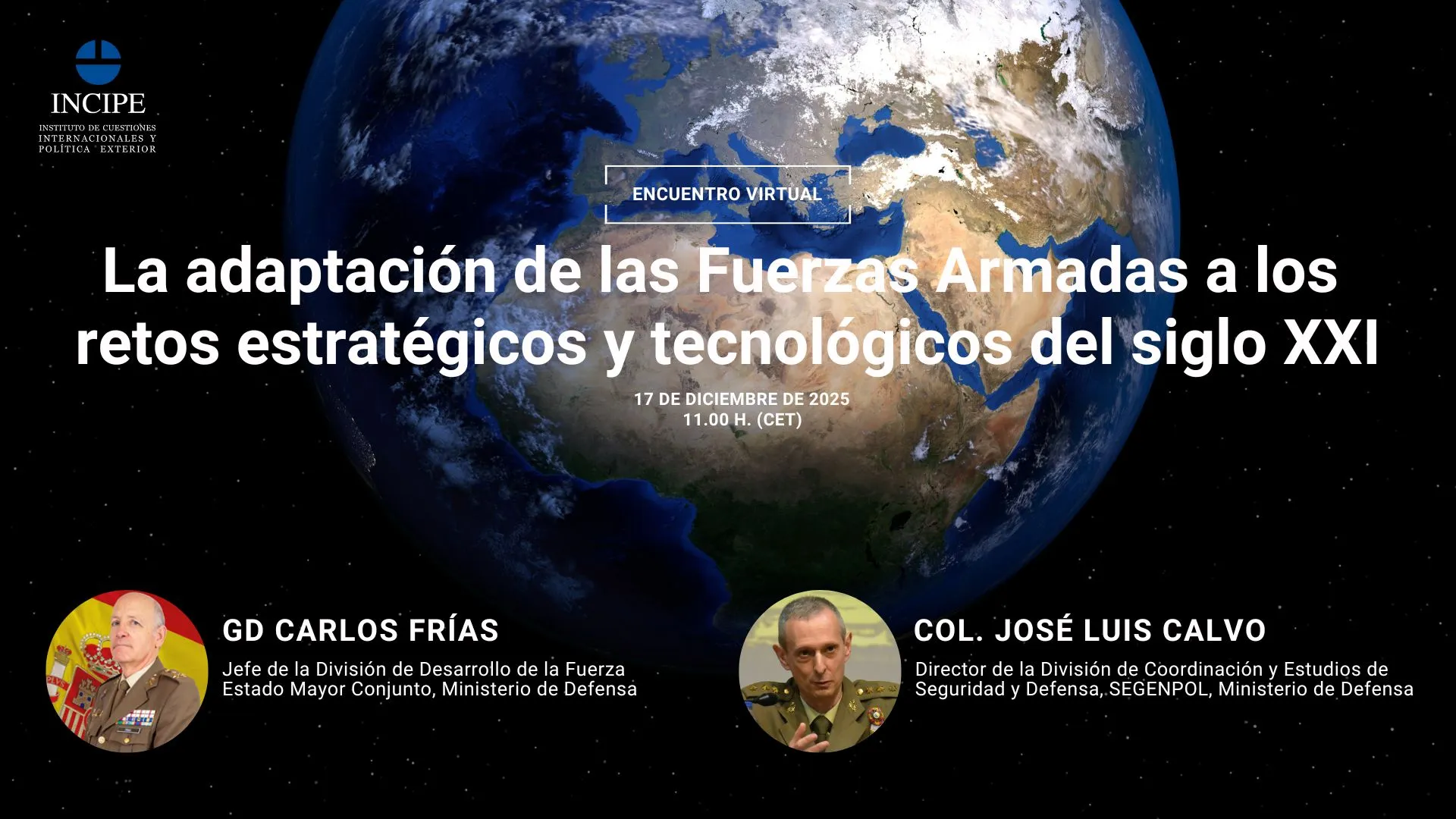
On 17 December, INCIPE held the virtual session "Adapting the Armed Forces to the Strategic and Technological Challenges of the 21st Century." The event featured two members of the Spanish Ministry of Defense: Major General Carlos Frías, Head of the Force Development Division of the Joint Defense Staff, and Colonel José Luis Calvo, Director of the Security and Defense Coordination and Studies Division. The session was introduced by INCIPE's Secretary General, Ricardo Díez-Hochleitner, and, following the speakers' presentations, a Q&A segment was moderated by Vicente Garrido, Director General of the Foundation.
Major General Carlos Frías has devoted his career to military service, specializing in artillery and holding various command and leadership positions in the Spanish Army. He has served as an instructor, analyst, chief of operations, and director in different units and bodies, both in Spain and abroad, including international missions in Bosnia and Herzegovina, Chad, and the Central African Republic. He has also completed advanced courses in strategy and global security and holds a PhD in International Peace and Security.
Colonel José Luis Calvo's career includes participation in international operations in Bosnia and Herzegovina and Afghanistan. He is also the author of various publications on strategy and conflict and has taught Theory of War and National Security at the U.S. Army War College, as well as at the Spanish Army War College in Madrid.
The session opened with Major General Frías's presentation, which offered a historical review of how war has been conceived and how armed forces have been configured. He explained how, following the collapse of the Soviet Union, a shift in mindset gave rise to a new framework for military activity: war came to be seen as a thing of the past and, as a result, the missions of the Armed Forces began to focus on regional stabilization, peacekeeping, and humanitarian assistance rather than direct confrontation.
In this context, Major General Frías referred to a "doctrinal pause" during which the emphasis was placed on peace and investment in the Armed Forces was cut back. Now, with the war in Ukraine and the United States' pivot towards the Indo-Pacific, it has become necessary to redefine war: "We need to update our understanding of what it should look like and determine what resources it requires." Today's combat environment is very different from that of thirty years ago, mainly as a result of technological advances. Technologies such as artificial intelligence and unmanned systems are now transforming the way wars are fought. He cited the conflict in Ukraine as an example, where the use of drones for reconnaissance, surveillance, and attack has shown how these tools can change the course of combat and decision-making on the battlefield.
At the same time, U.S. foreign policy suggests that Europe will have to take on increasing responsibility for its own defense, which means that European countries will need to strengthen their military capabilities and rely less on NATO: "It is in this context that it will be important to define the role Spain should play, given its geographical position."
Following this first presentation, Colonel José Luis Calvo focused on the European defense model and the demands that war places on the defense of one's own territory. He noted that the European Union, which "has neglected defense for decades owing to the absence of a direct threat," faces challenges such as human mobilization, to ensure sufficient personnel and troops for effective defense; industrial mobilization, to produce weaponry; and the mobilization of resources, which involves strengthening society's capacity to rebuild and recover from damage (bombings, attacks on power plants, and so on).
In conclusion, Colonel Calvo noted that the Armed Forces are currently undergoing a profound transformation, particularly in light of the lessons emerging from the war in Ukraine. He stressed that they can no longer confine themselves to stabilization missions or prepare exclusively for traditional conflicts, but must instead develop greater flexibility and adaptability. This means being prepared to face a wide range of scenarios, from high-intensity conflicts to hybrid, cyber, and technological threats.
The session closed with an insightful discussion on current and future challenges, addressing questions on topics such as deterrence through nuclear proliferation, Europe's military capabilities, and coordination between NATO and the European Union.
Mireya Domínguez