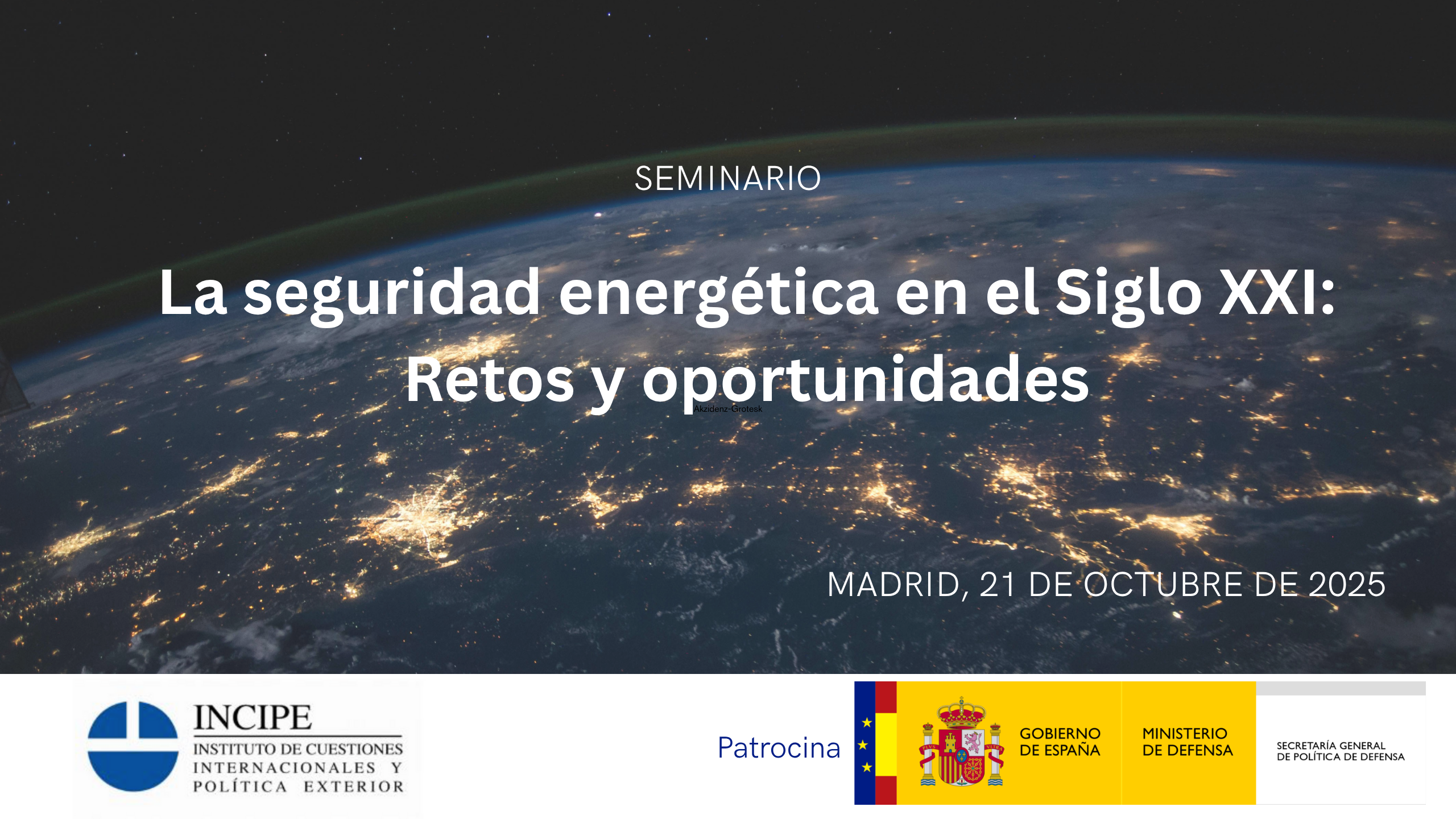
Structured around two roundtables, the conference analysed the global challenges shaping energy supply and highlighted the importance of strengthening strategic resilience in Europe. The opening remarks were delivered by Ambassador Ricardo Díez-Hochleitner, Secretary-General of INCIPE, and Lieutenant General Fernando López del Pozo, Director-General for Defence Policy (DIGENPOL).
The keynote address was delivered by Minister Claudio Aranzadi, who emphasised that energy has become one of the central drivers of international security. Reviewing the effects of the recent cycle of global instability —conflicts in Europe and the Middle East, the weakening of multilateralism and rising technological tensions— he stressed how the energy transition and the fight against climate change are introducing new pressures on production systems and on states’ foreign policy agendas.
Aranzadi examined global energy demand trends, China’s growing weight as a decisive actor, and the persistent dependence on fossil fuels. He warned of the difficulty of ensuring a secure, affordable and climate-compatible supply, and underlined the need for Europe to reinforce its strategic autonomy in the energy domain. He also highlighted the relevance of clean technologies, the role of nuclear energy, and the impact of energy costs on Europe’s competitiveness and industrial base.
Geopolitical challenges and their impact on energy supply
Moderated by Vicente Garrido, Director-General of INCIPE, the first roundtable featured Antonio Merino, Director of Studies at REPSOL; Colonel Ignacio Fuente Cobo; and Joaquín Pérez de Ayala, Director of Energy Transition at Técnicas Reunidas.
The speakers analysed the geopolitical implications of access to energy resources, underlining its historical role as a driver of conflict and a lever of international power.
They stressed the high vulnerability of supply chains, particularly in critical regions such as the Middle East, the Horn of Africa and the Gulf of Guinea. The discussion also addressed the transformation of China’s energy mix, the expansion of its infrastructure, its continued dependence on coal, and its growing leadership in renewable energies and clean technologies.
The panel further examined Europe’s position in this evolving landscape: the need to diversify suppliers, the increasing reliance on liquefied natural gas, and the challenges posed by high energy prices, complex regulatory frameworks and lengthy infrastructure approval processes.
Overall, the experts agreed that competition over energy resources will continue to shape global geopolitics in the coming decades, with significant implications for Europe.
Energy security as a pillar of national resilience
Moderated by Navy Captain Eduardo Matres, Head of Geopolitical Analysis at DICOES, the second roundtable included contributions from Sonia Velázquez, Chief of Staff to the Secretary-General for Demographic Challenge (MITECO); Colonel Pablo Ahedo; and Fernando Maravall, former Director-General of CEPSA and former Secretary-General at the Ministry of Industry and Energy.
The discussion opened by emphasising the need to understand energy security as a key component of a country’s overall resilience. Participants noted that modern societies must not only be aware of threats, but also recognise that protecting their way of life may require collective effort and, at times, sacrifice. The Nordic and Baltic notion of “total defence” was introduced as an example of coordinated involvement of authorities, businesses and citizens to ensure the continuity of state functions during crises.
Energy was examined as a critical element of this resilience. Recent conflicts —such as the war in Ukraine— have shown how attacks on energy infrastructure can expose societal vulnerability. The panel highlighted the importance of strengthening critical infrastructure, anticipating vulnerabilities and promoting public awareness of responsible energy use.
The speakers also addressed the challenges posed by decarbonisation, international competition for strategic technologies, the development of hydrogen, carbon capture, and the modernisation of energy grids. They agreed that Europe needs a stable, realistic and long-term energy strategy that integrates ecological transition, industrial competitiveness and national security.
The subsequent discussion delved into emerging energy technologies, the impact of artificial intelligence on energy consumption, the feasibility of new sources such as thorium reactors, the future role of coal in security-driven contexts, and the geopolitical implications of the war in Ukraine for Europe’s energy architecture. Reflections were also shared on China’s capacity to lead in clean technologies, the need to streamline European regulation, and the role of energy costs in Europe’s deindustrialisation.
Closing Session
The conference concluded with remarks by Vicente Garrido, Director-General of INCIPE, who underscored the importance of approaching energy as a structural component of international security and highlighted the value of maintaining spaces for rigorous dialogue and analysis to better understand today’s global challenges.
Lucía Mantecón