
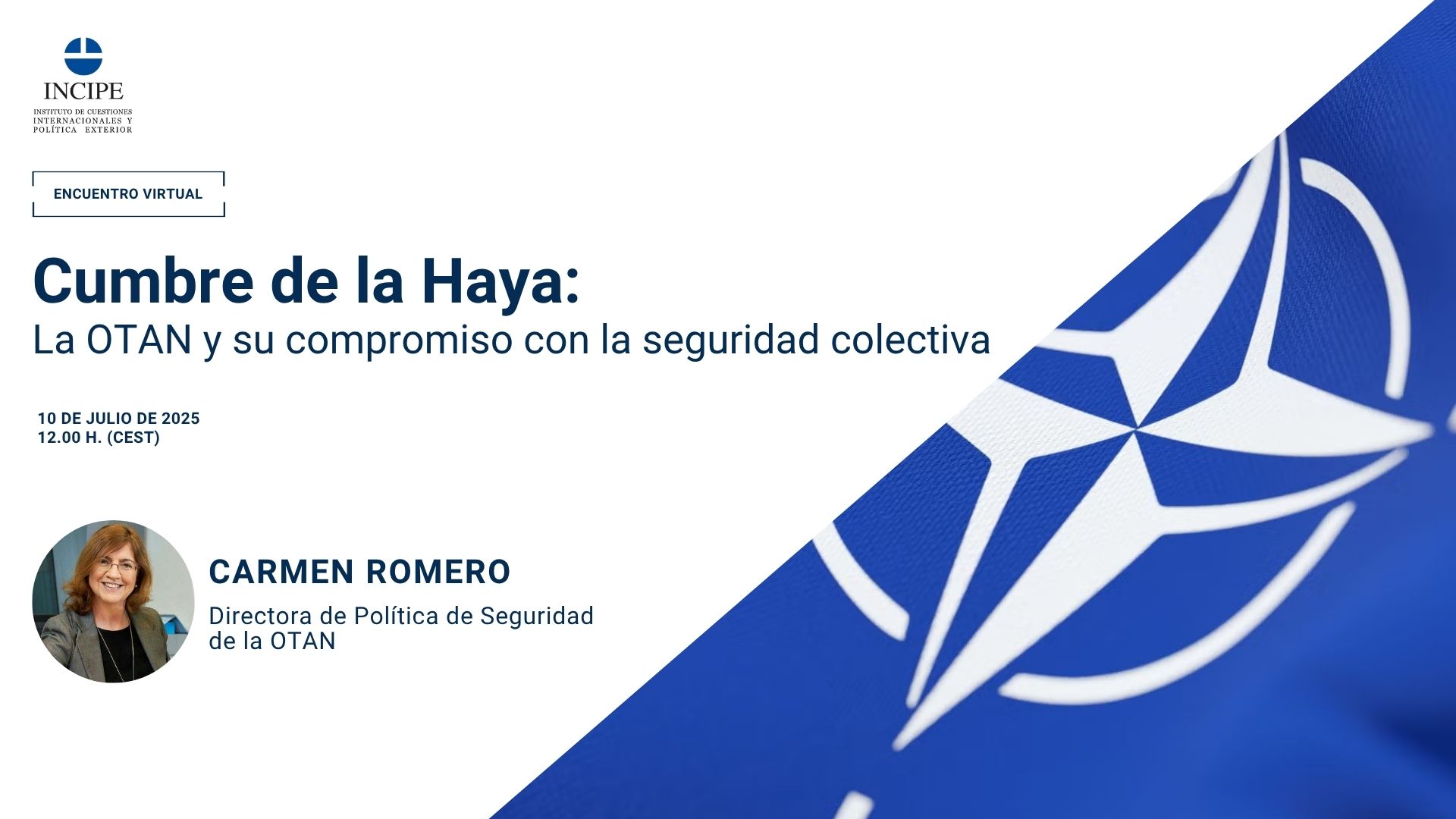
Carmen Romero brings extensive professional experience in both international journalism and multilateral diplomacy. A graduate in Journalism and Information Sciences from the Complutense University of Madrid, she began her career at Agencia EFE, serving as a correspondent at the United Nations Office in Geneva and in Moscow and Paris. She later covered defence and foreign affairs at the European Union and NATO, reporting from Iraq and Afghanistan as a special envoy. Since joining NATO in 2004, she has held several senior positions, including Deputy Spokesperson, Head of Press, and, for nearly eight years, Deputy Assistant Secretary General for Public Diplomacy. Her work has been recognised with a number of awards, including the Bernardo Álvarez Manzano Prize from the Spanish Association of Defence Journalists.
In her remarks, Romero provided a detailed overview of the main decisions adopted at the recent Hague Summit, describing it as both historic and transformative. The 32 Allies agreed to a more balanced sharing of responsibilities for collective defence: Europe and Canada will assume greater responsibility for conventional security, while the United States will remain the principal guarantor of nuclear deterrence, an essential pillar in preventing the use of nuclear weapons.
This agreement reflects an increasingly complex geopolitical environment, shaped by large-scale war in Ukraine and by sophisticated hybrid and non-conventional threats. Romero reaffirmed the Alliance’s firm commitment to international arms control and to upholding the Nuclear Non-Proliferation Treaty.
Strengthening the defence industrial base emerged as another central outcome of the Summit. Measures include the removal of trade barriers and the promotion of strategic partnerships with the European Union, Ukraine and Indo-Pacific partners. At the Defence Industry Forum, held alongside the Summit, new multinational industrial projects were launched to expand production capacity and prevent price inflation in the sector. Agreements were also reached to secure critical raw materials and to foster technological innovation, including cooperation with partners such as Australia.
Romero stressed that reinforcing the defence industry is not only vital for collective security but also presents an economic opportunity to generate employment and stimulate growth across Allied economies. NATO–EU cooperation, she noted, is currently more intensive and effective than ever.
A renewed commitment to supporting Ukraine constituted another key pillar. This year alone, Ukraine has received over €35 billion in security assistance, with Europe and Canada increasing their share of contributions. Romero underlined that the objective is not to prolong the conflict, but to strengthen Ukraine’s position so that it can negotiate a just and lasting peace from a position of strength, while deterring future aggression.
At the global level, she pointed to the growing challenge posed by the strategic alignment between Russia, China, North Korea and Iran. She highlighted China’s expanding nuclear arsenal, the presence of North Korean troops in the European theatre, and Iran’s provision of drones to Russia. Persistent terrorism and hybrid and cyber threats targeting critical infrastructure in Europe also remain significant concerns.
In the final part of her intervention, Romero addressed NATO’s southern agenda, a priority area for the Alliance. Efforts are underway to deepen cooperation with regional organisations such as the African Union and the Gulf Cooperation Council, among others. As a concrete step, the forthcoming opening of a liaison office in Amman, Jordan, was announced, aimed at strengthening NATO’s regional presence and facilitating dialogue and cooperation.
Romero concluded by emphasising that the Hague Summit inaugurates an ambitious political and military agenda for the next twelve months, to be reviewed at the subsequent meeting of Allied leaders in Ankara in 2026. The session closed with a substantive exchange on the Alliance’s present and future challenges, including questions related to energy interconnections, cooperative security, and the further development of the defence industrial base.
Aranzazu Álvarez