
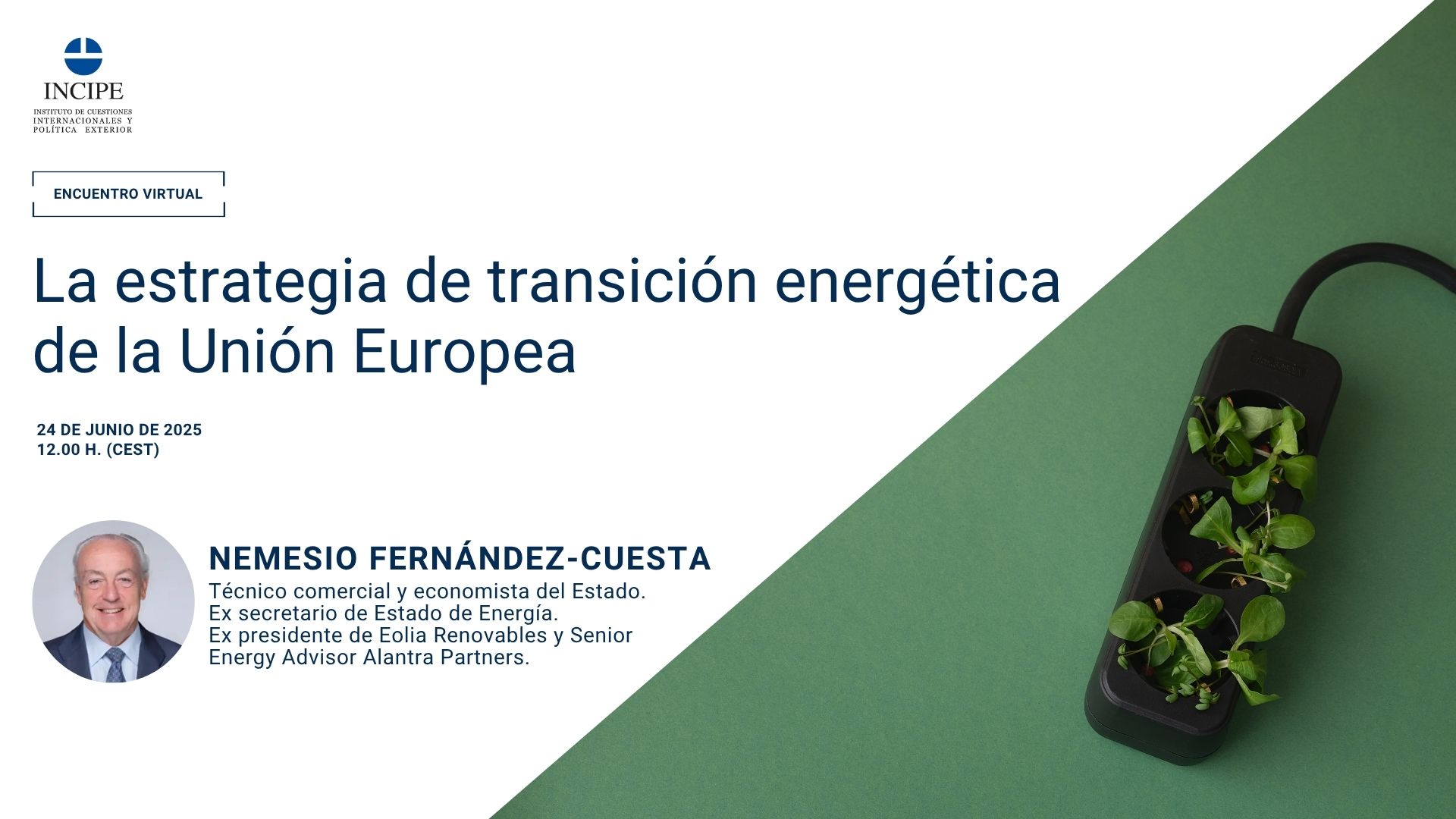
The event, conducted in Spanish, brought together an audience interested in the economic and environmental implications of the energy transition — particularly in Europe, a key global actor in this field.
A seasoned expert on energy and climate change, Fernández-Cuesta joined Spain’s Senior Corps of State Economists and Trade Experts in 1981. Over his career, he has served as Secretary of State for Energy, and for more than 20 years held senior positions in Repsol’s commercial and exploration and production divisions, where he became the company’s second-in-command. He has also served as CEO and Chairman of Diario ABC, Vice President of Vocento, CEO and Chairman of ISOLUX Corsán, and Chairman of Eolia Renovables. He currently chairs the Advisory Board of Engie Spain, is a member of the Advisory Council of Llorente & Cuenca, and serves as Senior Energy Advisor at Alantra Partners. In addition, he teaches at IE University and Universidad Carlos III.
Fernández-Cuesta opened his remarks by emphasizing the essential role of the greenhouse effect for life on Earth, noting that without atmospheric heat retention, night temperatures would plummet, making life impossible. He recalled that in the 19th century, British scientist John Tyndall discovered that beyond the 99% of oxygen and nitrogen that make up the atmosphere, there is a small but crucial proportion of gases—such as carbon dioxide (CO₂), methane, and nitrogen oxides—responsible for trapping heat. CO₂ measurements began in 1958, revealing an annual cycle with higher winter emissions and lower levels in spring, as well as a steady rise since 1850, coinciding with the Industrial Revolution, reaching unprecedented levels.
Today, the three main fossil fuels—coal, oil, and natural gas—still account for over 80% of global energy consumption, with rising demand in recent years except for a temporary drop in 2020 due to the pandemic. Meanwhile, renewable energy has been expanding rapidly, with an average annual growth rate of 11.7% over the past five years, though it still represents a relatively small share compared to fossil fuels.
Greenhouse gas emissions—including CO₂, methane, nitrogen oxides, and carbon—continue to rise, with only temporary declines during the 2008–2009 financial crisis and the 2020 pandemic. China now accounts for 31% of global emissions, followed by the United States (14%), India (8%), and the European Union (7%). Fernández-Cuesta noted that while the EU and the U.S. have reduced emissions, most countries have not, and that seven nations account for 70% of the total.
This rise has driven a steady increase in global average temperatures, which reached 1.6°C in 2024, the warmest year on record. Projections suggest that by 2100, temperatures could rise by up to 3°C. If all national commitments — including those conditional on financial assistance such as COP-related funding from developed to developing countries — were fully met, the increase could be limited to around 2.6°C. Fernández-Cuesta described this scenario as unlikely, given that China and the United States are not parties to the agreement and that Europe faces mounting budgetary pressures, particularly on defense, which complicates its pledge to triple financial support for developing nations.
He stressed that the energy transition must involve not only mitigation but also adaptation policies to prepare economies for a warmer planet. In Spain, he called for investment in water management, including improved supply systems, inter-basin transfers, modernized irrigation, and expanded desalination and purification infrastructure, to mitigate the economic effects of a possible 3°C rise.
Among the key measures, Fernández-Cuesta underscored the central role of electricity consumption, which can be generated with zero emissions through renewable sources that also offer lower production costs. Leading technologies include solar, followed by combined-cycle gas plants—competitive only in the United States, where gas prices are four times lower than in Europe—wind, and hybrid solar-plus-battery systems.
To achieve a fully decarbonized electricity system, he pointed to the need for a balanced mix of firm and variable generation, combining renewables with other flexible sources. In 2024, Spain reached 57% renewable generation and 77% zero-emission generation, including nuclear. Progress toward full decarbonization, he said, depends on three key actions: extending the lifetime of nuclear plants (which produce cheap, emission-free electricity); developing energy storage through batteries and pumped hydro; and investing in transmission and distribution networks.
Beyond electricity, Fernández-Cuesta mentioned renewable fuels such as conventional and advanced biofuels (ethanol and biodiesel) and renewable gases (biogas and biomethane) derived from organic waste. He also cited organic gasification as a complementary option, though these alternatives remain costly and still produce some emissions, albeit much lower than fossil fuels.
He concluded by advocating for an energy policy that ensures secure and affordable supply, supports development through clean energy use, and safeguards economic growth. He warned that Europe’s industrial competitiveness is declining, as electricity costs are three times higher than in the United States or China, criticizing the EU’s so-called “stick policy” that raises energy prices without offering viable technological alternatives.
By contrast, he noted, the Biden administration’s approach relies on fiscal incentives to offset technological costs, while China continues to rely on coal to preserve its competitiveness and leads global production of critical minerals and rare earths. Fernández-Cuesta cautioned that Europe’s strictest measures—such as the ban on combustion-engine vehicles—risk deepening dependence on the Asian giant.
As a final reflection, he highlighted that forecasts suggest Spain could soon reach electricity prices comparable to those in China and the United States, paving the way for a recovery in industrial competitiveness. The session concluded with a Q&A focused on energy interconnections in Europe, nuclear power, and global warming.
Aranzazu Alvarez