
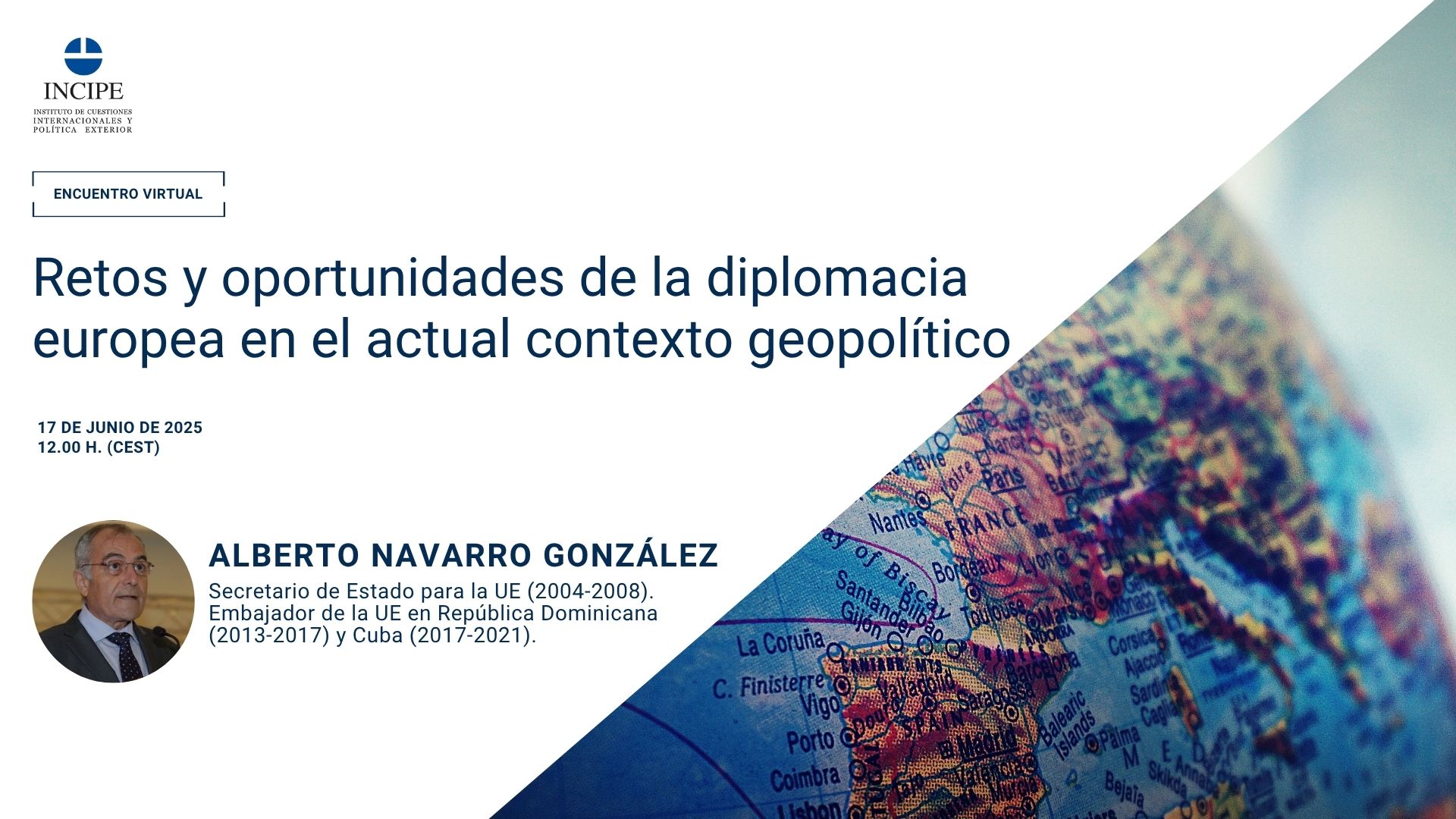
The session, conducted in Spanish, brought together an audience interested in gaining deeper insight into the key issues and dynamics shaping European diplomacy in a global context marked by heightened tensions and uncertainty.
Ambassador Alberto Navarro opened his remarks by recalling the 40th anniversary of Spain and Portugal’s accession to what was then the European Communities, signed on 12 June 1985. He highlighted this period as the most stable and prosperous in Spain’s modern history. Spain’s entry into the European Union profoundly transformed Spanish society, with the country’s GDP increasing sixfold—from €243 billion in 1985 to €1.59 trillion in 2024—per capita income rising from €5,800 to €32,630, and foreign trade growing from 30% to 75% of GDP. He also noted the emergence of major global Spanish multinationals such as Banco Santander, BBVA, Iberdrola, Inditex, and Telefónica. Navarro underscored Spain’s important contributions to the European Union, including the concept of European citizenship proposed by Felipe González, the Erasmus programme, the creation of a common area of Freedom, Security and Justice, and the strengthening of EU relations with Latin America and the Mediterranean through the Barcelona Process.
Regarding European diplomacy, Navarro highlighted the role of the European External Action Service (EEAS), a “young” body established by the Lisbon Treaty in 2009, with more than 4,500 staff—2,100 in Brussels and 2,400 in EU delegations and embassies worldwide. Today, the European Union has the most extensive diplomatic network in the world, with 173 offices—146 embassies and 27 representations in EU Member States—followed by China (170) and the United States (168). By contrast, President Donald Trump has announced the closure of ten U.S. embassies—two in the EU (Luxembourg and Malta)—as well as several consulates and USAID, eliminating what was once one of the world’s largest providers of development and humanitarian aid.
Navarro also shared that the European Union is the world’s second-largest trading power, surpassed only by China. In 2024, China’s foreign trade exceeded €6.1 trillion, while the EU reached €5.7 trillion and the United States €5.3 trillion. In development assistance, the European Union remains the global leader, accounting for over half of global development aid and more than 60% of humanitarian aid through ECHO, the EU’s Directorate-General for Civil Protection and Humanitarian Aid Operations, which Navarro headed for three years. He emphasized that humanitarian aid is non-political and aims to save lives and alleviate suffering, while development cooperation has a political dimension: Spain focuses its efforts on Latin America, the Maghreb, and Equatorial Guinea; France on Francophone countries; and the United Kingdom on the Commonwealth.
The ambassador explained that the strengthening of the European External Action Service has led some Member States to close their own national embassies and assign their diplomats to EU delegations, particularly in countries where maintaining an independent mission is not economically viable.
Among the challenges facing Europe, Navarro referenced the INCIPE session “How Far Can EU Defence Spending Go?” delivered by Ambassador Enrique Viguera, and noted that increasing defence spending is one of the main challenges, as Europe can no longer rely solely on the U.S. security umbrella in the current geopolitical climate.
He also highlighted the growing influence of the BRICS group, which in 2025 welcomed Egypt, Eritrea, Indonesia, Iran, Saudi Arabia, and the United Arab Emirates. Together, the BRICS now represent 43% of the world’s population—compared to 9% for the G7—and 30% of global GDP, approaching the G7’s 43%. While lacking internal cohesion, the BRICS share a common critique of the post-1945 world order, feeling underrepresented in institutions such as the United Nations, the World Bank, and the International Monetary Fund. Among other initiatives, the BRICS have created the New Development Bank, headquartered in Shanghai, which has already financed nearly 100 projects worth more than USD 32 billion.
Navarro cited several examples illustrating the rapid pace of global change and the rise of the BRICS:
- India’s imports of Russian oil rose from USD 2.45 billion in 2021 to USD 46.5 billion in 2023.
- Before the war in Ukraine, Russia’s trade with the EU was twice the size of its trade with China; today, it is less than half. Russia and China now conduct 95% of their bilateral trade in roubles and yuan, amounting to more than USD 240 billion in 2023.
- Over the last 25 years, EU GDP has grown at an average annual rate of 1.5%, compared to 2% in the U.S. and 8% in China.
- Currently, 130 of the 190 United Nations member states conduct more trade with China than with the United States or the European Union.
In conclusion, Navarro cited French President Emmanuel Macron’s 2023 Sorbonne speech, in which he proposed a “Europe First” agenda—echoing America First—focused on strengthening Europe’s defence, securing its borders, and gaining strategic autonomy from the United States, which no longer regards Europe as a priority. He also referred to Enrico Letta’s report highlighting the need for a unified European financial market, as well as energy and telecommunications union, and Mario Draghi’s report, which stresses the importance of boosting Europe’s competitiveness and mobilising European savings, much of which is currently invested in the United States.
Contrasting with the unilateralism of the Trump administration, Navarro emphasised the European Union’s commitment to defending multilateral values and principles, working to improve institutions such as the United Nations and the World Trade Organization and promoting fair, rules-based trade as opposed to the use of tariffs as political weapons.
The session concluded with a Q&A session focused on the role of the High Representative, EU embassies and delegations, defence policy, and Europe’s current geopolitical challenges.
Aranzazu Alvarez