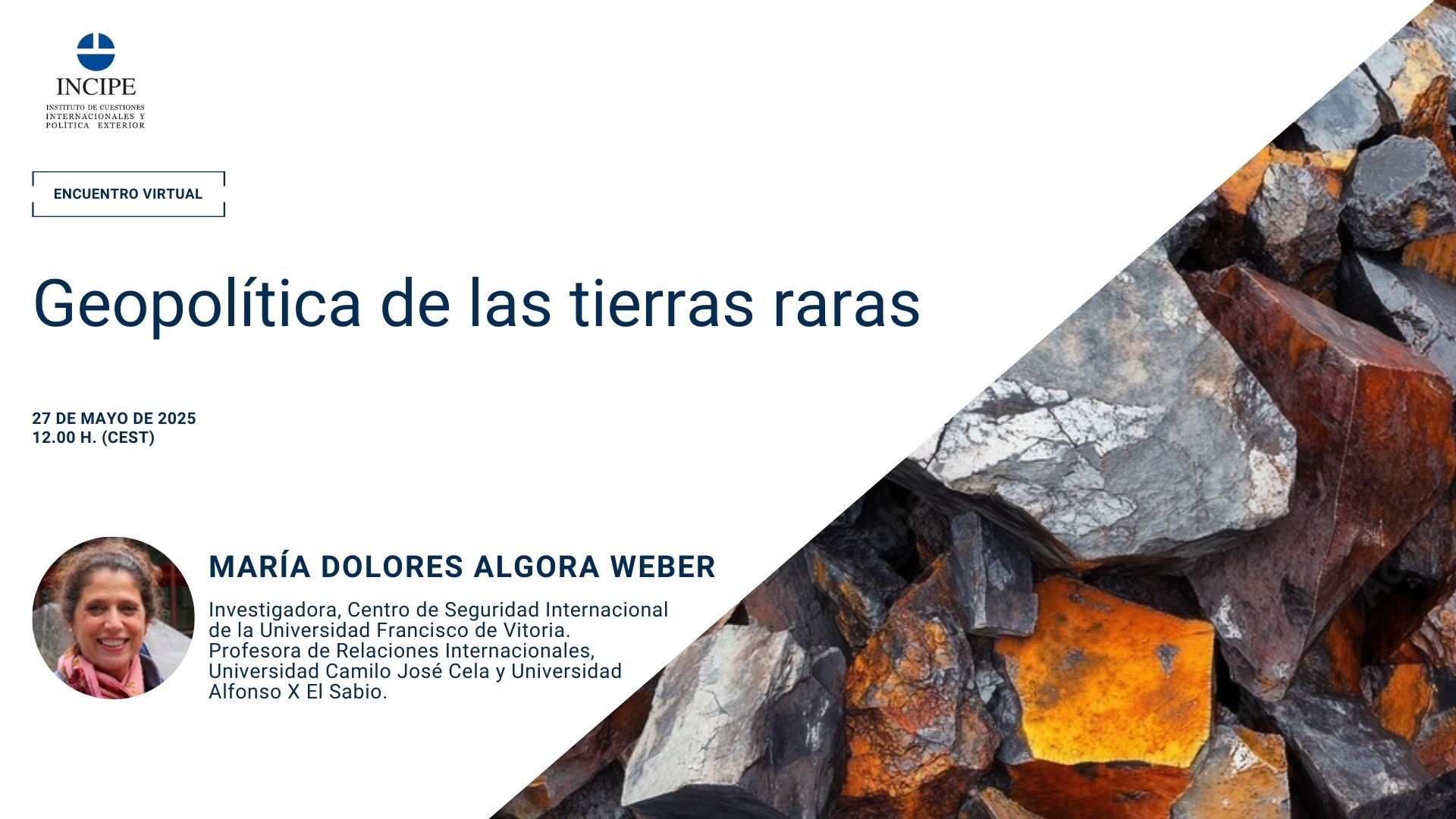
The session, conducted in Spanish, attracted an audience keen to explore the strategic implications of rare earth elements and the geoeconomic tensions arising from their geographic concentration. To address this topic, INCIPE invited María Dolores Algora Weber, a pioneer in the study of these resources in Spain, researcher at the International Security Center at Universidad Francisco de Vitoria, collaborator with CESEDEN, and professor of International Relations at various Spanish universities.
Professor Algora Weber opened her presentation by emphasizing the importance of rare earths in today’s global landscape, driven by two parallel and interconnected processes. On one hand, climate change has raised global awareness about climate security, prompting states and international organizations to promote renewable energies. On the other, this trend intersects with the new technological revolution of the 21st century, characterized by robotization, digitalization of production processes, and the rise of industrial mining. The convergence of these factors has led to a global energy transition in which critical minerals, particularly rare earths, play a fundamental role in ensuring strategic security.
These dynamics have increased international competition over access to and processing of critical minerals, a challenge affecting both great powers and emerging states such as those within the BRICS. Although rare earths are distributed across various regions worldwide, not all countries have the technical capacity to exploit them, shaping geostrategic alliances among states. Moreover, a new world order marked by rapid transportation and communication has brought the concept of human security to the forefront, closely linked to defense and the arms race, where minerals take on growing strategic value.
Algora Weber noted that rare earths are essential to key sectors including electronics, defense, and renewable energies, among others. Their indispensable nature presents new challenges related to the location of reserves, extraction and storage processes, and supply chain management.
Rare earths encompass seventeen chemical elements, primarily oxides and metals, with magnetic, electronic, and optical properties essential for clean energy production. They are also crucial for manufacturing batteries for electric vehicles, wind turbines, digital displays, and military applications such as surveillance equipment, drones, weaponry, and nuclear bomb reactors. However, these elements are often found mixed in deposits with other minerals like phosphates and uranium, complicating and increasing the cost of extraction and refining — an investment that until recently was not economically viable.
China has been described as the “magnate” of rare earths, holding 38% of the world’s deposits — approximately 44 million tons — and leading global production with a 62% share. Its output has grown from 50,000 tons in 1996 to 132,000 tons today, while maintaining influence over other major producers such as Myanmar and Vietnam. The United States ranks second, producing 12.2% of the global total with 26,000 tons annually, although its reserves amount to only 1.8 million tons. Russia holds 12 million tons in its territory but has limited production capacity, with just 2,700 tons per year.
This distribution of resources generates international tensions due to factors such as import dependency, competition over access and extraction, and commercialization. According to Algora Weber, production — rather than possession of resources — determines global leadership, explaining the rivalry between China and the United States.
In the 1990s, Chinese President Deng Xiaoping famously said that while the Middle East had oil, China had rare earths — a reality that has solidified today, marked by China’s entry into the global market following its WTO accession in 2001, its ambition to become a world power through the Belt and Road Initiative and the Made in China 2025 project, and exponential growth in R&D investment.
During his first term, Trump implemented a trade policy focused on increasing tariffs on Chinese exports, arguing that U.S. dependence — especially on critical minerals — compromised American economic security. Algora Weber noted that in a potential second term, the rivalry between the two countries could threaten the global economic system. In this context, rare earths also play a central role in resolving the conflict in Ukraine, as the country is estimated to have nearly one hundred untapped deposits, with around 40% of critical minerals concentrated in Donbas, currently occupied by Russia. U.S. interest aims not only to prevent these resources from falling into Russian hands but also to reduce its own dependence on China.
At the end of her presentation, Algora Weber highlighted the presence of rare earths in other regions such as the Sahel and South Africa, Afghanistan’s subsoil, Gulf countries, and especially Turkey, where recently discovered untapped deposits could place the country as the second-largest holder of reserves, after China. She also mentioned the European Union’s efforts to develop innovative and sustainable environmental technologies and its import dependency in this sector: annually, the EU imports rare earths worth over 350 million euros, mostly from China. In parallel, she noted European advances in ethnospheric extraction, a recycling technique that could recover these minerals even from plastic packaging.
To conclude, the researcher emphasized Spain’s mineral wealth, including strategic resources such as coltan, lithium, and uranium, as well as rare earth deposits in the province of Ciudad Real.
The virtual session ended with a Q&A focused on the global governance of rare earths, the role of organizations like the G20 and G7, and China’s dominance in this field.