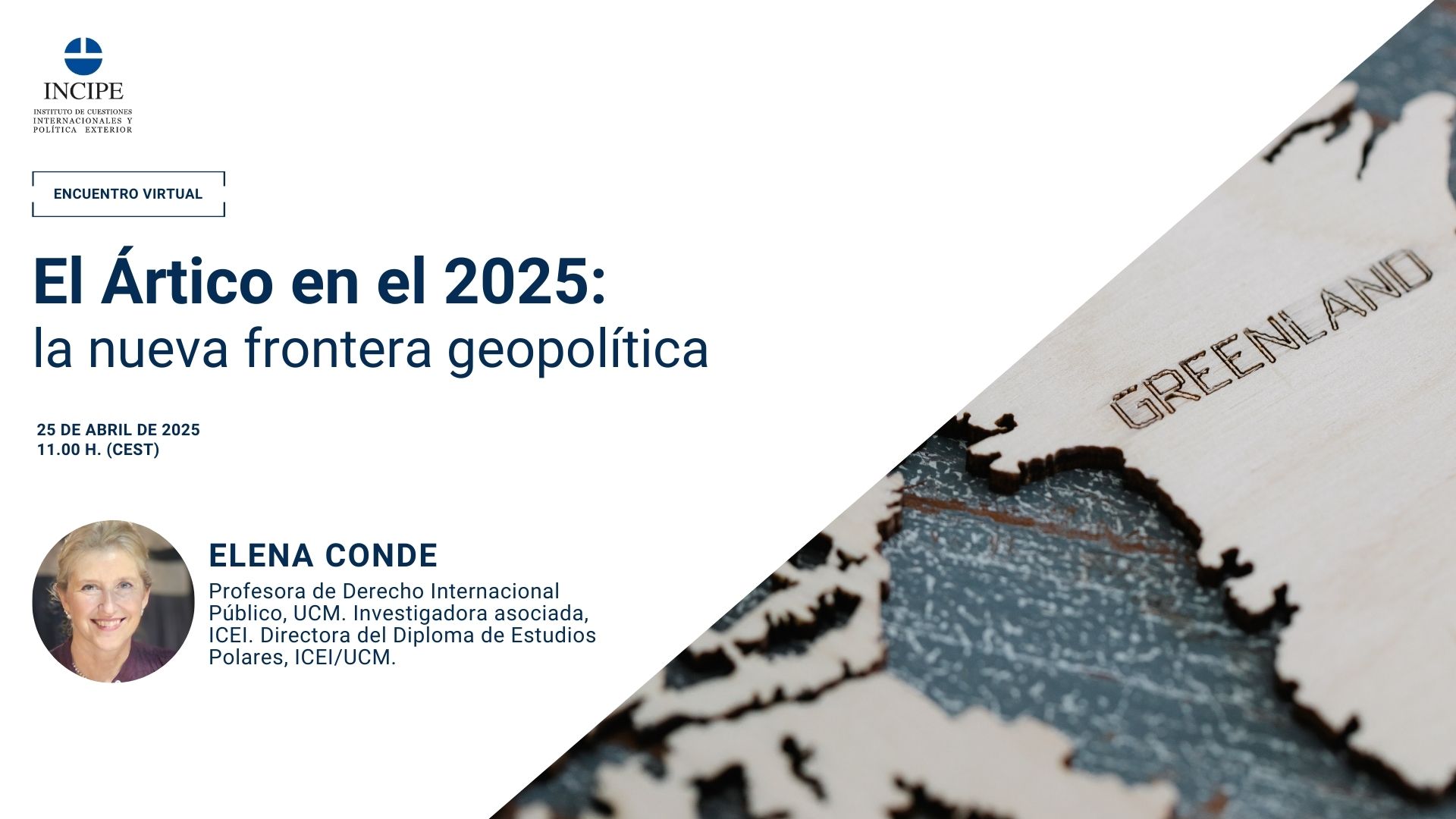
The session, conducted in Spanish, brought together an audience interested in understanding the geopolitical dynamics of the Arctic, at a time when tensions between regional powers have increased due to factors such as Donald Trump’s return to the White House, the outbreak of the war in Ukraine, and the intensifying effects of climate change. To address these challenges, INCIPE invited Professor Elena Conde, whose distinguished research career includes leading several international projects focused on the Arctic.
Professor Elena Conde opened her presentation by highlighting the deep relationship between geopolitics and International Law, especially in the Arctic, a region she described as a circumpolar space of exceptional geopolitical, human, and economic complexity. The region comprises eight countries: Russia, Canada, Norway, Denmark (through Greenland and the Faroe Islands), the United States (through Alaska), Sweden, Finland, and Iceland — all members of the Arctic Council, a key forum for regional cooperation.
From a social perspective, the Arctic is home to a great diversity of Indigenous communities— including the Inuit, Yupik, Saami, and Chukchi — whose ways of life have long been under threat from colonial legacies, climate change, and the extreme weather conditions. Climate change has transformed the Arctic ecosystem, but also exposing vast natural resources. Due to the rapid melting of Arctic ice, opportunities have emerged, including the establishment of new commercial shipping routes. However, this situation has also posed new geopolitical challenges. Today, the Arctic finds itself at the crossroads of intensified resource extraction — both fossil and mineral — as well as growing interest in transportation and tourism.
In a second section, Professor Conde pointed out that in just a few years, the region has shifted from a center of cooperation into a theatre of geopolitical friction. The first signs of this shift — or “Arctic rifts,” as she described them — began during Donald Trump’s first term, followed by several tipping points in 2022, due to the conflict in Ukraine, and again in 2025, with Trump’s return to the White House. Since 2017, it has become increasingly clear that the Arctic is not immune to the broader unraveling of the post-World War II liberal international order — a shift many analysts now describe as the end of an exceptional historical era.
Seven of the eight Arctic states — with the exception of Russia — belong to the Atlantic Alliance. As a result of the war in Ukraine, collaboration in the Arctic Council has ceased, creating a significant new front of geopolitical tension. In parallel, NATO has progressively increased its military presence in the region, reflecting both defensive and strategic ambitions that contribute to the Arctic’s evolving security dynamics.
Moreover, world powers have shown growing interest in Greenland, due to its strategic position along major shipping routes. President Trump has repeatedly expressed his desire to acquire the island to expand the U.S. Arctic presence, currently limited to Alaska. It was also during his administration that the U.S. government announced the initiation of a public auction to grant licenses for oil and gas exploration in the Arctic National Wildlife Refuge. According to Professor Conde, the Refuge, located in Alaska, hosts the greatest diversity of animal and plant species in the region. However, the U.S. government appears to prioritize the potential oil and gas reserve over environmental concerns.
Professor Conde also addressed one of the most current topics: the growing presence of China, viewed with both concern and interest. In its 2018 Arctic Strategy, China claimed rights to the region’s resources, arguing that such rights should correspond to the size of its population. China’s ambitions in the Arctic is connected to the Belt and Road Initiative, a modern Silk Road based on infrastructure investment and development projects. One of these initiatives involves building a “blue economic passage” to reach northern Europe through the Arctic Ocean, a strategy that links Chinese interests with Russia’s, considering that the route would pass through the Northern Sea Route, a 6,000-kilometer maritime corridor along Russia’s coast that has recently become navigable due to the accelerated melting of Arctic ice.
To conclude, Professor Elena Conde introduced the concept of lawfare, which has become popular in recent years. She described it as a sophisticated legal strategy used to delegitimize opponent, justify controversial actions, influence public opinion, and give the entire process an appearance of legality. Russia, in particular, has been a prominent practitioner of lawfare. In 2001, Russia requested an extension of its continental shelf — proposals that continued through 2023 — and has built major infrastructure along the Northern Sea Route, through which it has gained absolute control of the passage, thanks to lawfare. Professor Conde concluded by emphasizing that the instrumental use of International Law to reinforce strategic interests fosters unilateralism, posing a significant challenge to the prevailing multilateral legal order.
The virtual session concluded with a discussion in which participants raised questions about the issues covered, with particular attention to the possible consequences of Greenland’s annexation by the United States and the control of Arctic defense by global powers.
Marina Urizarna
Communication Assistant, INCIPE