
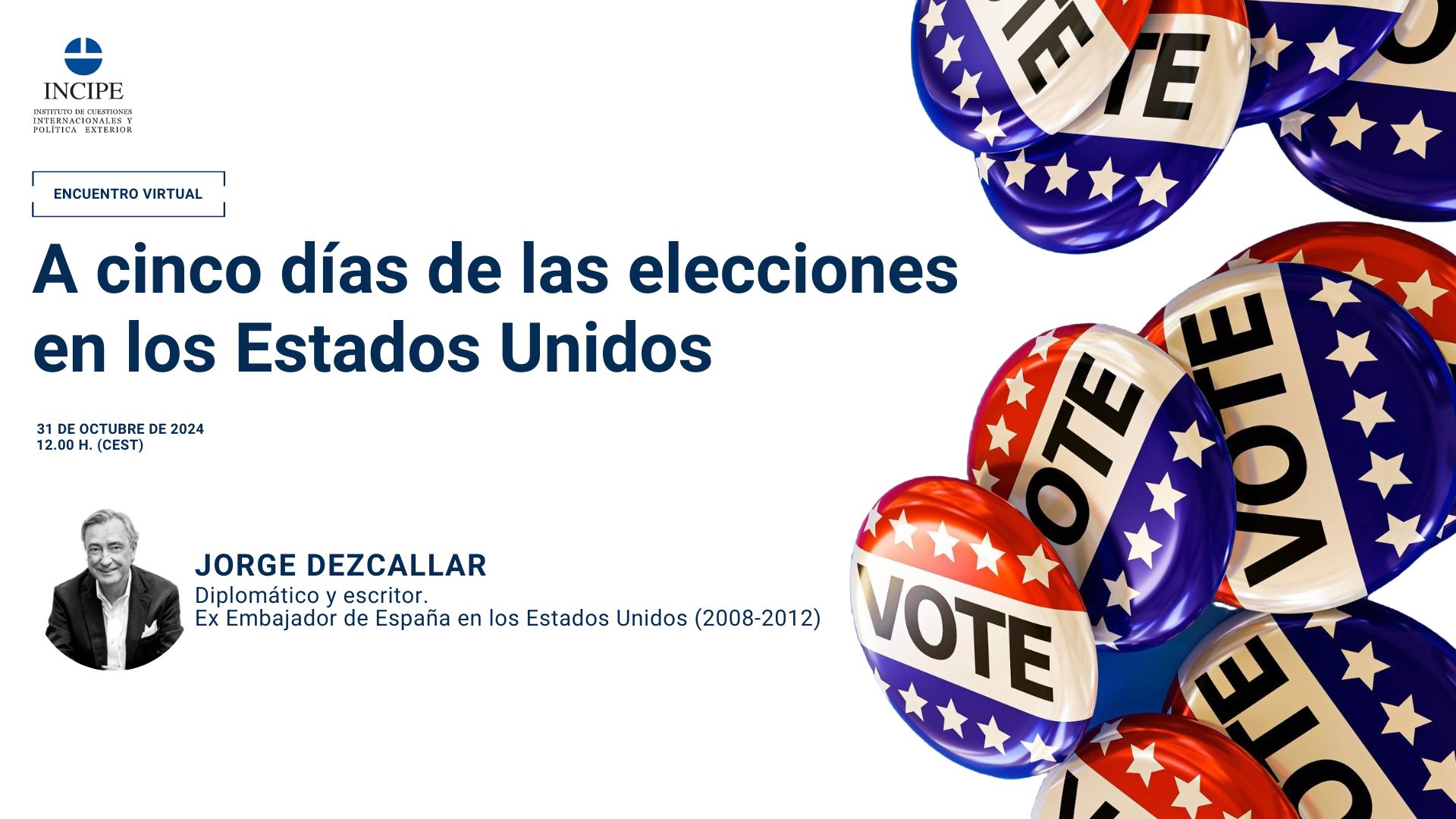
The session was conducted in Spanish and gathered an audience interested in understanding future perspectives in view of the U.S. elections on November 5, 2024. For this purpose, we had the participation of Jorge Dezcallar, former Ambassador of Spain to the U.S. (2008-2012), among other positions. During the session, Jorge Dezcallar presented a detailed analysis of the political programs of the U.S. presidential candidates, Kamala Harris and Donald Trump. The speaker focused on foreign policy, highlighting the impact of the U.S. perspective on international geopolitics.
Jorge Dezcallar began his intervention by emphasizing the profound importance of the U.S. elections, stressing that they not only affect voters but have significant global repercussions. The speaker illustrated the extreme polarization of the current political landscape, where the level of debate has reached concerning lows. Additionally, he reminded the audience that these are not centralized and proportional elections, but are divided into 50 distinct contests, with seven volatile states being crucial in determining the outcome. After these introductory remarks, Dezcallar provided an analysis of each candidate, with a particular focus on foreign policy.
Regarding Kamala Harris, Dezcallar noted continuity in Biden’s policies, although with the need to establish some distance. Harris would seek to reinforce the economic competitiveness of the U.S., maintaining a foreign policy focused on serving the American middle class. This would include, for example, the application of moderate tariffs.
Dezcallar also highlighted Harris’s commitment to multilateralism, strengthening international organizations like the UN, including the Security Council. Harris would aim to bolster strategic alliances, especially with Europe and NATO. In this regard, she would maintain leadership in the war in Ukraine and commitment to Article 5. Regarding China, Harris would seek to strengthen the Quadrilateral Security Dialogue (QUAD) with Japan, Australia, and India. Dezcallar also pointed out that the candidate would maintain her commitment to strengthening democracy worldwide, even if it means engaging with countries that are not democracies to address global issues. All of this stems from the recognition of the need for allies, as the U.S. tries to reverse the image of being a declining power that some countries associate it with.
Concerning her management of geopolitical adversaries, the relationship with China is viewed as a strategic challenge, where she would seek to maintain a constructive dialogue to reduce risks. Still, she would firmly position herself on Taiwan to maintain her image with other countries in the region. Regarding Russia, Harris would keep sanctions and support for Ukraine, in a context where Russia is seen as a regional power. On the Middle East crisis, the speaker noted that she would maintain unconditional support for Israel while pushing for a ceasefire.
In contrast, the figure of Donald Trump represents a radically different approach. Trump is described as a nationalist who distrusts traditional democratic processes, favoring a leadership style that is perceived as autocratic and polarizing. His vision of international politics is geoeconomic rather than geostrategic, and although he is not isolationist, he believes in the principle of ‘burden-sharing.’ This means that under his leadership, NATO could suffer significant weakening, as he considers that European countries do not contribute enough to their defense. Unlike Harris, he would not seek coordination with Europe on issues of common interest, although he could ally with European countries bilaterally. Trump also intends to impose high tariffs on European products, and in the event of a trade war with China, Europe could also be affected.
Regarding the Middle East conflict, Trump is considered the most pro-Israel president in recent memory. For him, the problem is not with the Palestinians, but with Iran, and controlling Iran will solve the Palestinian issue. He also believes the U.S. should not push for a peace process between Gaza and Israel. Dezcallar pointed out that, despite this, there are no major differences between Harris and Trump in their support for Israel. Concerning China, Trump sees it as a strategic competitor that could challenge the established world order. His inner circle does not rule out a radical ‘decoupling,’ with tariff increases that could reach up to 200% and the adoption of a confrontational policy.
After analyzing each candidate, Dezcallar also offered a reflection on the evolution of the voter profile for each candidate. In general, a greater influence of gender, age, and educational level has been observed over ethnicity or socio-economic class. In this context, Kamala Harris seems to have more support among women, young people, and educated individuals, while Trump stands out in preference among men and less-educated voters.
The speaker concluded his intervention by emphasizing that, according to what he presented, Trump’s victory could have negative consequences not only for the U.S. but for the international community as a whole.
The session concluded with a debate where participants could ask questions about the topics discussed. This exchange highlighted the importance of understanding the potential global impact of the candidates’ international political perspectives in the U.S. elections.
Lucía Rodríguez