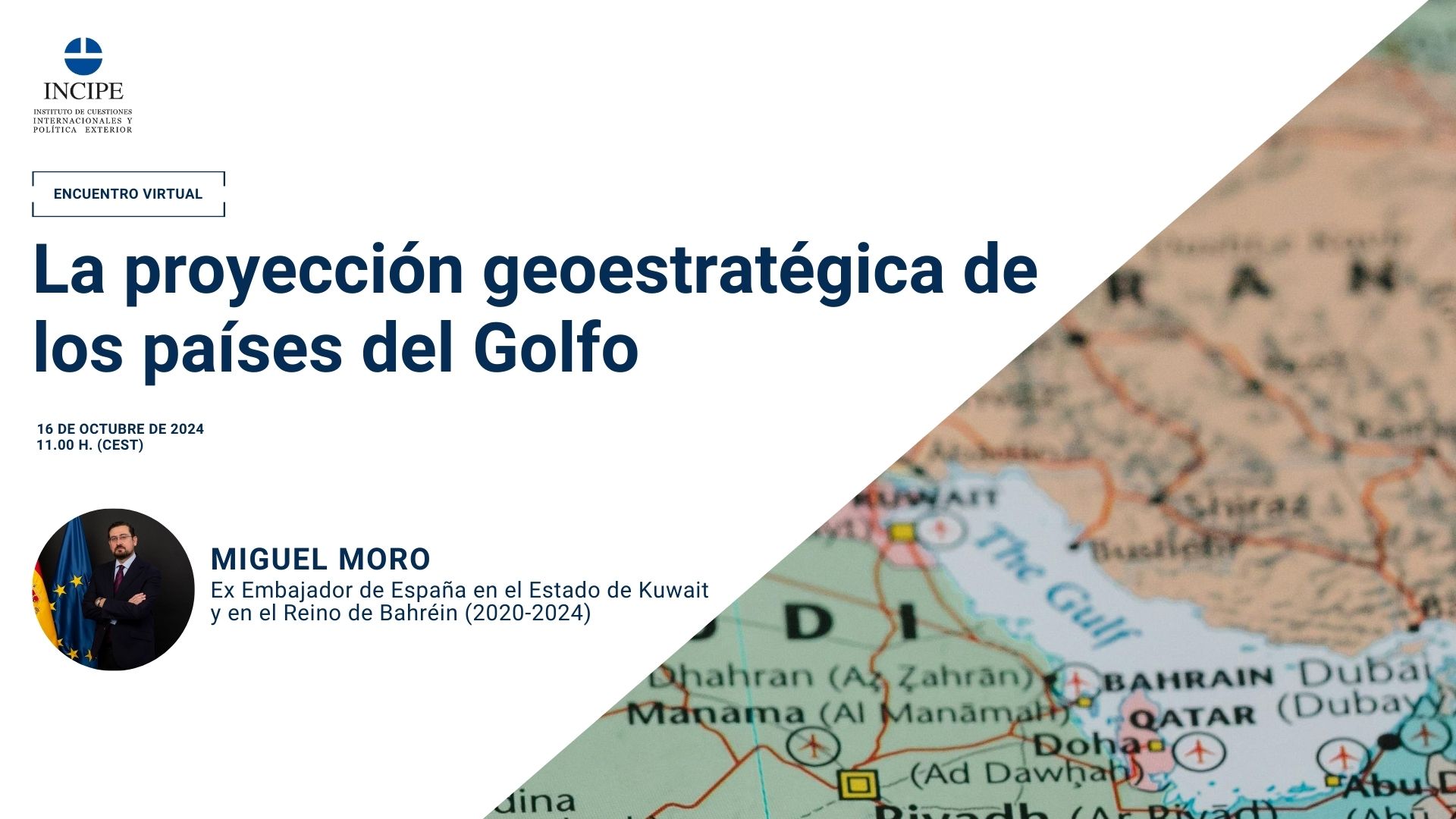
The session was conducted in Spanish and brought together an audience interested in understanding the factors that have driven the geopolitical growth of the Persian Gulf region. To this end, we had the participation of Miguel Moro, the official responsible for Syria and Yemen at the Ministry of Foreign Affairs and Cooperation (MAEC), as well as for the Gulf Cooperation Council (GCC) countries within the same ministry. During the session, Miguel Moro presented a detailed analysis of the importance of the Persian Gulf countries as geopolitical actors, highlighting the various factors that have led to their new strategic positioning.
Miguel Moro began his presentation by emphasizing the key position that Gulf countries have acquired in recent years, with the shift of the Arab world’s center of gravity towards this region. Although these countries have always had vast energy reserves and financial leverage, it was only in recent years that phenomena such as the Arab Spring and certain international economic developments have solidified their leadership. Miguel Moro pointed out that this new position is also due to the realization by these countries’ leaders of the opportunities offered by the changing international landscape, in light of the decline of historical Arab powers such as Jordan, Syria, and Egypt.
Among the factors that have driven this shift, the speaker first pointed to the region’s economic and demographic weight. Although all Gulf countries have significant GDPs, Saudi Arabia and the UAE stand out as the main powers, concentrating 75% of the subregion’s economy. Additionally, the Gulf has an attractive market of around 50-60 million people, with 70% of the population under the age of 30. According to Miguel Moro, these demographic factors shape the direction of current and future reforms to harness this available energy.
In the energy sector, Miguel Moro highlighted the vast oil reserves, with the combined reserves of Gulf countries positioning the region as the world’s leading crude oil hub. Saudi Arabia is the world’s largest oil exporter, holding 17% of the world’s proven reserves, while Kuwait, the UAE, and Qatar rank sixth, seventh, and fourteenth, respectively. Regarding natural gas, Qatar is the key player, holding approximately 12.8% of global reserves, followed by Saudi Arabia (4.2%) and the UAE (3.1%).
Miguel Moro pointed out how these energy reserves contribute to the financial prominence of these countries, a reality reflected in their concentration of nearly half of the world’s largest sovereign wealth funds (six out of 15), which are essential for the internal development of strategic economic sectors as well as for their international investment activities. Furthermore, Gulf states solidify their influence through their capacity as international donors. In 2022, the four main Gulf countries invested approximately $9.2 billion, according to the OECD, mainly in their primary sphere of influence, the MENA region, but also in sub-Saharan Africa and Latin America. Miguel Moro noted that this financial capability poses a challenge to Western donor policies, as Gulf countries do not impose conditionality criteria on their aid. Another factor reinforcing their importance is their role as international logistics hubs, given their position at the crossroads of different regions.
Additionally, Miguel Moro emphasized the central role these countries have acquired in the green transition. He noted that their power and influence stem not only from being major fossil fuel producers but also from their increasing leadership in the green transition, with a growing focus on renewable energy. Saudi Arabia, the UAE, Kuwait, and Bahrain are examples of Gulf countries with significant renewable energy projects underway, including infrastructure for green hydrogen plants, solar energy, and more.
All these elements contribute to the strengthening of their foreign policy, which, as the speaker explained, combines traditional elements with newer strategies such as oil and gas diplomacy or «checkbook diplomacy,» exercised through their large investment funds.
Foreign policy, as a key instrument of these countries’ external action, has also been gradually shifting towards more assertive strategies, as evidenced by their intervention in the Arab Spring in alignment with their specific interests, as well as their increasing involvement in sub-Saharan Africa. This is accompanied by the region’s rise in the defense sector, with Saudi Arabia, the UAE, and Qatar among the world’s top ten arms importers. Moreover, their importance as arms producers has also grown. These strategies are complemented by the use of soft diplomacy, a policy of attraction through major cultural and educational institutions, as well as their significant tourism potential.
The speaker also highlighted the important role of the Gulf Cooperation Council as a unifying institution for these countries. It serves as a coordination and harmonization body, with ultimate goals of integration, though political disagreements and cohesion challenges make this final objective difficult to achieve.
Miguel Moro concluded his presentation by mentioning some of the future challenges that Gulf countries may face, including their dependence on hydrocarbons, determining their true energy direction, human rights issues, potential regression due to conservative or religious sectors, and security concerns amid emerging crises in neighboring subregions. Additionally, he emphasized the need for Spain to develop a more consistent and strategic relationship with the Gulf. Despite increased attention to the region in recent years, Spain’s engagement remains insufficient compared to the efforts of other neighboring countries.
The session concluded with a debate, where participants had the opportunity to ask questions about the topics discussed. This exchange underscored the importance of understanding the factors that have driven the Gulf countries’ growing strategic projection in recent years.
Lucía Rodríguez