
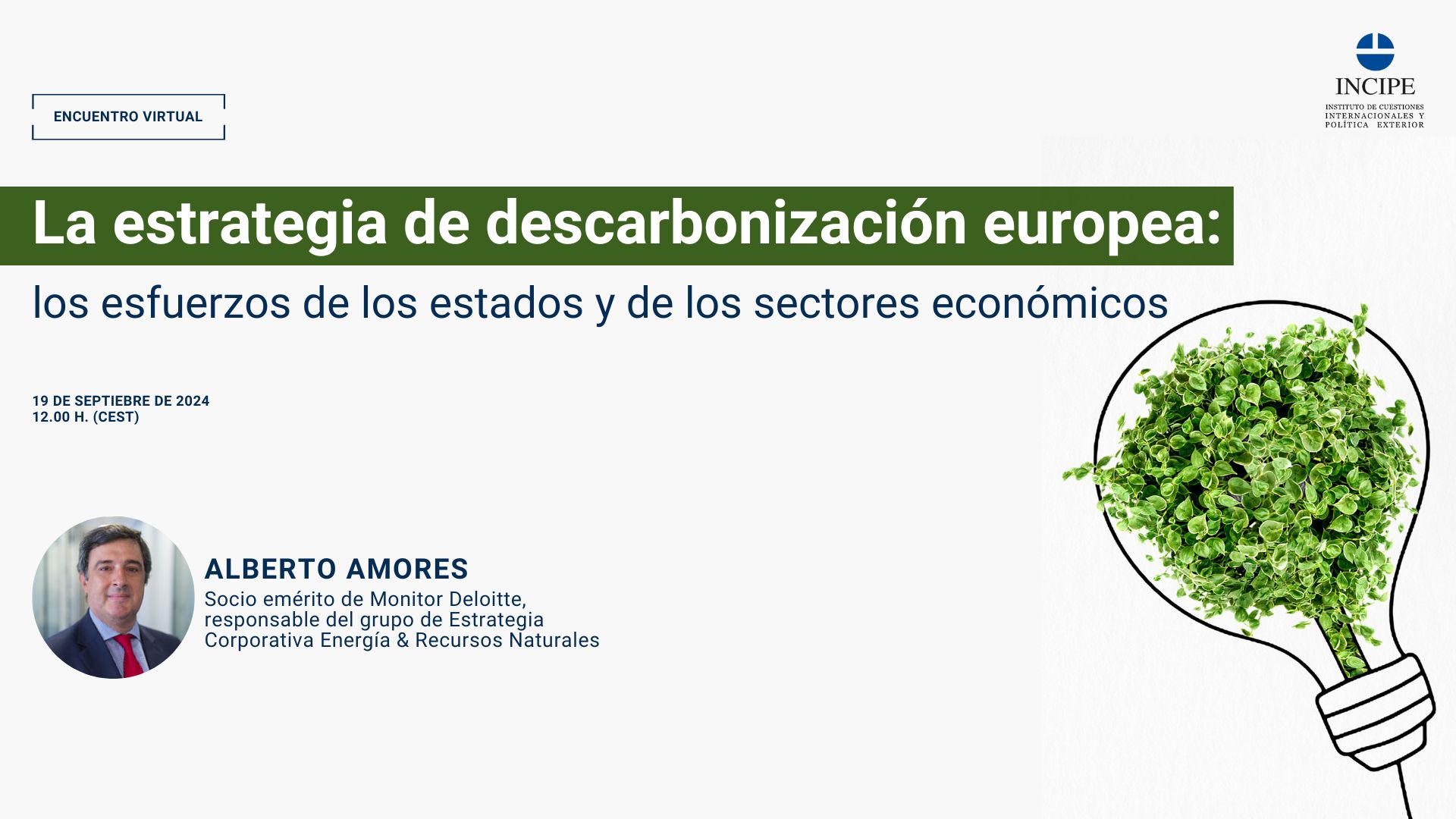
The session was held in Spanish and gathered an audience interested in understanding the European strategy for the energy transition and its consequent challenges. To achieve this, we had Alberto Amores González, who has vast experience in projects and advisory services for public administrations, regulators, and the private sector regarding the implications of the European decarbonization process and European and Spanish transition models. During the session, Alberto Amores presented an analysis of the European decarbonization strategy, focusing particularly on the challenges faced by the most emissions-intensive economic sectors in meeting the community’s goals. He highlighted the complexity of the decarbonization objectives and the key steps to ensure their viability in the various economic sectors.
Alberto Amores began his presentation by referring to the general objectives of European decarbonization. According to the speaker, the strategy goes beyond curbing emissions from member states, which account for only 9% of global emissions. The goals aim to reduce Europe’s significant dependence on fossil fuel supplies and develop a new, competitive, and sustainable economy by lowering energy costs through the introduction of renewable energies.
Amores pointed out that the challenge of decarbonization lies in the fact that, in addition to incorporating renewables into the energy system, it requires a structural shift in European energy consumption. This means a structural shift across all economic sectors, which would demand significant innovation, investment, the widespread adoption of new technologies and business models, and changes in the behavior of companies, governments, and citizens.
However, Alberto Amores emphasized that the efforts required by each member state to achieve these structural changes are very different, requiring significant negotiation and solidarity among European countries. On the other hand, when focusing on the activity sectors, it becomes clear that most emissions are concentrated in electricity generation, heavy industry, and road transport. Amores stressed the need to understand the specifics of each key sector to act effectively.
Electricity generation, for example, is the sector with the most significant progress toward meeting objectives, as the necessary technologies were already available. However, Amores noted that 27% of this sector will still emit in 2030, with these emissions concentrated in Germany, Poland, and Italy. The difficulty in further reducing emissions from the sector comes from challenges such as planning issues, lack of appropriate market signals to invest in renewables, slow administrative procedures, social resistance to infrastructure proximity, and discussions about the role of storage or nuclear energy.
For the industrial and transport sectors, progress is less evident. More than 40% of industry in Europe will still use fossil fuels in 2030. Meanwhile, 23% of emissions in that same year will come from land transport. In the case of industry, the main challenge comes from technological development issues, particularly concerning the role of electrification in high-temperature processes. As for transport, the adoption of electric vehicles is hindered by a lack of charging infrastructure, as well as administrative issues that make expanding the infrastructure difficult. Furthermore, freight transport poses other challenges related to the role that different types of energy should play in its decarbonization process.
Other relatively significant sectors are buildings, which are responsible for an estimated 12% of emissions in 2030, mostly from natural gas used in heating, and agriculture, which is expected to account for 16% of emissions in the same year. In the case of buildings, the solution would require retrofitting building envelopes, a process that is complex both technically and financially. For agriculture, solutions involve circular economy practices, the consumption of sustainable products, and the development of carbon sinks.
To conclude, Alberto Amores pointed out that although the complexity of the objectives is evident, they become feasible in the long term by focusing on key aspects such as the use of available technology, increasing investment, and simplifying existing regulations. He also emphasized the need to understand that decarbonization is a transversal change that requires public support and fair transition models that cover the most disadvantaged populations. The session ended with a debate where participants could ask questions about the topics discussed. This exchange highlighted the importance of understanding the European decarbonization objectives and the challenges facing member countries in achieving them.
Lucía Rodríguez