
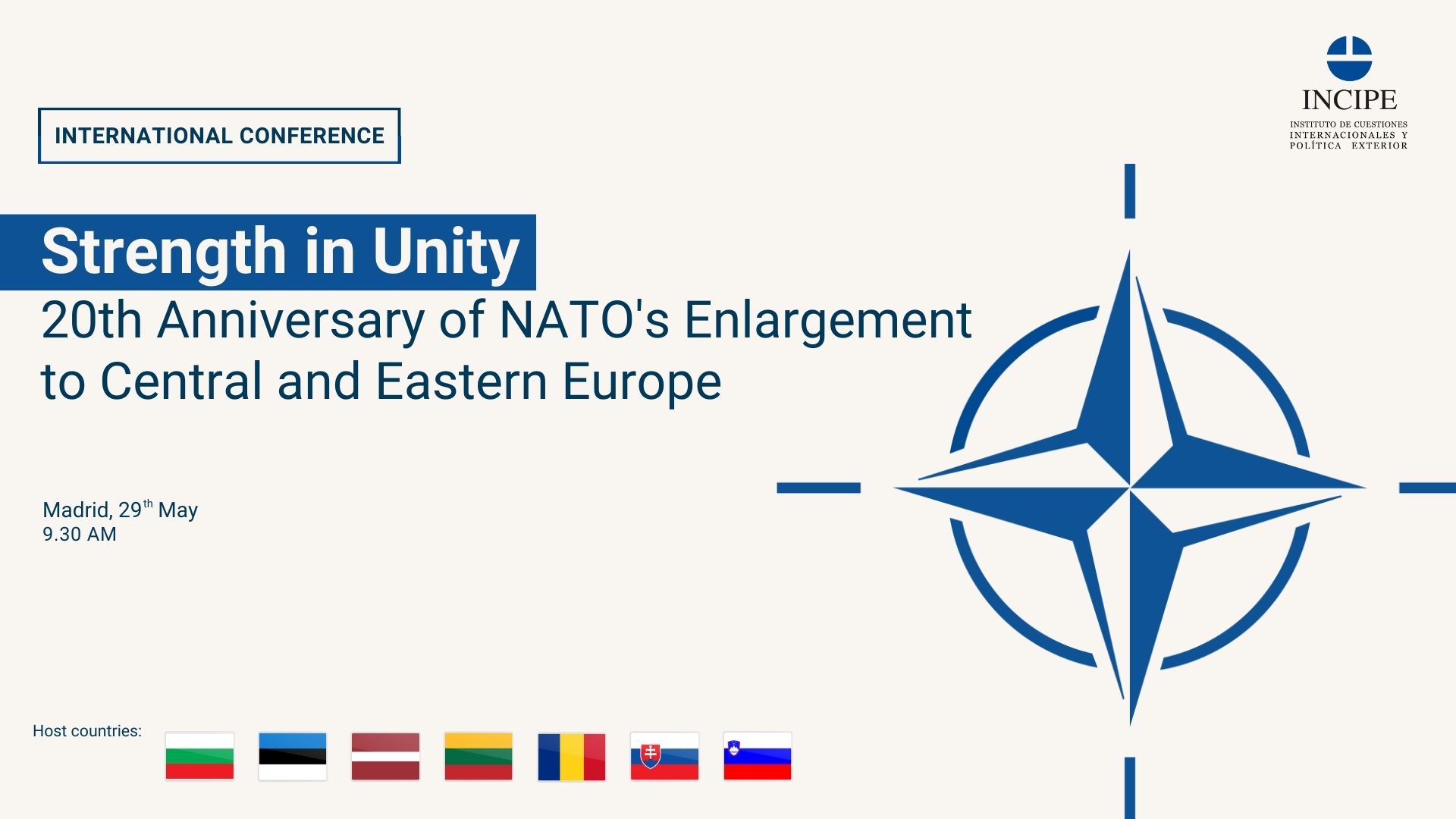
At this conference, we had the opportunity to organize two roundtable discussions. The first, titled NATO’s Profile on its 75th Anniversary: Current Challenges and Perspectives, was moderated by Vicente Garrido, Director General of INCIPE. The panel featured Alberto Ucelay, Director General for Foreign and Security Policy at the Ministry of Foreign Affairs, European Union, and Cooperation of Spain; Gergana Karadjova, Director General for Political Affairs at the Ministry of Foreign Affairs of the Republic of Bulgaria; Norbert Brada, Director of the Security Policy Department at the Ministry of Foreign and European Affairs of Slovakia; and Margus Kolga, Director General of the Policy Planning Department at the Ministry of Foreign Affairs of the Republic of Estonia.
The second roundtable, titled The Alliance’s Security Environment: Global and Regional Perspectives on Conflicts and Partnerships, was moderated by Felipe Sahagún, journalist and professor of International Relations. The panel featured Rita Kazragiené, Ambassador and Special Envoy for the Indo-Pacific at the Ministry of Foreign Affairs of Lithuania; Jānis Zlamets, Director General for Security Policy and International Organizations at the Ministry of Foreign Affairs of the Republic of Latvia; Alice Sabau-Georgescu, Deputy Director for Security Policies at the Ministry of Foreign Affairs of Romania; and Andrej Slapnicar, Ambassador and Head of the Security Policy Department at the Ministry of Foreign and European Affairs of Slovenia.
Ricardo Díez-Hochleitner, Secretary General of INCIPE, began his remarks by highlighting NATO’s evolution since its founding, stating that today it is larger, stronger, and more united than ever. He emphasized the decades of peace that the Alliance has ensured, serving as the first line of defense against terrorism since 2001 and strengthening collective defense. NATO plays a crucial role in safeguarding peace, stability, and prosperity in times of war, increasing threats, and emerging risks, noted the Secretary General of INCIPE. Today, new threats related to terrorism in all its forms are emerging, creating the need to develop new strategies to ensure NATO’s collective defense, based on a 360-degree approach and a series of key mandates.
For his part, DIGENPOL Lieutenant General Fernando López del Pozo stated that to fully understand NATO as we know it today, it is essential to recognize the significance of its expansion into Eastern Europe, which began 25 years ago, highlighting Spain’s key role in this process. He also underscored the security that NATO has provided and continues to provide, reinforcing its credibility and reliability.
NATO’s Profile on its 75th Anniversary: Current Challenges and Perspectives
During the first roundtable, titled NATO’S Profile on its 75th Anniversary: Current Challenges and Perspectives, the Director General for Foreign and Security Policy at the Ministry of Foreign Affairs, European Union, and Cooperation, Alberto Ucelay, began his speech by celebrating Finland and Sweden’s accession to NATO and highlighting the rejection of Russian provocations at the borders of the European Union, stating that this represents an attempt to destabilize the region. Ucelay emphasized that NATO’s future will be shaped by Russia’s aggression against Ukraine. Additionally, he highlighted the signing of a significant memorandum on cooperation, in which the President of Ukraine, Volodymyr Zelensky, and the President of Spain, Pedro Sánchez, participated on May 27, 2024. The memorandum addresses security issues, including military support commitments, the shipment of military equipment, and political, diplomatic, economic, and humanitarian aid, reaffirming Spain’s steadfast and unwavering support. He also mentioned the upcoming NATO summit in Washington this July, which comes at a crucial moment for the Ukraine conflict, stressing the importance of demonstrating NATO’s unity.
Finally, Ucelay pointed out that NATO must pay attention to developments in the Sahel and Mediterranean regions due to their instability, mainly caused by ties with Russia, among other factors. In conclusion, he stated that the Washington Summit represents an opportunity to reinforce NATO’s unity and solidarity in addressing global challenges.
In her speech, Gergana Karadjova, Director General for Political Affairs at the Ministry of Foreign Affairs of the Republic of Bulgaria, emphasized the significance of celebrating not only NATO’s 20th anniversary but also Bulgaria’s accession to the Alliance following the post-Cold War transformation. She stressed that NATO should remain open to welcoming new members, underscoring the recent accession of Finland and Sweden as a demonstration of its strength. Additionally, Karadjova highlighted that Bulgaria’s priority as a NATO member lies in Black Sea security, arguing that no other region has been as affected by Russia’s aggression against Ukraine. She pointed out that Russia perceives the Black Sea as a projection of its power and that Russian policies are aimed at creating and manipulating existing regional weaknesses, thus challenging territorial integrity, particularly that of neighboring states.
Karadjova concluded by affirming that with continued support, Ukraine will eventually become a NATO member. She also stated that NATO’s future is shaped by peace and security in all its forms.
Next, Norbert Brada, Director of the Security Policy Department at the Ministry of Foreign and European Affairs of Slovakia, took the floor. He began by emphasizing that, in these challenging and uncertain times, it is essential to maintain NATO’s characteristic unity and strength. Like Karadjova, he took the opportunity to commemorate Slovakia’s accession to NATO. He reiterated Slovakia’s firm commitment to NATO’s open-door policy, arguing that the Alliance’s expansion fosters democracy and prosperity. Brada concluded by underscoring that solidarity, collective defense, and mutual support are among NATO’s defining pillars.
To conclude the first roundtable’s interventions, Margus Kolga, Director General of the Policy Planning Department at the Ministry of Foreign Affairs of the Republic of Estonia, stressed the importance of Estonia’s accession to both NATO and the European Union, ensuring the country’s democratic values, the rule of law, and national security. He also called on European members, along with Canada, to contribute more resources and effort to balance the influence of the United States.
After the interventions from representatives of Spain, Bulgaria, Slovakia, and Estonia, a Q&A session was opened to encourage a more enriching dialogue. Both in-person attendees and virtual participants had the opportunity to ask questions on various topics discussed during the roundtable. This exchange of ideas and perspectives helped broaden the collective understanding and enrich the discussion within the framework of the Alliance before concluding the session.
The Alliance’s Security Envioronment: Global and Regional Perspectives on Conflicts and Partnerships
The second roundtable, titled The Alliance’s Security Environment: Global and Regional Perspectives on Conflicts and Partnerships, focused on the current situation in Europe and future security, addressing the issues and conflicts discussed in the first panel.
The first to speak was Andrej Slapnicar, Ambassador and Head of the Security Policy Department at the Ministry of Foreign and European Affairs of Slovenia. He referenced former Spanish Foreign Minister Javier Solana, who supported Slovenia’s accession to both NATO and the European Union, highlighting Spain’s unwavering support in these processes. Additionally, Slapnicar advocated for NATO’s openness to allowing new member states to join, as well as for the expansion of the European Union. He also stated that the upcoming NATO Summit, scheduled for July, will demonstrate that the Alliance is stronger and more solid than ever, reaffirming its commitment to security and stability in the region and worldwide.
Slapnicar addressed the major question of NATO’s current role. Despite facing significant challenges such as the war in Ukraine and the situation in the Middle East, NATO remains as relevant as in past times. According to Slapnicar, Russia’s aggression has shattered Euro-Atlantic security and stability, necessitating a safer Europe and a stronger NATO. He concluded his remarks by emphasizing that both the European Union and NATO are guided by the same democratic values and the rule of law, expressing hope that prospective new members will share these values to continue making progress.
In her speech, Rita Kazragiené, Ambassador and Special Envoy for the Indo-Pacific at the Ministry of Foreign Affairs of Lithuania, reaffirmed the importance of the Alliance’s open-door policy, making special mention of Ukraine and its potential accession, stressing that the country increasingly needs NATO’s support and guarantees. Kazragiené also underscored NATO’s need to expand and strengthen its alliances. Furthermore, the conflict between Russia and Ukraine requires the Alliance to act forcefully and collectively. NATO’s future, as reflected in the Southern Neighborhood policy, is fostering growing security ties between the East and the South.
«Everything that happens in Europe and Ukraine matters to Asian countries», stated Rita Kazragiené. To support her claim, she provided several examples, such as the military aid China is providing to Russia, as well as resources for its military industry. Additionally, she pointed out that Russian gas is being exported to China at a better price, while Chinese military capabilities are increasing at an unprecedented rate. According to Kazragiené, this indicates that China is learning from Russia, including hybrid warfare, which encompasses military, informational, and economic actions.
Finally, Rita Kazragiené stated that NATO must be more vigilant than ever in the face of this challenge, as Russia, North Korea, China, and Iran have never been so aligned, posing a threat to other countries in the region. This implies an increasing importance of soft power, referring to the non-military domains each country possesses.
Next, Jānis Zlamets, Director-General of Security Policy and International Organizations at the Ministry of Foreign Affairs of the Republic of Latvia, began his speech by answering the question: «Why does NATO have partnerships?» Zlamets asserted that they are essential for the Alliance to fulfill all its functions and provide defense and security to all its members. Closely related to this, he introduced the importance of NATO members engaging in the threats and challenges faced by any member state, as well as in joint decision-making among all member countries.
Alice Sabau-Georgescu, Deputy Director of Security Policies at the Ministry of Foreign Affairs of Romania, closed the second roundtable by addressing the war in Ukraine, noting that this conflict has been a milestone, marking the first time NATO cooperation has been taken so far, as well as a crucial moment for its expansion. She also recalled the Madrid Summit in 2022, where the New Strategic Concept was presented alongside several historic decisions that provided NATO with an adaptation tool. Sabau-Georgescu stated that we are currently facing an unprecedented multiplication of security challenges and new threats. Terrorism remains a significant threat to Euro-Atlantic security, the proliferation of weapons is still a pressing issue, and aggressive policies continue to be one of NATO’s main challenges.
Finally, she emphasized that the conflict in Ukraine is also challenging economic, energy, and food security, as Russia is destabilizing these areas not only in Ukraine but globally. This requires a response from a much broader perspective, not just at the regional level, implying that security must be addressed through a 360º approach.
Following the interventions of the representatives from Slovenia, Lithuania, Latvia, and Romania, the session proceeded to the second debate, where in-person and virtual participants posed their questions to the panelists of this second roundtable.
Conference Closing Remarks
o conclude the Conference, we had the closing remarks of Paula Redondo, NATO’s Program Coordinator for Russia and Central Asia, who began her speech by emphasizing that all countries that joined NATO did so freely—something that Russia is denying to Ukraine. Redondo referred to NATO’s evolution and growth: in 1949, the Alliance had only twelve member states; however, 70 years later, it has expanded to 32 countries, demonstrating the success of the Alliance.
Over the past two years, according to Paula Redondo, there has been an increase in public support for NATO, as well as NATO’s backing of Ukraine. She also mentioned the upcoming Washington Summit, where key issues will be discussed to ensure continued unity and the ability to respond effectively and collectively to challenges. NATO must demonstrate that it is stronger than ever, with new capabilities, and ensure the production of all the resources the Alliance needs.
One of NATO’s top priorities is supporting Ukraine by providing military aid, which has enabled Ukraine to fight against Russia and reclaim territory. However, more institutional support is needed to provide greater predictability and transparency in the delivery of these supplies, Paula Redondo noted.
Aranzazu Álvarez