
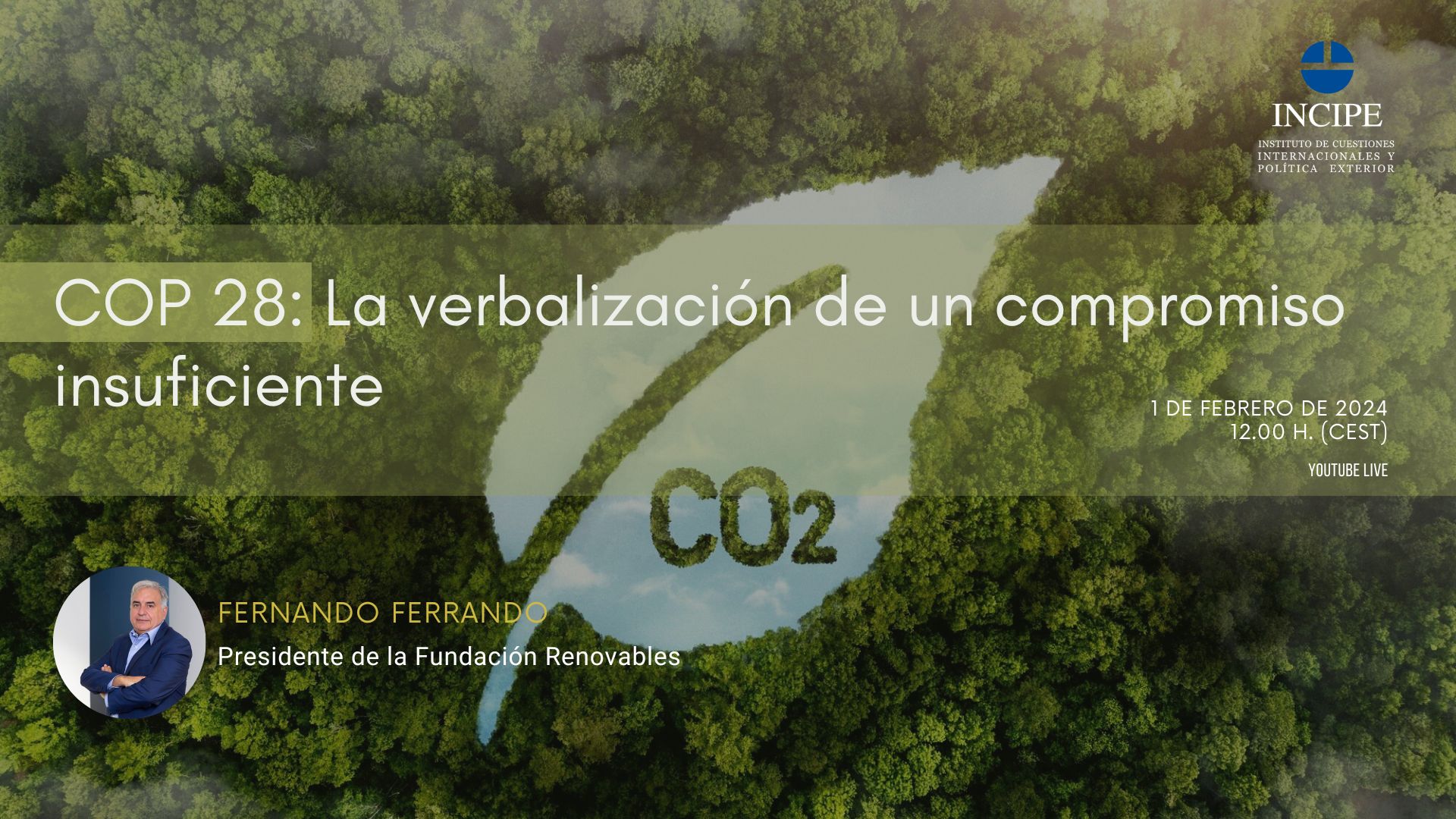
Fernando Ferrando began his speech by emphasizing that we have already exceeded six of the nine planetary boundaries set by Stockholm University for maintaining Earth’s health. He went on to highlight that, globally, we consume in seven months the natural resources that should last a full year, while in Spain, consumption is 2.4 times beyond sustainable limits.
Since the 1950s and the development of the industrial phase, the acceleration in energy demand has multiplied by eight, leading to a serious problem of increasing energy consumption, Ferrando noted. In the last 20 years, global energy consumption per capita has increased by 2,100 kWh, multiplied by 1.7 billion more people compared to the year 2000. This consumption remains heavily dependent on fossil fuels.
Ferrando continued by pointing out that in the European Union, the economic losses caused by extreme weather events have drastically increased over the past six years. These losses are even more severe in developing countries.
Regarding the acknowledgments made at COP 28, he reminded the audience that the agreement reached is not legally binding for countries. He also noted that while there was a commitment to triple global renewable capacity, there was no mention of the need to electrify demand to replace fossil fuels. Furthermore, countries agreed to accelerate efforts to reduce coal-based energy production, but without concrete measures. The agreement also focused on transitioning away from oil, gas, and coal rather than eliminating them outright.
In terms of financial support and media recognition at COP 28, Ferrando highlighted the creation of a loss and damage fund to be managed by the World Bank. However, he considered this commitment insufficient, given that the estimated needs amount to $400 billion, while the fund has only been allocated $792 million.
Regarding potential solutions, Ferrando stressed that population and economic growth will continue driving higher energy and material consumption. He argued that relying solely on technological development is not enough and that a shift in production and consumption models may be necessary.
In the final part of the session, a debate took place, where participants raised questions about the inadequacy of the so-called Loss and Damage Fund, originally proposed at COP 27, as well as different methods for reducing emissions and the potential for renewable energy production.
Discussions also covered China’s energy consumption model, the need to scale down unsustainable activities, and the feasibility of nuclear energy. Additionally, topics included the link between global warming and extreme weather events, public opinion on climate change, and expectations for COP 29.
Elena Ferro