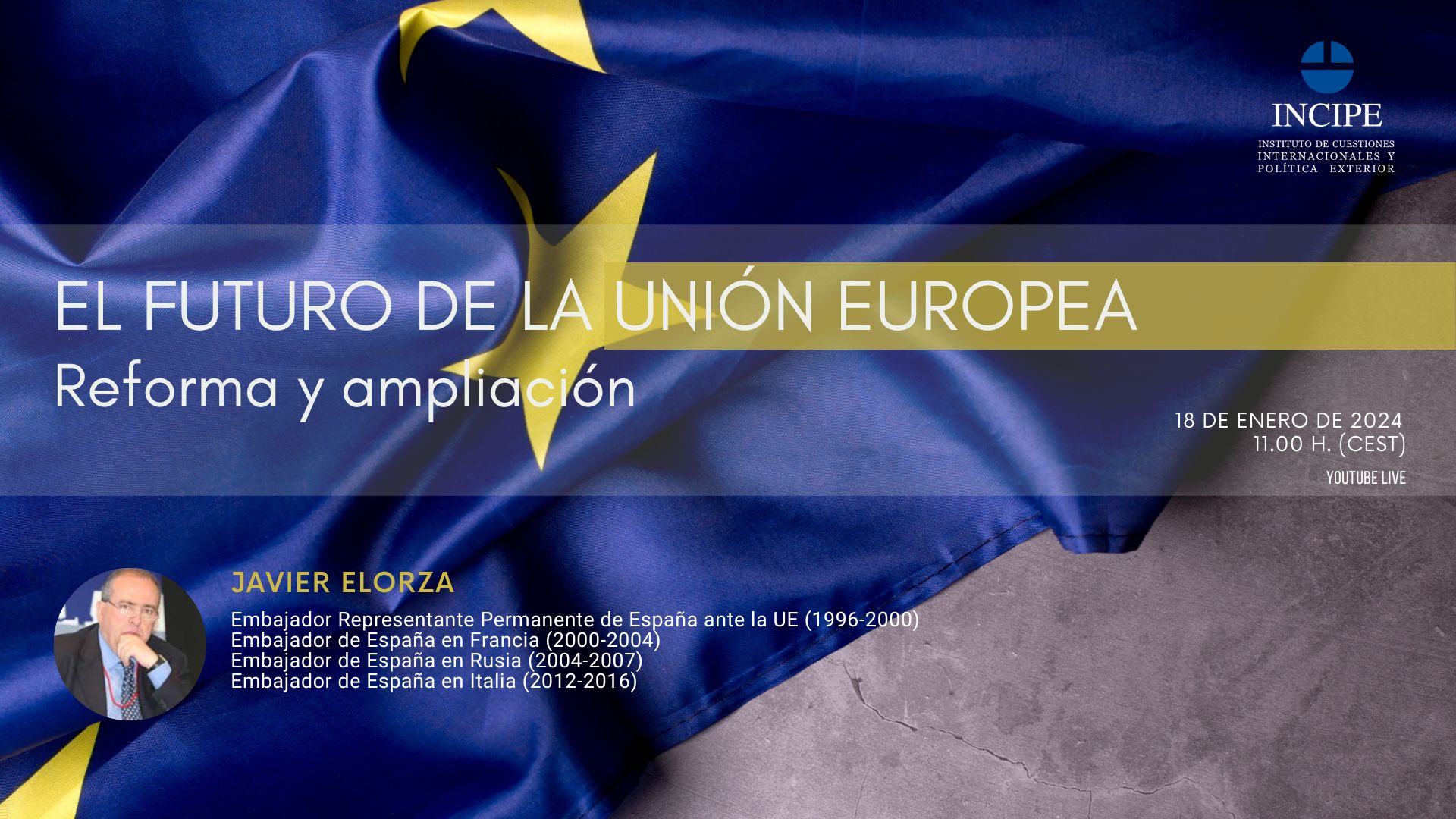
Javier Elorza began his speech by identifying Brexit as the starting point of the situation the European Union is currently facing. As a consequence, an existential crisis arose in Brussels, which materialized months later with the publication of the White Paper on the Future of Europe by the European Commission in 2017, analyzing different options for the Union’s development.
Later, in 2022, more than half of the Member States rejected the possibility of revising the treaties. In September 2023, France and Germany published a document with two central ideas: the necessity of EU enlargement for geostrategic reasons and the proposal to carry out financial and institutional reforms beforehand—something that, according to Elorza, is unlikely to gain the support of other Member States.
Elorza went on to emphasize that enlargement requires funding. As outlined by the Copenhagen criteria (or accession criteria), the European Union must have absorption capacity, which entails increased spending, raising the population covered from 446 to 512 million.
In previous enlargements, Elorza explained, the European Council had always agreed on the necessary means to finance them. He argued that the same approach should be taken now, evaluating costs based on integration agreements and transitional periods, and ensuring that the final cost is distributed fairly and equitably.
Elorza highlighted that negotiations for the accession of Ukraine, Moldova, and Bosnia and Herzegovina began during Spain’s Presidency of the Council of the European Union. These negotiations are expected to last a long time, as none of the candidates currently meet the necessary accession requirements. He concluded by noting that Belgium’s Presidency of the Council of the European Union is tasked with drafting a list of potential internal reforms and analyzing current policies in light of enlargement—an effort that is unlikely to receive unanimous support from all Member States.
The final segment of the session featured a debate in which participants raised questions on various topics, including an assessment of Spain’s rotating Presidency of the Council of the European Union—its achievements and challenges—and how to address Member States that do not respect the Rule of Law within the Union. Discussions also covered Spain’s eligibility for cohesion funds, the EU’s reindustrialization policy in strategic sectors, and Brussels’ ambitions regarding the Green Deal.
Additionally, the debate touched on public opinion in different European countries regarding the accession of Ukraine and Turkey, the impact of Brexit on the EU, and the feasibility of creating a European army. Finally, participants discussed the challenge of adopting an effective European migration policy.
Elena Ferro