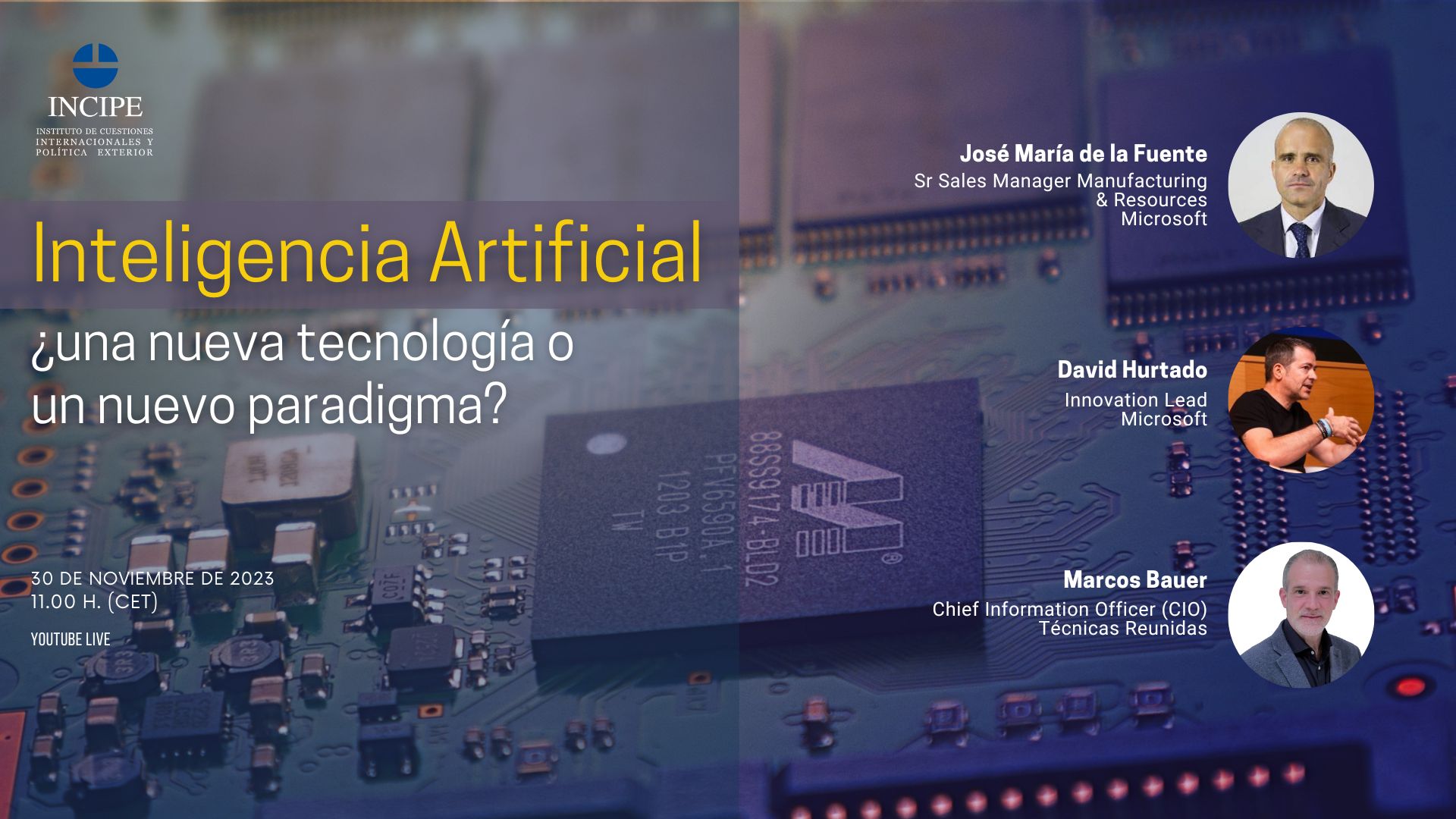
David Hurtado focused his intervention on trying to clarify some of the main doubts that have arisen around the revolution brought about by generative artificial intelligence. He began by explaining where we are at the moment, where artificial intelligence serves as a productivity assistant, making it clear that this technology is not capable of thinking or reasoning on its own, but rather consists of a mathematical system that works with algorithms.
Hurtado then continued describing how it has evolved over the past fifty years, explaining the leaps that have been made, from the artificial intelligence that began in 1956, to machine learning that, starting in 1997, focused on translating data into predictions; then to deep learning in 2017, which was capable of solving more complex problems; and now the leap to generative artificial intelligence, which started in 2021 and, by training the model with a massive volume of data, is able to handle language very effectively.
He then explains the three main areas of disruption that generative artificial intelligence is creating. First, the infrastructure to make this intelligence available to everyone; next, the data-driven models; and finally, the way this intelligence reaches the end user, referred to as a ‘co-pilot’, as it works as a productivity assistant.
José María de la Fuente then discusses the revolution in the world of infrastructure, as all the advancements around artificial intelligence would not have been possible without progress in computing capacity. He also highlights two major limitations in developing these infrastructures: the large amount of energy required to make them work, and the need for creating chips and processors. Finally, Hurtado and de la Fuente focus on the ethical implications and responsibilities, emphasizing the importance of regulation, security, and privacy protection.
Next, Marcos Bauer speaks about the implementation of artificial intelligence at Técnicas Reunidas, which, since 2018, identified the integration of this new technology as a key factor for maintaining competitiveness. This led the company to join the INDESIA association in 2021, aimed at promoting the use of artificial intelligence in the industrial sector, and in 2023, to create its own data and artificial intelligence area. He also highlights the need to be prepared for this change that is unfolding, and thus stresses the importance of training, the ethical use of this intelligence, and governance, which should be tied to data management.
Regarding the impact of this intelligence within the company itself, Bauer explains several examples that will be implemented in the internal work dynamic, such as incorporating ChatGPT via TEAMS across the entire organization, optimizing material acquisition through machine learning, recognizing graphic elements in blueprints using artificial intelligence, or generating detailed reports through the development of robotic processes.
At the end of the session, a debate took place in which participants asked questions on topics such as the distinction between machine and deep learning, the dichotomy between ethics and benefits in the field of artificial intelligence, or the difference between human and artificial intelligence. There was also discussion about the risks and challenges that this technology entails, emphasizing the importance of ensuring its development is always accompanied by governance and ethical use. Furthermore, the enormous financial resources required for its development were discussed, along with its incorporation into the business sector, and the possibility of achieving so-called ‘artificial general intelligence.’ Finally, the discussion touched on the importance of regulating the development and use of this new technology.
Elena Ferro