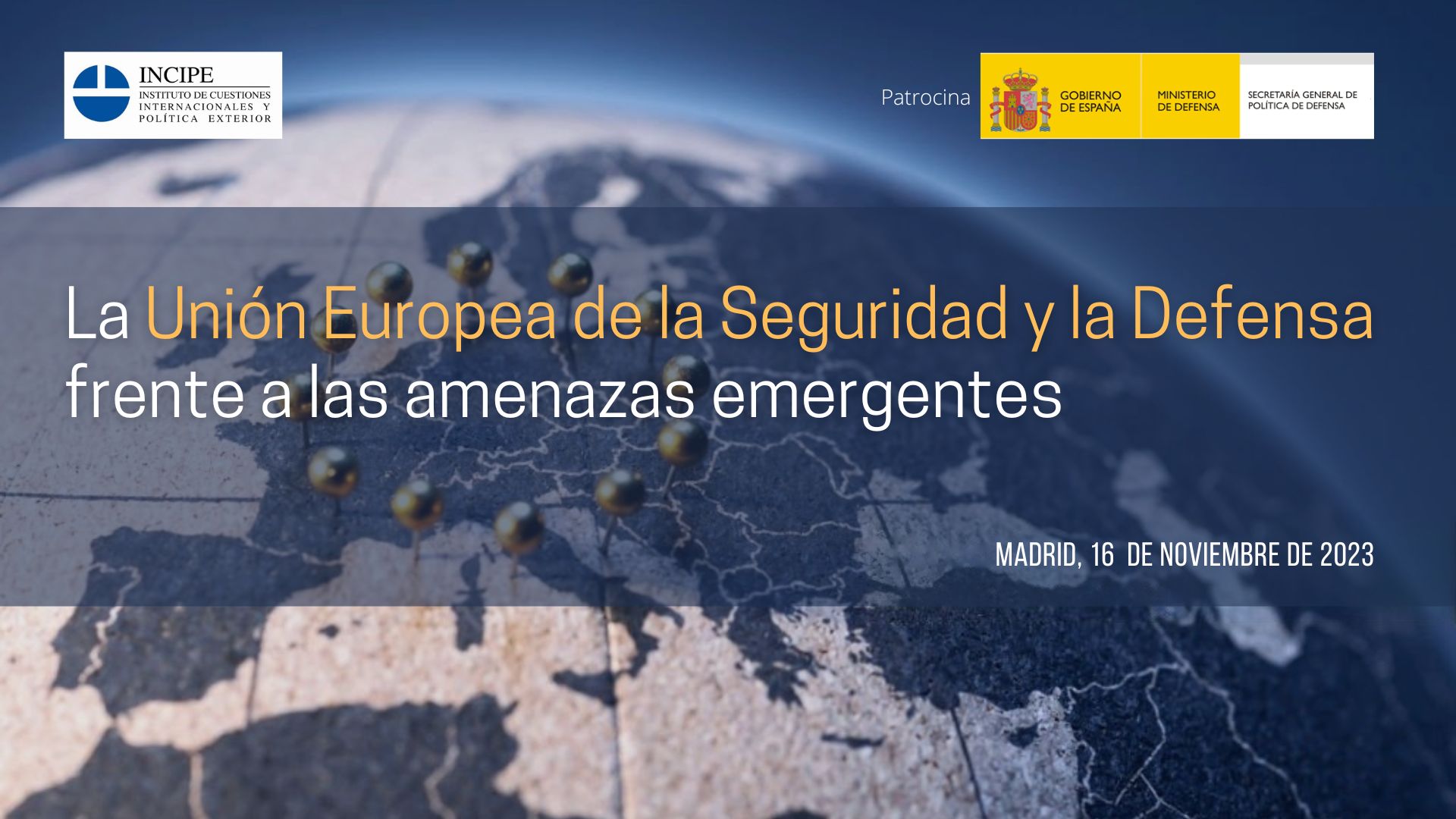
In this session, we had the opportunity to organize two round tables. The first, titled «The Defense Industry and the Strategic Compass: Implications for Spain,» was moderated by Colonel José Luis Calvo. It featured the participation of Colonel Alfonso Barea Mestanza, head of the Multilateral Cooperation Area, SDG for International Relations, Ministry of Defense; Ricardo Martí-Fluxá, president of TEDAE and Secretary of State for Security (1996-2000); and Colonel Carlos Sánchez-Ledesma, head of the Force Capabilities Division, European Union Military Staff, Brussels. The second round table, «The Strategy for a Union of Security,» was moderated by Vicente Garrido, general director of INCIPE, and included CN Francisco Ruiz González, head of the European Union Area, Directorate General of Defense Policy, Ministry of Defense; Félix Arteaga, senior researcher in the security and defense area at the Real Instituto Elcano; and Diego López Garrido, executive vice-president of Fundación Alternativas, emeritus professor of Constitutional Law, and Secretary of State for the European Union (2008-2011).
Colonel José Luis Calvo began his intervention by framing the European Union as a peace project, designed to prevent the horrors of the First and Second World Wars from repeating. However, over time, Colonel Calvo explains, the Union has realized that if it wants to go beyond a common market, it must have a dimension that addresses security and defense, which is reflected in the Common Foreign and Security Policy (CFSP) and the Common Security and Defense Policy (CSDP), and also the creation of the European External Action Service (EEAS). But the war in Ukraine has made us realize the true need to continue advancing in this area, says the colonel.
He continues by highlighting the importance of balancing the two pillars of any security system: the hard pillar (military capabilities) and the soft pillar (negotiation); because, in his opinion, in the case of the war in Ukraine, deterrence has failed, and in the case of Africa, more specifically in the Sahel, dialogue has failed. To continue advancing in this field, we have the Strategic Compass, approved in March 2022, but we must also enter, according to the colonel, a period of reflection to assess where we have failed, and a period of developing capabilities.
The Defense Industry and the Strategic Compass: Implications for Spain
During the first roundtable, «The Defense Industry and the Strategic Compass: Implications for Spain,» Colonel Alfonso Barea Mestanza began his intervention by highlighting that, in recent years, the European Union has had to face numerous challenges, which have driven the development of Europe’s defense and the defense industry. This has triggered a series of initiatives and tools aimed in the same direction: the clear will to have military capabilities to act effectively in the face of the challenges and threats of the 21st century, being able to act, if necessary, autonomously.
From the Versailles Declaration, signed in March 2022, the political commitment to greater responsibility regarding European security and the commitment to decisively invest in defense capabilities and innovation technologies has been clearly established. This declaration also established that the Strategic Compass would provide guidance for making the Union a stronger and more capable security guarantor.
The Strategic Compass stands out in the following areas: it offers a common assessment of the strategic environment; it provides greater coherence and unity of action; it establishes new ways and means to improve collective capacity, fostering investment and innovation; and, finally, it specifies clear objectives to measure progress. Furthermore, the Strategic Compass establishes four main pillars: act, protect, invest, and partner.
The Colonel concludes by emphasizing that we are at a critical moment in terms of managing and executing armament programs, and that, due to the current geopolitical situation, European initiatives and activities have multiplied exponentially, which is why, more than ever, it is necessary to have an innovative, competitive, and resilient industrial and technological base.
In his intervention, Colonel Carlos Sánchez-Ledesma offers the perspective from the European Union Military Staff on how military capabilities are evolving within the Union, beginning by explaining the role of the European Union Military Committee (EUMC) in this field.
The EUMC is the highest military body within the European Union Council, and is made up of the chiefs of defense staff from the twenty-seven member states. In the area of capability development, the Colonel highlights a specific initiative: the Capability Development Plan, which outlines the deficiencies within the Union for carrying out the missions included in its ambition level, primarily focused on crisis management missions.
He concludes by stating that, since the invasion of Ukraine, all member states have considerably increased their defense budgets and their willingness to cooperate to foster the defense industry. This is something that the European Commission has also actively promoted, entering the area of capabilities with strength, through funding for cooperation in procurement, in order to strengthen the defense industry and, ultimately, achieve the long-awaited European strategic autonomy.
Finally, Ricardo Martí-Fluxá explains that, within NATO, Spain already plays a very significant political and military role, being the seventh-largest financial contributor; and within the European Union, it is the largest contributor to missions and operations abroad, providing 36% of the personnel deployed in military operations. He also emphasizes that our defense companies are increasingly technological and more interconnected with the companies in their environment.
He continues discussing the Strategic Compass, emphasizing that it is a historic document, as, for the first time, the twenty-seven member states are conducting a common analysis of the global situation we are facing. In this new context, Martí-Fluxá states, Europe needs a strong defense, which requires coordinated operational capabilities and an innovative, competitive industry.
Therefore, he explains, the current challenges affect three levels: the political level, focused on the need for strategic autonomy; the military level, where the rationalization of demand for systems is one of the pending challenges; and the industrial level, where some internal contradictions that affect our industry’s production capacity must be resolved.
Focusing on the national situation, Martí-Fluxá indicates that our industry must position itself based on our capabilities and interests, and for this, we must take time to think about its future for the next decade, and make a necessary restructuring of the sector, contributing to strengthening Spain’s role in a Europe that needs to reinforce itself.
The Strategy for a Union of Security
In the second roundtable, The Strategy for a Union of Security, Diego López Garrido begins by explaining that there are two factors, in his opinion, that hinder a European Union of defense: national interests and the fact that the Union was not created as a «hard power,» but primarily as an economic organization.
He continues by stating that, after the invasion of Ukraine, European defense policy has shifted, making Europe the continent that has increased its defense spending the most—by 13%. He argues that, to build a European defense, it is necessary to initiate some projects that currently do not exist, including: greater integration of the armed forces, a European Headquarters, European military capabilities in all domains (air, land, sea, and communications), a sufficient defense industry and market, organic projection, and, finally, achieving the desired strategic autonomy.
Félix Arteaga continues the second roundtable by explaining the European Union’s public policy, which should focus not only on external security but also on internal security, covering areas such as immigration, counterterrorism, cybersecurity, and economic security.
Arteaga states that there are «different securities» and various actors, which has led the Union to adopt a comprehensive approach. In this framework, when facing a crisis, all dimensions and actors are addressed. This means moving from coordination to management focused on an integrated approach. He continues by explaining what he believes is the missing factor, both at the European and national level, in the field of security: the ability to supervise and enforce binding actions. As he explains, unless one is a major power, it is very difficult to impose and coordinate intermediate actors.
Finally, CN Francisco Ruiz González participates in this second roundtable, focusing on the European Union’s Common Security and Defense Policy. He explains that, currently, Spain and Italy are the main contributors to Union operations and missions, while France and Germany have dramatically reduced their contributions, with neither reaching 5%.
Regarding the relationship between the European Union and NATO, Ruiz González emphasizes that there should not be a contradiction; rather, there should be coherence in initiatives and complementarity of efforts, without a clear division of labor. A stronger NATO contributes to a stronger European Union, and vice versa. Francisco Ruiz continues by highlighting the achievements of Spain’s Presidency of the Council of the European Union, such as the improvement of rapid reaction capabilities, one of the main objectives of the Strategic Compass; the enhancement of the Military Planning and Conduct Capability (MPCC); progress in the area of common spending; and the development of collaboration with Latin America.
Closing Remarks
Javier Rupérez was the one who closed the seminar, framing his remarks around the premise of whether we find ourselves in fear or in hope. He concluded, in his opinion, that we are in hope, and from that perspective, he listed some relevant issues.
Rupérez believes we must ask ourselves if the European Union has its own defense capabilities, and he thinks it is crucial to have coordinated understanding between Europe and the United States. He goes on to explain that over the past eighty years, the Western world has gained a consistency it previously lacked; however, at the same time, we must consider several new, highly relevant situations: Russia’s actions, the future of China, Islamic terrorism, and the need for collaboration in intelligence systems and defense systems.
Despite all this, he believes we are anchored in hope. Democracy has gained considerable momentum, and the evolution of the economy and the social market economy are at the forefront. We don’t live in a perfect world, he concludes, there is much to improve, but we must continue reaffirming the convictions of those who have allowed people to be freer, more prosperous, and with greater respect for their dignity.
Elena Ferro