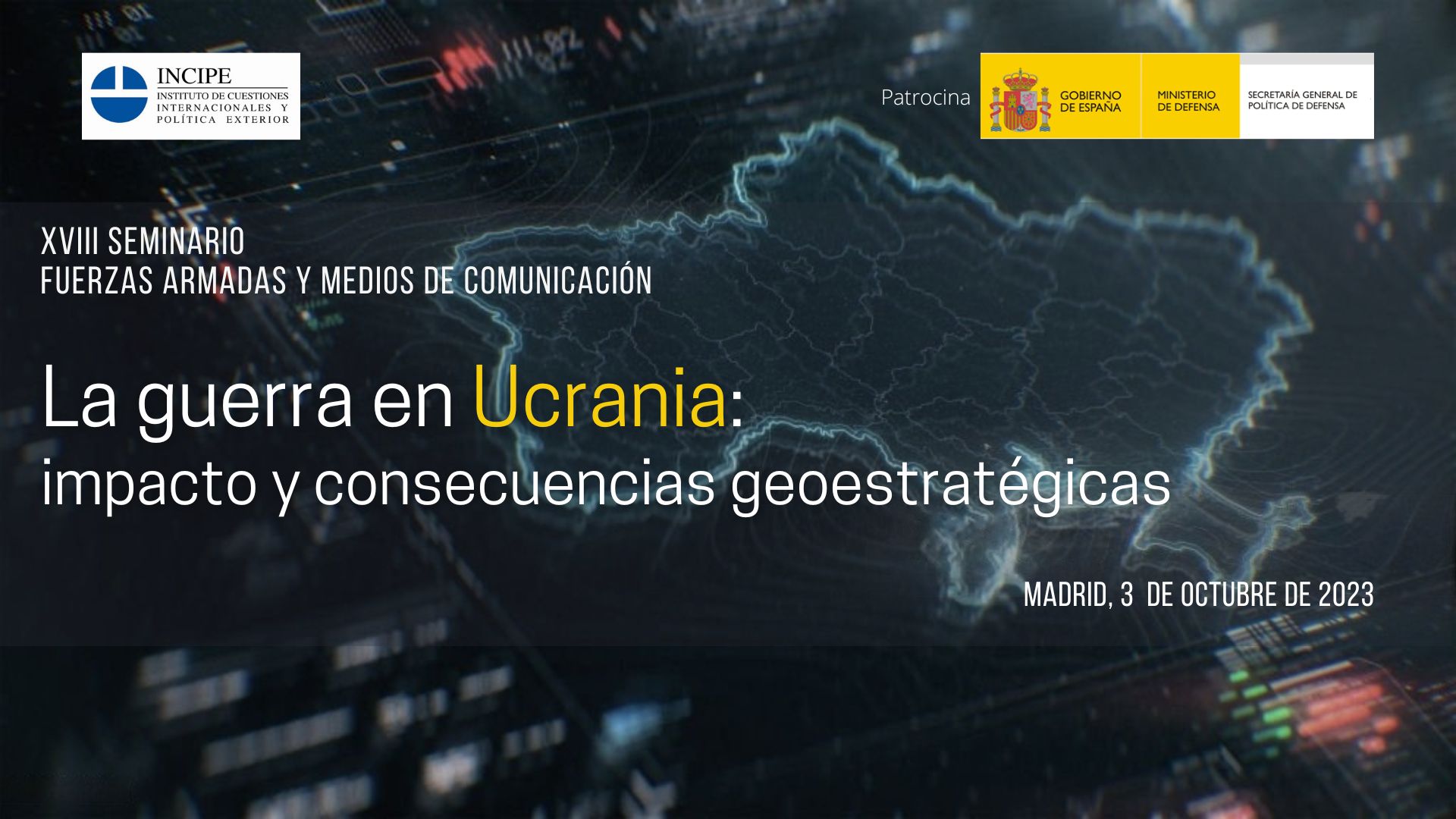
In XVIII Seminar on Armed Forces and Media, we had the opportunity to organize two roundtable discussions. The first, titled Information and Disinformation in the War in Ukraine, was moderated by Vicente Garrido, Director General of INCIPE. It featured CN Ignacio Nieto Fernández, Head of the Strategic Leadership Section at the Joint Defense Staff (EMACON); María Senovilla, independent journalist and photographer; and Óscar Mijallo, international affairs journalist at TVE. The second roundtable, Geostrategic Consequences of the Conflict, was moderated by Eloísa Moreiro, diplomat and analyst in the Geopolitics Area of the Security and Defense Coordination and Studies Division, Ministry of Defense. Participants included María Álvarez de Eulate, journalist and director of the program “Cinco Continentes” on RNE; Col. José Pardo de Santayana, Research Coordinator and Lead Analyst at the Spanish Institute of Strategic Studies (IEEE), Ministry of Defense; and Col. José Luis Calvo, Director of the Security and Defense Coordination and Studies Division, Ministry of Defense.
Yolanda Rodríguez Vidales began her intervention by talking about disinformation and highlighting that we live in complex times where the line between the real and the imaginary is increasingly fine. In the post-truth era, data and objective facts have less influence on shaping public opinion than appeals to emotions. This is something we can see more and more in the War in Ukraine, says Yolanda Rodríguez. The dissemination of narratives of wear and division has been perfected, and disinformation, enhanced by immediacy, seeks to break the bond between institutions and citizens, eroding trust and weakening defense capacity. Against disinformation, she argues, we need new tools, so we must advance research in artificial intelligence as a technology with great potential to prevent the spread of disinformation campaigns. In hybrid conflicts like this, she continues, we need to invest more in training to make our societies more resilient, educating people to appreciate public institutions and fostering free and objective journalism.
Information and Disinformation in the War in Ukraine
During the first roundtable, Information and Disinformation in the War in Ukraine, Óscar Mijallo began his intervention by highlighting that in this war, the two most effective propaganda apparatuses humanity has ever known are at play: the Russian and the American propaganda apparatuses. He emphasizes that disinformation now has two channels: it starts on Telegram and spreads on Twitter. He also points out that in the past, reporters would provide an analytical filter for the news being disseminated, whereas today, any international actor can reach their target audience directly without any verification.
He continues by explaining that on the Ukrainian side, the most manipulated information revolves around the missiles that fall in the country, which are diverted from their target by Ukrainian air defenses and end up falling in other places, where journalists are prohibited from filming the incident. On the Russian side, he highlights that censorship is much more severe, stressing that entering Donbas is almost impossible for journalists. Therefore, he concludes, there is greater commitment to transparency and access to information on the Ukrainian side.
In his intervention, CN Ignacio Nieto Fernández starts by discussing Russia’s strategy and how it uses disinformation. He highlights that Putin uses all the instruments of national power to send messages to the population, while simultaneously using information to position Russia as a global actor. He continues discussing the perfect cognitive bubble created by Russia and how we have no means to penetrate it. Moreover, he explains that social media fosters information ecosystems that become increasingly radicalized. But he concludes by highlighting that there is still hope against this disinformation, as the European Union and NATO have managed to complement each other perfectly, asserting their normative power and using sanctions as a tool to fight against it.
Finally, María Senovilla, who participates remotely from Ukraine, explains how the war has professionalized across all areas during these nineteen months of conflict. This professionalization has also extended to the methods of disinformation, which, Senovilla explains, regarding Ukrainian authorities, is not so much disinformation per se, but rather the control of information. She also recalls how, at the beginning of the conflict, the military’s relationship with the press was not as professionalized as it is today, creating difficult situations, something that has been progressively resolved over the months. She highlights that, at the same time, this professionalization has allowed Ukrainian authorities to control the narrative of the war to some extent.
Therefore, she states, journalists must gather their own sources and draw their own conclusions to be able to cross-check the information and not adopt the institutional discourse of the Ukrainian government as their own. As Senovilla puts it, in every war, there is an intrinsic war, the war of information. She continues by emphasizing that Russia makes it impossible for journalists to enter the occupied territories, while accusing them of providing biased information. She also points out that in recent months, there has been a significant escalation of violence on social media from the Russian side.
Geostrategic Consequences of the Conflict
In the second roundtable discussion, Geostrategic Consequences of the Conflict, María Álvarez de Eulate began by explaining how the strategies of both sides have evolved over the past months. Currently, Russian bombings are fewer but much more strategic, while Ukraine’s major shift has been to definitively bring Crimea into the war map.
Álvarez de Eulate went on to discuss the decline in Zelensky’s popularity and the dissenting voices now emerging in Ukraine. This has been reinforced by various corruption scandals within the government and the high number of casualties caused by the conflict. Many young people no longer want to go to war, and the population is experiencing significant fatigue. Additionally, many analysts consider Zelensky’s criticism of Poland a diplomatic mistake, and his visit to the United States has been perceived as a failure by Ukrainian public opinion.
Colonel José Pardo de Santayana continued the discussion by highlighting the current deadlock in the conflict, emphasizing that neither side has a clear strategy for victory. He explained that the war in Ukraine serves as a catalyst for the ongoing transformation of the world and exposes the contradictions of the international system. «We lack the mechanisms to manage the rivalry between major powers,» he stated, adding that nuclear weapons are once again playing a crucial strategic role, which tends to destabilize the entire global nuclear system. Moreover, he argued that Russia and its vast strategic resources have been underestimated, while at the same time, its ambitions exceed its actual capabilities.
The Colonel further elaborated on Russia’s foreign strategy, which requires simultaneously maintaining military efforts and an economy strong enough to endure a prolonged war and sustain its status as a great power once the conflict ends. He pointed out that Russia’s primary battleground for its grand strategy is the Global South, where it aims to redirect Europe’s commercial, technological, and financial flows toward this emerging space.
Lastly, Colonel José Luis Calvo explained that to understand the consequences of the war in Ukraine on the international order, one must consider that every security system is based on two pillars: a hard pillar (deterrence) and a soft pillar (dialogue), which must always remain well-balanced. He emphasized that in the future, a new security system will need to be built, as the existing one has failed to prevent Russia’s attack on Ukraine. He also stressed that once the war ends, Russia will still be there—with or without Putin—and some form of agreement will have to be reached.
Finally, regarding the war’s influence on the rest of the world, he highlighted that Western supremacy is being called into question. «A shift is underway, and our relationship with the world must adapt,» he concluded.
Closing Remarks
Admiral (Ret.) Juan Francisco Martínez Núñez, SEGENPOL, was responsible for closing the seminar, emphasizing that in the face of a media landscape increasingly focused on immediacy and attention-grabbing narratives, it is crucial to seek balanced information to help combat disinformation.
«If we do not foster a culture of defense,» the admiral stated, «this will happen again.» He stressed the importance of prevention and deterrence, advocating for a firm narrative to reinforce deterrence efforts. He highlighted that this conflict has demonstrated a stable and strong European Union, but the most challenging stage of this journey is just beginning, requiring perseverance.
Elena Ferro