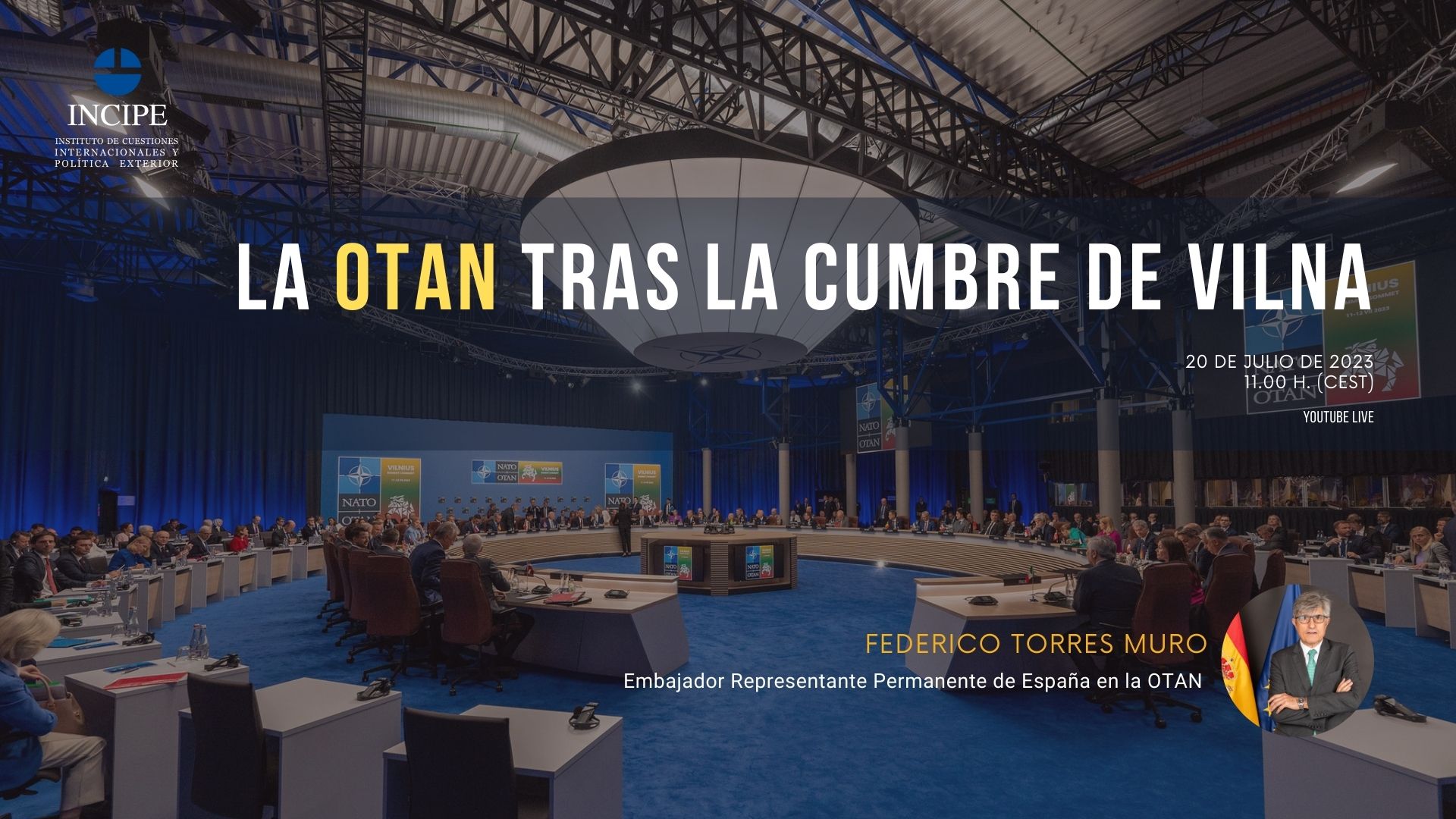
Federico Torres Muro began his speech by highlighting the overall success of this Summit, which brought together the heads of state and government of the 31 NATO members, along with Sweden as an invited state. Torres Muro explained that this Summit faced some situational challenges while also having to address more structural ones, focusing on the two main threats: the war in Ukraine and terrorism.
He then went on to outline the three sessions that took place during the Summit. The first session, internal in nature, served to approve the regional plans governing NATO’s activities. Additionally, the investment and defense commitment signed in 2014, known as the Wales Pledge, was renewed, reaffirming the goal of allocating 2% of GDP to defense investment. The Summit also approved an action plan to promote defense industry production and a multi-year plan to support Ukraine’s defense sector.
The second session focused on the Asia-Pacific-4 partners (Australia, South Korea, Japan, and New Zealand) alongside representatives from the European Union. This session analyzed the challenges and threats to the international order. The discussion covered China and NATO’s stance of remaining open to a constructive relationship while acknowledging concerns among allies, such as China’s arms race and its ties with Russia. It was also noted that the concept of security and defense is evolving; it can no longer be addressed solely from a geographical perspective, as new domains like cyberspace and outer space must also be considered.
In the third session, which included Ukrainian President Volodymyr Zelensky, the NATO-Ukraine Council was formally established. Additionally, in parallel, the G7 security arrangements were formalized, with several allies, including Spain, joining the agreement. These arrangements rest on three key elements: support for Ukraine’s defense sector, assistance for Ukraine’s economic stability and reconstruction, and financial and technical support to enhance good governance reforms. Ukraine, in turn, committed to strengthening transparency and implementing institutional reforms to reinforce the rule of law, democracy, and human rights.
Another key issue discussed at the Summit, in which Spain has a significant interest, is reflected in paragraph 22 of the final communiqué: the need to strengthen NATO’s policy toward the «southern flank.» To achieve this, two fundamental pillars were established: strengthening political dialogue and enhancing defense capabilities.
Regarding Spain’s role in the Summit, Torres Muro emphasized the country’s commitment to deploying new forces in Slovakia and Romania, reinforcing its contribution to collective defense, as well as its support for Ukraine through the aforementioned G7 agreement.
At the end of the session, a debate took place, with participants raising questions on topics such as Ukraine’s NATO membership, which is unlikely to happen while the war continues. Discussions also covered Turkey’s lifting of its veto on Sweden and its relation to counterterrorism efforts. Additional topics included NATO’s expansion to the east, Spain’s defense spending and public opinion, and the prospects for industrial cooperation within NATO, along with the need to coordinate and complement these efforts with the European Union.
Aranzazu Álvarez