
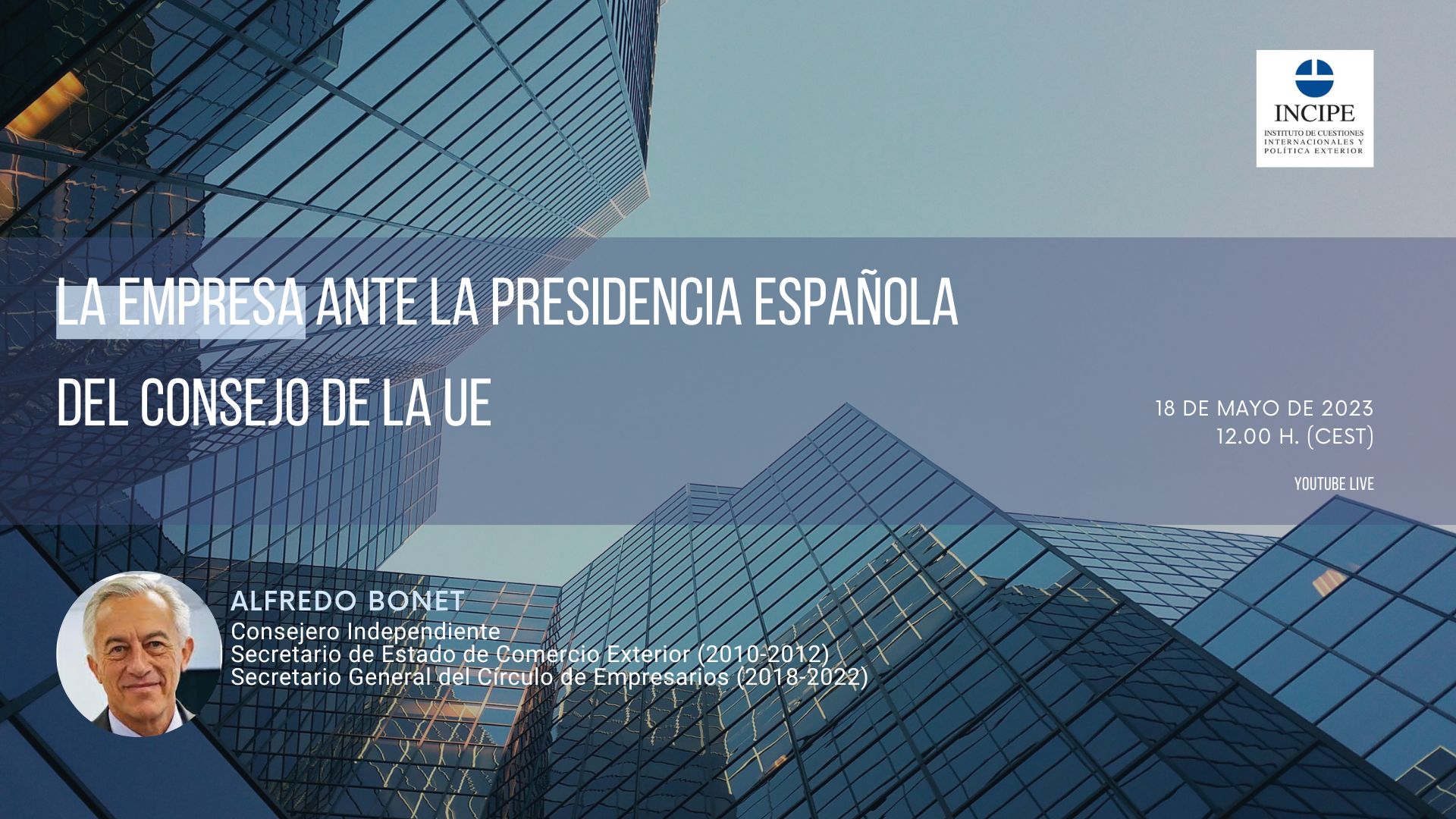
Alfredo Bonet began his participation by highlighting the differences between the Council of the EU in 2010 (the last time Spain held the EU Presidency) and the current context, in which Spain would assume the presidency starting July 1, 2023. During this period, major milestones have taken place within the European Union, such as the UK’s exit and Croatia’s accession, as well as the creation of the position of President of the Council—an office that did not exist in 2010 and now has the potential to influence the decisions of the countries holding the EU Presidency. Bonet made it clear that Spain would assume the Presidency during a challenging period, marked by a global economic crisis that has severely impacted the global market. He pointed out that countries holding the Presidency have the ability to influence the EU agenda. However, he noted that no explanatory document outlining Spain’s Presidency priorities had been made available, likely due to Spain’s ongoing electoral period, which could explain this lack of transparency.
Bonet continued by stating that the competitiveness of Spanish businesses is a widespread concern and is closely linked to the business environment in which they operate. While access to the international market is necessary, it is not sufficient for success in the global economy. European policy has a significant impact on competitiveness, both directly and indirectly. He also highlighted several key issues that will shape business competitiveness and the European economy in the short, medium, and long term. These include the state gas regime, the potential for a permanent EU budgetary capacity to finance strategic investments and macroeconomic stabilization, industrial policy, open strategic autonomy (including relations with Latin America), the digital transition, and the green transition.
To conclude his presentation, Bonet emphasized that ensuring business success requires improving the business environment to allow companies to fully develop their competitive potential. This involves addressing various factors affecting the competitiveness of the production model, such as protecting democracy, strengthening institutions to ensure legal security, and ensuring the proper functioning of labor and tax markets.
During the discussion, Bonet noted that the single market has been a great success and stressed the importance of maintaining the liberal economic system. He reiterated that competitiveness is affected by government subsidies and advocated for the reestablishment of fiscal rules that promote fair competition. Regarding the pandemic, he acknowledged that state intervention was justified at the time. However, once the emergency subsided, governments should have returned to normal regulations and gradually phased out the protectionist measures implemented during the crisis.
On relations with Latin America, Bonet expressed the business sector’s interest in finalizing agreements such as Mercosur, Chile, and Mexico to establish predictable and reliable trade relations. Regarding relations with China, he acknowledged the complex situation caused by the rivalry between the United States and China, which leaves the EU caught in the middle. While he recognized that EU interests align more closely with those of the United States, he pointed out that China generates large trade surpluses with its partners while showing little reciprocity by not opening its markets to imports.
Finally, Bonet addressed questions regarding the impact of the inflationary spiral faced by the European Union and, in particular, Spain. He explained that inflation inevitably reduces competitiveness, although its impact has been mitigated to some extent because the crisis has been widespread. Nevertheless, he emphasized the importance of a swift recovery to make a difference and positively impact the country’s economy.
Danela Bordones
Asistente de comunicación, INCIPE