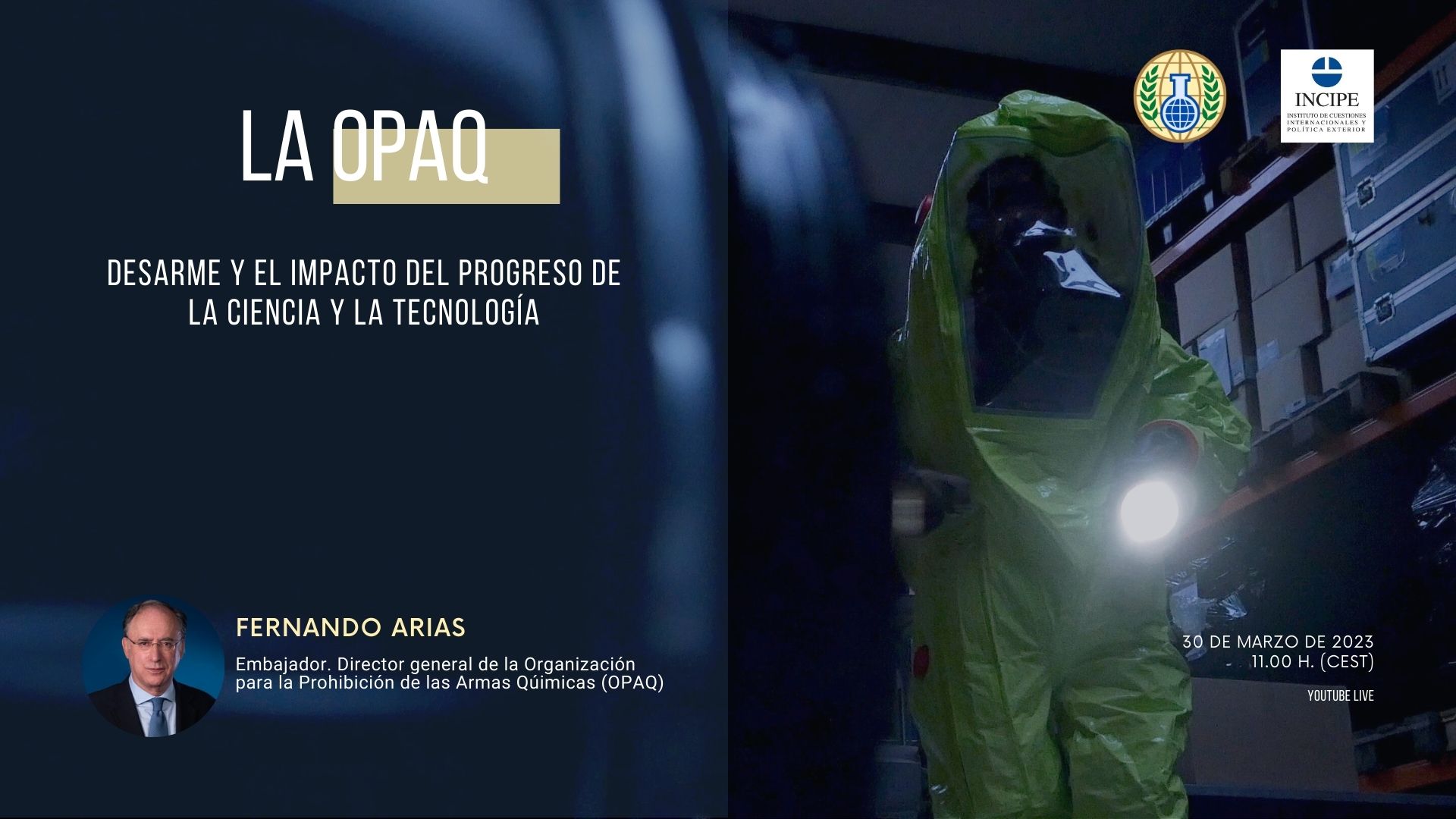
Fernando Arias begins by highlighting that the world is experiencing significant deterioration in international security. He provides a historical overview, emphasizing that the Chemical Weapons Convention came into force in 1997, marking a historic milestone in international law. This convention was essential, as during World War I, more than 100,000 tons of chemical agents were used, resulting in over 90,000 soldier deaths. Over the 26 years of the OPCW, nearly all declared chemical arsenals have been destroyed, a success recognized with the Nobel Peace Prize in 2013.
The OPCW comprises 193 member states, making it the disarmament treaty with the highest number of signatories. However, the continuation of its success is not guaranteed, as chemical weapons have been used in recent years in Iraq, Malaysia, the United Kingdom, Russia, and Syria. Another critical issue is the war in Ukraine, where there are fears and threats regarding the use of weapons of mass destruction, including chemical weapons. The OPCW has a dedicated team that continuously monitors the situation in Ukraine.
For Fernando Arias, ensuring the prosecution of those responsible for the use of chemical weapons is a crucial additional step in strengthening the regulations against their use. Following the fall of the Berlin Wall, there was an atmosphere of optimism and international openness, with constructive positions in multilateral diplomacy. However, since then, international cooperation has significantly weakened. While the work accomplished over the years is undeniably significant, unfortunately, the OPCW has already embarked on a new and challenging path even before the complete elimination of chemical weapons. In the current climate of heightened tensions among major states and even active warfare, most treaties in this field are no longer in force or are not effectively implemented.
Scientific and technological advancements in recent years have facilitated the development of new chemical agents, new methods of deployment, and new production techniques. Additionally, many armed forces possess armed robots, drones, and powerful computer programs that can be militarized to efficiently transport and disperse highly dangerous chemical agents.
Furthermore, the chemical industry frequently and legally uses substances known as dual-use chemicals. These substances serve peaceful purposes, but their production, commercialization, transport, storage, and use must be strictly regulated to prevent their diversion for illicit purposes, such as terrorism. The OPCW’s new Chemistry and Technology Center, set to be inaugurated soon, addresses this need by providing a high-quality platform for collaborative scientific research, modern laboratory analysis methods, and specialized training for the organization’s inspectors.
In response to questions raised during the discussion, Fernando Arias stated that 240 inspections are conducted annually to advise the chemical industry and ensure compliance with procedures that prevent dual-use chemicals from falling into the hands of terrorists or unauthorized entities. At the same time, safe methods are recommended to prevent accidents and protect the health of those handling these substances. According to Arias, the key to the OPCW’s work is adaptation. Under the Convention, the Secretariat cannot initiate an inspection based on suspicions of a chemical weapons attack; it can only do so if a member state requests it and submits it to the Executive Council. Terrorism is a pressing concern, but it is up to states to implement national legislation and enforce the Chemical Weapons Convention. Without specialized domestic legislation, the Convention cannot be properly enforced.
Universality remains a priority, as established by the member states. One of the organization’s ongoing objectives is strengthening relations with civil society and the academic world. Through the new Chemistry and Technology Center, the OPCW aims to create a network of individuals and institutions interested in collaborating and participating in joint international cooperation programs. Over the next decade, the OPCW’s greatest challenge will be the advancement of science and technology, as well as fostering mutual understanding among the most influential member states.
Jaime Osorio
Asistente de comunicación, INCIPE