
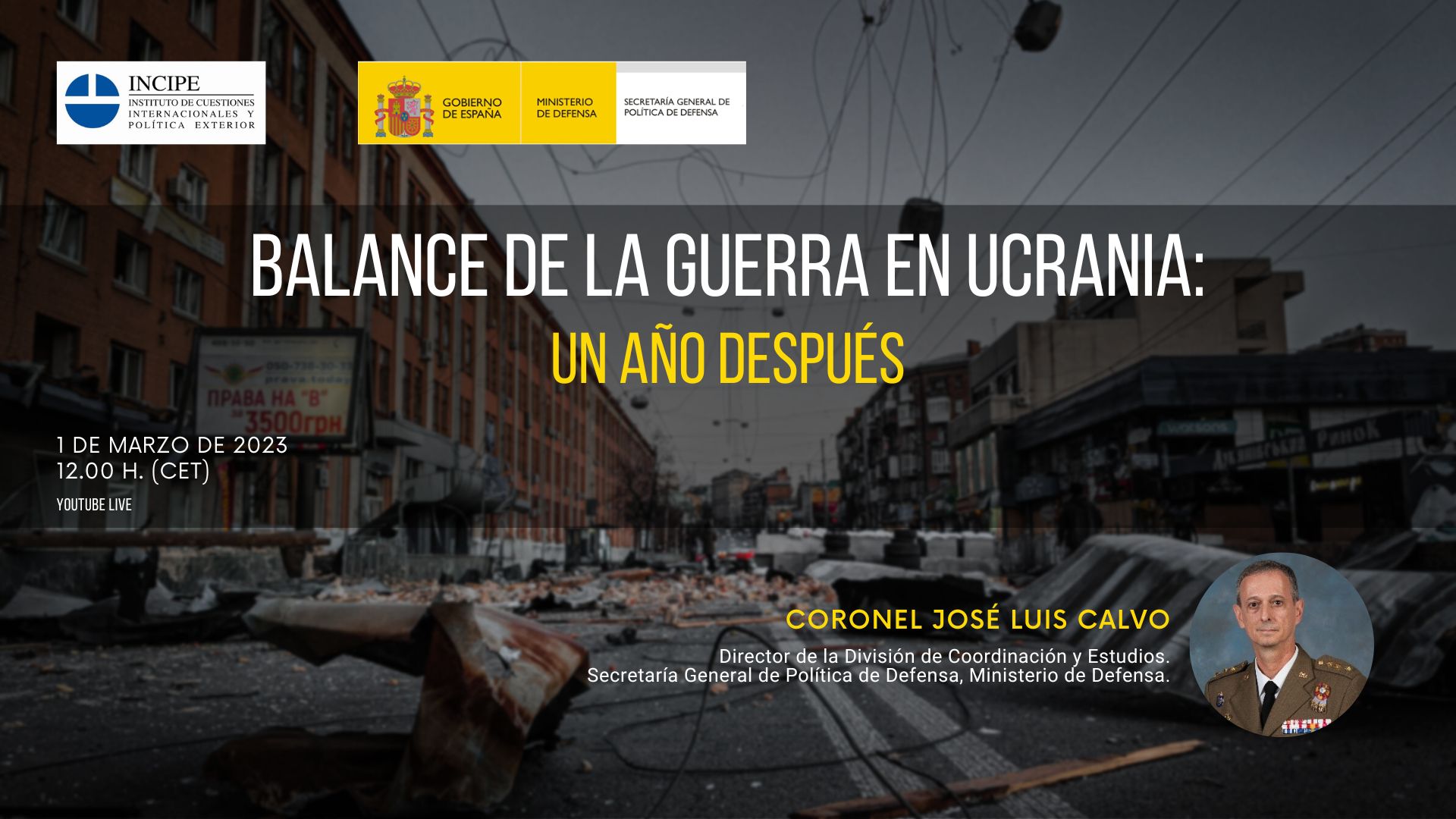
Colonel Calvo begins by stating that the war in Ukraine was surprising from the very beginning, as it was initially thought to be only a Russian pressure maneuver. Nothing like it had happened since World War II in terms of the scenario, and concepts such as mobilization, which were thought to be outdated, were being brought back. He also mentions that Ukraine survived due to Putin and his leadership’s overconfidence: they believed that the Ukrainian will to resist would be weak and that the state would collapse, and they did not anticipate the demonstrated will to fight. Furthermore, it is significant that between 2014 and 2022, Ukraine improved its intelligence capabilities, defense core, and civil networks, and it was backed by international solidarity.
Continuing on this issue, José Luis Calvo observes that Russian operations show planning, command, and control flaws, as they thought the operation would last only a few days. The Russians are unable to gain air superiority, and the reason remains unclear, in addition to their failure in the hybrid aspect (cyberattacks) and the irregular morale of their troops. He further states that at the core of defense lies the individual (an aspect that the Ukrainians have paid more attention to) in both the moral and professional spheres, followed by the system core (capabilities) that enables the force to operate, and finally the platforms, which must perform at the highest level. He also clarifies that defense is not only about armed forces, as infrastructures like Ukraine’s railway system have been essential, and it is crucial to win the information and connectivity war by dominating the battle for credibility.
The colonel continues by establishing that, when it’s over, Russia will remain relevant, and international balance will need to be rebuilt, while NATO has emerged much stronger, and the European Union, though needing to strengthen its strategic autonomy, has acted with more vigor than expected. He also notes that the military balance of power is shifting toward Eastern Europe (although the south should not be forgotten), and clarifies that nuclear weapons represent a very high level of security and defense escalation, making their use unlikely unless Putin feels irreparably threatened. Regarding the war’s end, the colonel states that there are currently few prospects for immediate negotiation, and the impression is that both sides expect to gain advantages on the battlefield before sitting down to reach an agreement.
In response to questions raised during the debate, José Luis Calvo expresses that the Leopard tanks being sent to Ukraine from Spain were not operational and do not detract from National Defense, as they were not in use. The currently employed model in Spain, the A6, has not been sent and will not be sent. Sending F-16 or F-18 aircraft would also not make a difference in the short term, as it would take months for these air units to become operational. The policy is to provide what is necessary while affecting National Defense as minimally as possible. Regarding China, this country may conclude that the West is capable of reacting more cohesively and energetically than previously thought, and that this could also happen in the event of a crisis in Taiwan.
The colonel’s final points summarize that Russia’s suspension of the START agreement is symbolic, and that Turkey’s role as the most successful mediator so far is highly relevant due to its control over access to the Black Sea. He mentions that the Wagner Group is playing a tactical role, although it is suffering many casualties, and specifies that support is being given to Ukraine to restore its dignity as a state, trying to prevent an imposition by force from Russia. On his part, INCIPE’s Secretary General Manuel Alabart concludes by emphasizing that there are many unresolved questions, demonstrating the uncertainty and concern evident in this conflict.
Jaime Osorio
Asistente de comunicación, INCIPE