
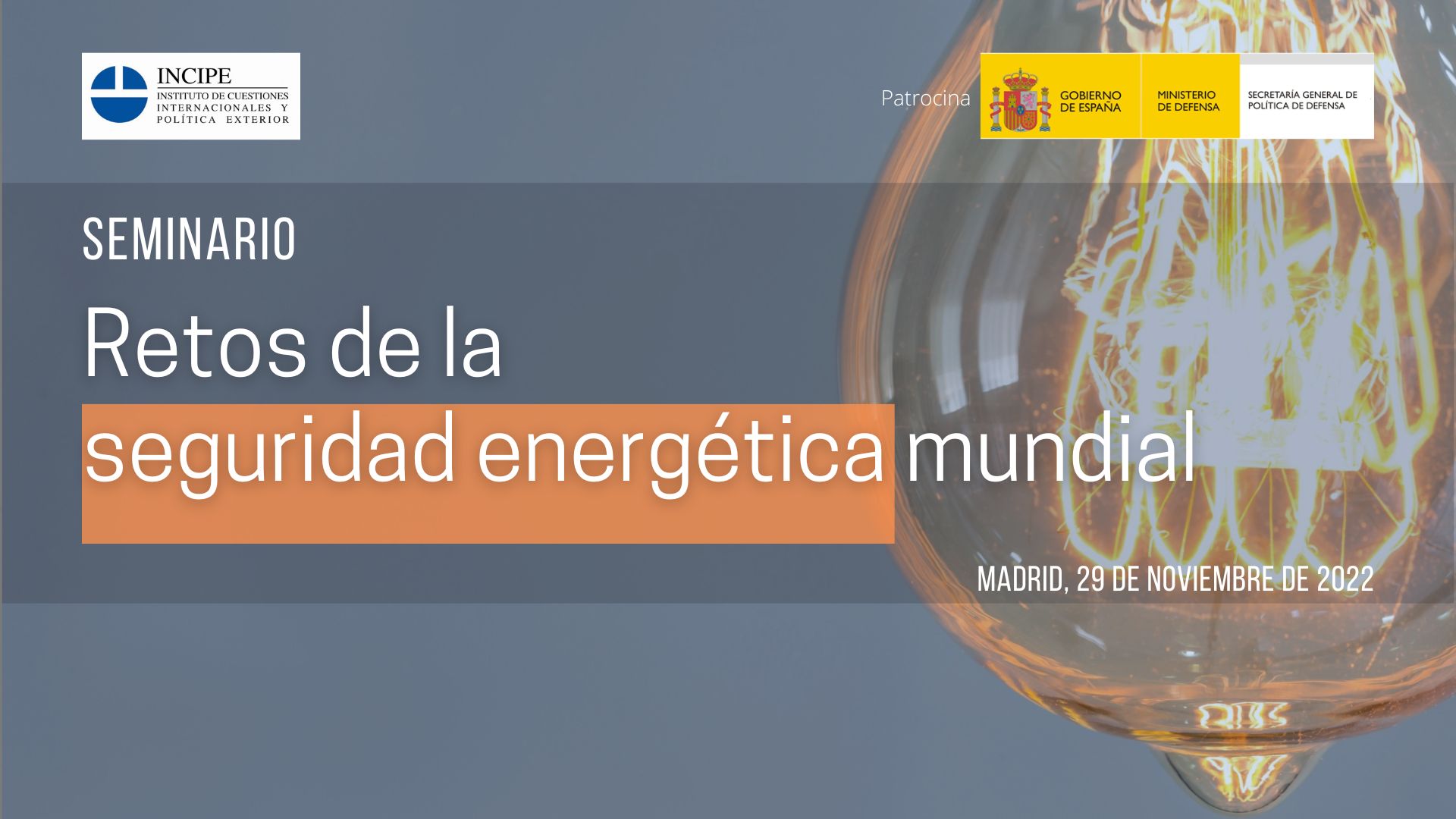
The event consisted of two roundtable discussions. The first, titled Geopolitics and Geostrategy in the Era of the Energy Transition, was moderated by Vicente Garrido, Director General of INCIPE. The participants were Colonel José Pardo de Santayana, Research Coordinator and Senior Analyst at the Spanish Institute for Strategic Studies (IEEE); Sonia Velázquez, Deputy Director at the General Subdirectorate for International Relations, Ministry of Transport, Mobility, and Urban Agenda; and Captain Francisco Ruiz, Head of the European Union Area at the General Directorate of Defense Policy, Ministry of Defense. The second roundtable, Current Trends in the International Energy Market, was moderated by Silvia Iranzo, Board Member of INCIPE and former Secretary of State for Trade. The participants were Bill Richardson, former U.S. Secretary of Energy and former U.S. Ambassador to the United Nations; Adrián Lajous, former Director General of Pemex (Mexico) and Board Member of the Oxford Institute of Energy Studies; and Ramón de Miguel, Board Member of INCIPE, Ambassador of Spain, and former Director General of Energy at the European Commission.
Antonio Notario, Head of the Strategic Planning Unit at the Department of National Security, spoke, describing energy vulnerability as the greatest security threat to Spain’s national security. His intervention was structured around three key ideas:
- Energy security as an area of special interest for national security, requiring specific attention to preserve citizens’ rights and freedoms. It is a matter of state that requires a long-term vision («intergenerational heritage») and has a transversal nature (requiring enhanced interdepartmental coordination).
- The integral concept of energy security in its triple dimension: supply security, environmental sustainability, and price acceptability. The National Energy Security Strategy of 2015 was the first political-strategic document in Spain to incorporate a 360-degree view of energy security.
- Spain’s commitment to accelerating the objectives of the energy transition currently in place. This will be done with the new Energy Security Strategy to be published in 2023, based on three goals: greater energy efficiency and savings; greater strategic autonomy and penetration of renewable energies into the mix; and greater supply security through geographical diversification and the geopolitics of materials.
Antonio Notario outlined the key points of the National Energy Security Strategy of 2015. In addition to the aforementioned, it established Spain’s own energy profile with its weaknesses and strengths and adopted a position of solidarity-based European openness favoring the single internal market. Notario also emphasized the need to adapt it to the new hybrid scenario, with the penetration of renewable energies, the outbreak of the war in Ukraine (and the use of energy by the Russian Federation as a geopolitical weapon), and a complicated landscape for investment in long-term energy infrastructure.
Geopolitics and Geostrategy in the Era of the Energy Transition
Colonel José Pardo de Santayana opened the first round table with his intervention, announcing that the current geopolitical context is unfavorable to the energy transition, as well as the need for transition and security to go hand in hand. This geopolitical friction will inevitably continue in the coming decades, with China pursuing the configuration of an international system aligned with its interests, and this current decade being decisive for the achievement of energy security objectives. We are living in a turning point, where multiple transitions (geopolitical, social, and energy) have come together, bringing an element of uncertainty that complicates the energy transition. Pardo de Santayana points out that we are transitioning from a world centered on the diversity of sources to one with less supply diversity in order to ensure energy security.
In a world where demand for oil and gas is decreasing, it is more likely that this production will become even more concentrated in the few countries that produce it at lower production prices, with the Middle East gaining geopolitical influence. The global energy transition is an enormous challenge, especially in the less developed world, where it is even more transcendental. Energy security depends on a world that is increasingly distant from the developed world, and without its commitment, these objectives cannot be achieved. Finally, he emphasizes the importance of investment, which should be made in greater proportion into renewable energies than into fossil fuels, but that must not neglect the latter for fear of creating a volatile scenario with soaring prices. In this context, and unlike before, Spain finds itself in a more consolidated and favorable position compared to neighboring countries in terms of energy security.
Sonia Velázquez highlights the increased relevance of the concept of energy supply security (both at the national and citizen levels) over sustainability in the latest Climate Summit, COP27, held in Egypt. She states that countries must find a way to balance innovation in sustainability and energy efficiency, the energy transition (with natural gas and nuclear being the most common alternatives), and traditional energy security (with all the weight of coal and oil) for the economy and society. All of this underscores the importance of independence as a geopolitical instrument. Having made this point, Sonia Velázquez reviews the sources that could be key to achieving this commitment goal. She asserts that, although it is undeniable that renewables are the future and need investment, they are not yet ready to provide the energy security we need. This does not mean abandoning them but advancing, complementing, and analyzing their future risks. Starting with biomass, while it is a sustainable and powerful renewable energy source, it must be balanced with food security. The same applies to green hydrogen, whose use must be balanced with the scarcity of freshwater, or solar energy, with the waste generated by the panels and the need for environmental improvement.
Regarding nuclear and gas energy, she poses the following question: «How are we going to balance how much to invest, for how long, and in which energies until they are no longer profitable?» We must consider that both require expensive infrastructure that takes years to amortize, which is difficult to reconcile with the push for renewables. This is undoubtedly a central problem in the energy transition. Regarding gas, she also points out its polluting nature, so it cannot be used as a primary choice but rather as a backup for renewables.
Finally, in the developing and underdeveloped world, the need for supply and energy autonomy at affordable prices drives the demand for traditional fuels: oil and coal (with China being a leader in the latter and the mining sector as a whole). In the Western (Anglo-Saxon) world, coal is the enemy to be defeated, the most polluting energy, and its demand for reduction is difficult to impose on other countries. Even in the EU, Poland and Germany have not completely moved away from coal. Finally, she reminds us that infrastructures are vulnerable to attacks, and their security in the classic sense must be guaranteed.
Closing the first table, Captain Francisco Ruiz focuses mainly on the geopolitics of gas. He first defines Energy Security as an adequate supply from the perspective of security and transportation networks. Other factors that contribute to it include affordable prices, environmental security, and facility security, understood as physical security. Two factors contribute to strategic autonomy: not depending on external sources and reducing consumption, for which decarbonization is important, but care must be taken with how its pace and socio-economic impact are modeled. Primary energy consumption has continued to grow worldwide except during the crises of 2009 and 2020, with coal still occupying the dominant position. Coal is gradually decreasing, replaced by natural gas. Hydroelectric, nuclear, and renewables are progressively growing, but none reach 10% of the mix, still far from the global model that is intended to be reached. Currently, over 60% of China’s electricity is generated with coal, with other technologies being virtually residual, and we question whether the West can compensate for this situation. In Europe, this is reduced to 16%, presenting a much more favorable but still imperfect panorama, especially in Poland and Germany, where coal burning has increased since the onset of the conflict in Ukraine. In line with Sonia Fernández, he indicates that the use of gas for electricity generation will, although decreasing, still play a key role in supporting the intermittency of renewables.
Regarding the geopolitics of gas, Francisco Ruiz points out that the U.S. has increased its production by 50% in 10 years with shale gas, being a large consumer but also an important exporter, especially in LNG. Russia’s increase has been much lower (around 14%), with lower consumption and a large surplus for export. Regarding the Caspian, Azerbaijan cannot be seen as an alternative to major suppliers like Russia or Algeria due to its limited export capacity. Turkmenistan, for its part, is also not viable, not only because of the difficult logistics but also due to China’s competition as its main importer. In Europe, Norway, thanks to its small population, has a huge surplus to export. However, in general, the North Sea fields are progressively depleting, reducing Europe’s overall production by 25% in the last 10 years. Algeria increases by 26%, with a surplus of 55 bcm to export mainly to Spain and Italy via pipeline or LNG. Ultimately, Europe’s deficit, in the pre-Ukrainian war context, could be covered by pipelines from Russia, Norway, and Algeria, backed by LNG plants via sea routes; with the Caspian being insufficient. The price of this gas ensured its pre-feasibility by being linked to oil prices. Regarding spot LNG markets, while it guarantees flexibility, it contains greater uncertainty due to its diversion to other markets and requires the construction of plants. 30% of regasification plants are located in Spain, but they lack the capacity to reach the rest of Europe due to Spain’s energy island status.
In any case, the global gas trade model is gradually moving towards LNG, a scenario that Russia has anticipated in its need to disconnect from the fixed clients it previously traded with via pipelines. In the EU, Russia’s presence as the largest natural gas supplier in 2021, at nearly 40%, has been decreasing in favor of the UK and the U.S., which consolidated their presence in the second quarter of 2022. Geopolitical tension has led to Russia’s ability to send gas via pipeline decreasing exponentially, redirecting to China as its main customer, where, after the first pipeline (Power of Siberia), another is being considered along the border between the two countries, between Mongolia and Kazakhstan.
What will Europe do to replace Russian imports? The key now lies in replacing most of the gas demand with renewables, but in the short term, alternative sources are needed: Canadian, U.S., Gulf of Guinea, and limited Azerbaijani LNG, coordinating with other LNG buyers such as Japan, China, and Korea. It is crucial for Spain to restore the energy dialogue with Algeria. Europe must lead and drive the energy transition but adapting the pace to what it can and must do.
Current Trends in the International Energy Market
Bill Richardson opened the second roundtable with key considerations on the recent Climate Summit. The historic agreement to create a support fund to assist the countries most affected by climate disasters caused significant controversy among wealthy nations, who feared being held indefinitely responsible for the damages caused to their economies. The concept was thus developed not to hold any country accountable for damage resulting from past emissions. Slow progress was also observed toward emission reduction goals, now seen not as a matter of cooperation but of justice. The unfulfilled promise by developed nations to contribute 100 trillion dollars was used by developing countries to convince the international community of the need for a formal financial vehicle. The acceptance of the fund marked a shift in U.S. policy, but Richardson notes that the recent changes in Congress and the Republican rise put the achievements made at COP at risk. Regarding the failures, Richardson points out that no progress was made in phasing out fossil fuels or achieving the 1.5ºC global warming target, which had been priorities until last year. Factors such as the use of coal in Europe as a substitute for Russian gas or supply chain disruptions explain this shift in international climate change policy.
This shift in focus at COP27, from an optimistic perspective, represents a huge achievement, but also an acknowledgment by the global community of its failure to prevent the greatest catastrophes yet to come. In other words, it is a tacit acceptance of the shift from an era of prevention to one of consequences. In conclusion, while COP27 is important, the failures could prevent the major goals that have been part of the last 27 years of meetings.
Several factors are crucial to understanding the current international energy market. The shutdown of industrial plants in China and around the world due to the pandemic caused a significant drop in oil demand. With the resumption of industrial activities, oil production lagged behind the rising demand, which increased prices and generated worldwide inflationary spikes. This was exacerbated by the Russian invasion of Ukraine. The transition to renewable energy is a process that leaders must accelerate to ensure global peace and stability. Renewable energy generation continues to grow, concentrating unprecedented investments. The use of artificial intelligence to integrate various types of renewable energy into the transmission system has grown significantly, enabling the design of prediction systems and connecting more renewable plants to the transmission grid. The countries responsible for most emissions appear to remain committed to goals aligned with COP, notably the U.S., the EU, and China.
Over 80% of Millennials support their governments implementing sustainable energy policies, and 50% of this segment considers it important to work with companies that address sustainability challenges. New innovations in renewable energy seem to show that the instability Europe is suffering due to the energy crisis caused by the war in Ukraine is only temporary, urging investments in renewables that will lead us to energy independence.
Adrián Lajous, who participated remotely, emphasized that the complexity and depth of the energy transition are being deeply affected by immediate events contributing to instability. Under these conditions, making high-risk, large-scale decisions that alter relationships between countries is particularly difficult but essential. These risks must be recognized coldly without falling into paralysis due to excessively pessimistic analysis. Not only must the crisis be managed, but it must also be leveraged to generate long-term changes.
Demand for crude oil and petroleum products will continue to slow down, with factors such as the European energy crisis, lower global economic growth in 2023, and the persistent economic weakness of China. Supply will grow, albeit very slowly. The OPEC+ agreement with Russia to reduce production by 2 million barrels per day will, however, result in a much smaller effective reduction as most members of the organization did not alter their production. Russian production will decrease slightly in the last quarter of 2022 and by about 1.5 million barrels in 2023, although this is highly uncertain due to the effectiveness of sanctions. Part of these reductions will be compensated by an increase in U.S. production.
Regarding the immediate future, Lajous highlights the imposition of a price ceiling on crude oil, the level of which will be determined this week, and the potential adoption of a maximum gas price in Europe. The sixth sanction package from June 3, including a partial embargo on Russian crude imports, is expected to eliminate such imports by the coming Monday and petroleum products starting on February 5, 2023, though some exceptions will be made for countries highly dependent on Russian products with no alternative storage options. It also included the ban on European companies providing services related to the transportation of Russian oil, making it difficult for Russia to redirect its products elsewhere. The third element of the sanctions package included the establishment of a price ceiling on Russian seaborne crude exports. This will allow Russian crude to continue flowing out of Europe, but at a lower price, thus limiting its oil revenues and giving the West greater control over global inflation.
The development of Russian natural gas imports to Europe was based on mutual trust derived from a premise: both Russia and Europe depended on gas flows and foreign currency revenues generated. This guaranteed stability and encouraged growth for years. In 2022, mutual trust between Russia and Europe disappeared and will take a long time to restore. The collapse of Russian gas exports poses significant challenges for Europe, especially for Germany, the Czech Republic, Austria, Hungary, and Slovakia, countries that are particularly dependent. If current conditions persist, the situation could be catastrophic in the winter of 2023-2024 for this subregion, leading to the need to moderate demand. Likewise, the situation in Europe could affect the gas market in distant regions. For example, the European demand could be met through liquefied gas imports from the U.S., which had previously been directed to China but could be diverted due to low demand caused by COVID in that country.
Closing the second roundtable, Ramón de Miguel focused on the European situation, which he considers limited to the space. The issue of gas shortages particularly affects developed societies accustomed to a high standard of living and a deep commitment to reducing greenhouse gas emissions. Moreover, it is a problem limited in time; demand is strong, and supply has fallen. Therefore, it is a cyclical issue, not structural, since markets will stabilize, with some productions being replaced by others.
The world woke up from the pandemic with high gas demand, and prices began to rise in August 2021. With the war in Ukraine, the disruption of supply highlighted how European powers had ignored the risk of future shortages. Ramón de Miguel notes that Germany has never wanted to confront its dependence on Russia, as it suited their vision of the great European plain. Renewables have not developed enough to replace this demand, while gas production in the UK and the Netherlands has fallen to negligible levels. LNG had been neglected during times of abundance, except in the Iberian Peninsula where there were no other alternatives due to its energy island status. The excess supply cannot be exported due to French opposition to interconnections.
Ramón de Miguel adds that there has been a gradual elimination of nuclear energy in Europe and a decrease in hydroelectric production, partly due to a dry period, while renewables are developing at a relative pace due to slow administrative processes. Therefore, he summarizes that the main challenge lies in the internal market. It is incomprehensible that Europe does not have an internal gas and electricity market that flows and functions. If it existed, distortions could be reduced and would only require market liberalization, as well as the separation between transport and commercial networks, known as unbundling. France’s opposition to this prevents its implementation in the region.
In conclusion, Ramón de Miguel points out that the potential lies in the European Commission, which has two fundamental functions that make it unique in the world under the Treaty of Rome: the exclusive right of initiative and a duty it does not fulfill, that of being the guardian of the treaties and secondary law. If it truly fulfilled its obligation, it should open a procedure against France for not respecting the internal market directive before the EU Court of Justice, which would allow the system to be unblocked once and for all.
Sofía Provencio
Communication Assistant, INCIPE