
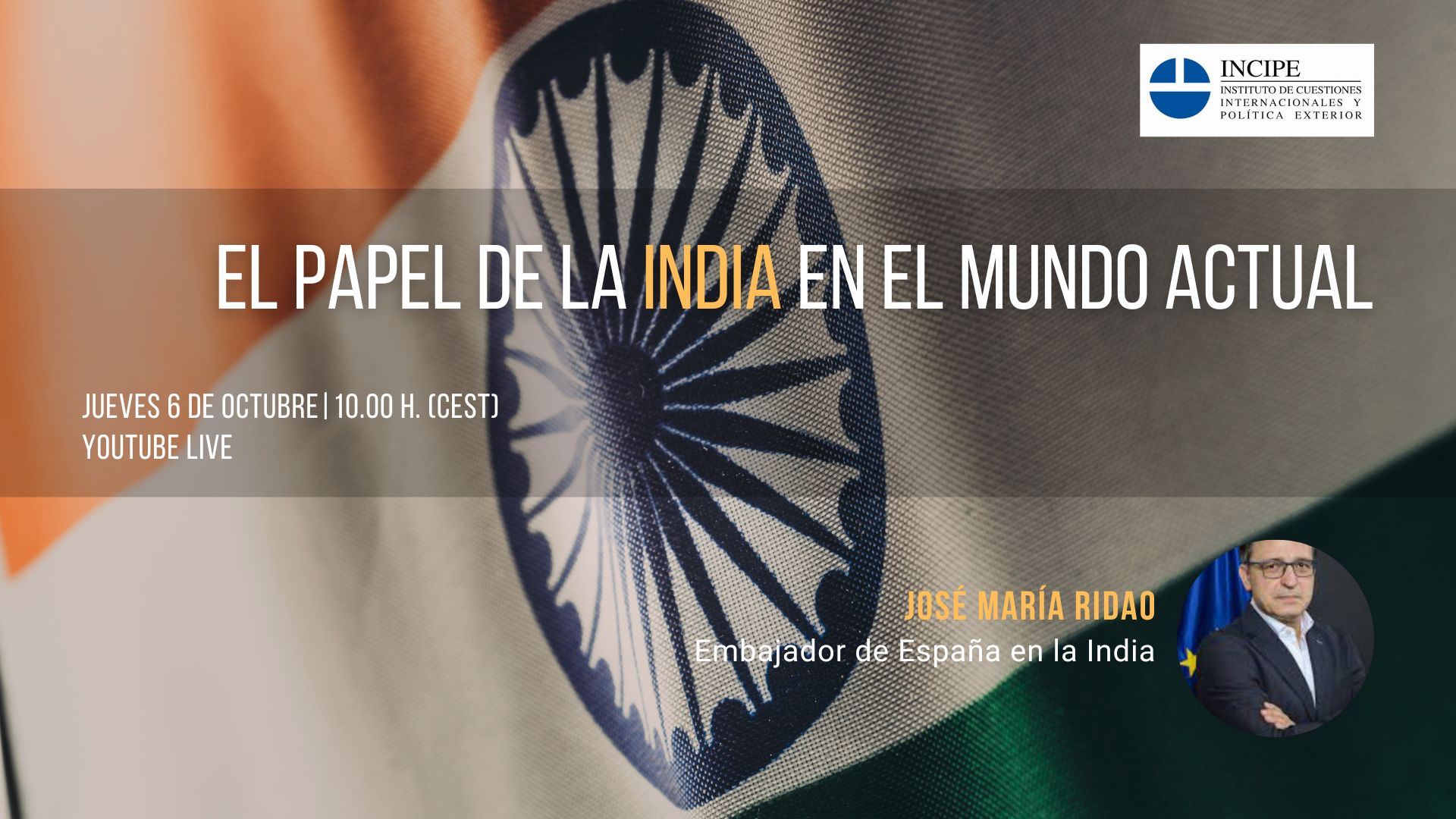
Ambassador José María Ridao began his presentation with a brief reflection on the complexity of India, understood as a vast array of phenomena and realities, not as irrationalism. To approach the country, Ridao emphasizes the importance of understanding the persistence of colonial traces, both the exploitation of resources and, especially, the European ideological worldview.
James Mill’s work The History of British India will permeate both national and international spheres with its idea of dividing the country into two identifiably divergent nations: Hindus and Muslims. This carries with it the transfer of a purely geographical and theological umbrella concept (Hindu) to one of a single creed, discarding the plurality of religions that the concept initially embraced. It also implants a mistaken image of Muslim pretensions to legitimize political power, to which, however, most of the Hindu umbrella’s faiths did not aspire. The immense plurality of beliefs and castes led Gandhi to find a unifying discourse against colonial power, protecting the most marginalized, the untouchables, as a fifth caste alongside the four traditional ones. However, this theological and political revision would not include the Muslim creed, which, together with the previously mentioned idea of a national division, paved the way for the creation of Pakistan.
José María Ridao insists that the profound mark of the partition, still open, cannot be explained without the figure of Nehru, who, unlike other colonial peoples, linked the anti-colonial struggle with the democratic and constitutional aspiration. Since 1947, and despite the federal and central dominance of the Congress (or INC), the wear and tear of the party and its constitutional proposal would open the way to Hindutva or Hindu nationalism, opposed to the Muslim nation. The inevitable wear of the system would lead in 2014 to the revitalization of the proposal with the victory of the Bharatiya Janata Party, led by Narendra Modi.
Ridao emphasizes how Nehru’s constitutional rethink would permeate the country’s foreign policy through the Non-Aligned Movement during the Cold War. With the dissolution of the Soviet Union and the transformation of the international landscape, India required a new positioning; remaining in an analytical limbo until the definition of a new policy with the arrival of Subrahmanyam Jaishankar at the Ministry of External Affairs. Reformulating Nehru’s non-alignment policy, Jaishankar promotes a multilateral approach, opening the country’s cooperation channels in a multipolar world to maintain its strategic autonomy. This comes with a commitment to the United Nations Charter but also with a demand for reform within the organization. In recent years, the search for new operational regional and extra-regional structures has marked India’s foreign policy, with the Ambassador highlighting the QUAD and the Shanghai Cooperation Organization.
Among the fundamental crises that India has had to face in recent times, José María Ridao highlights those in Afghanistan and Ukraine. The U.S. withdrawal from Afghanistan reignited the wound of the partition with the apparent victory of Pakistan and the defeat of the great democratic country. Pakistan presented itself as a potential communicator with the Taliban, rising as a first-rate international power. However, this sensation was short-lived, with India dominating the Indo-Pacific board in a matter of months through a skillful framing strategy and backing in multilateral forums and the United Nations, rather than through bilateral approaches. The strategic problem of Afghanistan was thus reduced to a de facto security issue.
Regarding the Ukraine conflict, while it is true that India depends on Russian defense material for 70% or needs access to energy supply markets, it should not be forgotten that India prioritizes its strategic autonomy. José María Ridao invites us, therefore, to avoid seeing things in black and white, paying attention to the multilateralism that defines the strategy and which continually guarantees favorable results.
To conclude, the ambassador raises two questions: Are we facing an enormously large country or a great power? Is India an international power per se, or does its new role stem from its undeniable importance in the Indo-Pacific? Regardless, what is undeniable is that «India is one of the countries with sufficient conditions to lead the international community, as long as its internal policies are appropriate and its foreign policy continues to develop with intelligence,» Ridao concludes.
Sofía Provencio
COmmunication Assistant, INCIPE