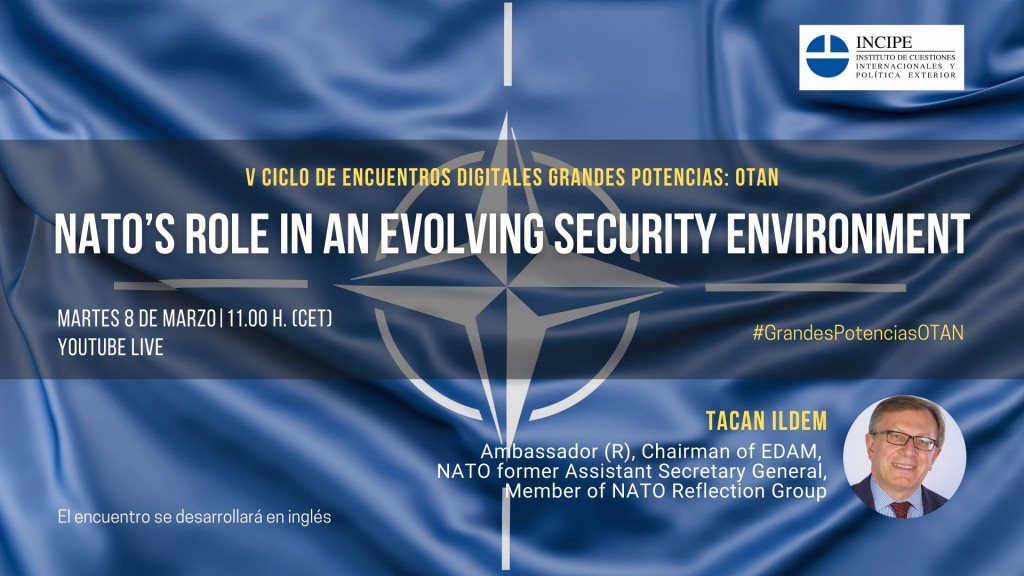
Tacan Ildem began his speech by highlighting the significance of the NATO Summit to be held in Madrid in June. During the summit, the Alliance’s new Strategic Concept will be presented, along with discussions on how NATO can strengthen its security capabilities to prepare for current and future threats.
The renewal of the Strategic Concept is primarily driven by a fundamental change: the environment. The current concept has been in place since it was approved at the Lisbon Summit in 2010, and the security landscape is constantly evolving. Therefore, the Alliance must be prepared for new scenarios. Ambassador Ildem referred to the Leaders’ Meeting held in London in December 2019, where NATO’s Secretary General established the Independent Reflection Group with the aim of providing recommendations on how to strengthen the Alliance’s unity and identify future threats that NATO will need to address in various areas of work.
Regarding Russia, NATO has adopted a dual-track approach since 2014. On one hand, it has strengthened its defense, while on the other, it has maintained political dialogue with Russia through the NATO-Russia Council, established at the Rome Conference in 2002. Concerning the current situation in Ukraine, EDAM’s predictions suggest that Putin aims to create a corridor linking Mariupol, Donetsk, Luhansk, and Crimea, extending it to Odesa to prevent Ukraine from having access to the Black Sea.
To conclude, Tacan Ildem emphasized the idea that NATO needs a more global vision while remaining a regional organization. Global threats, such as climate change, affect all countries, and global measures must be developed to effectively address these challenges.
Marta Herranz
Communication Assistant, INCIPE