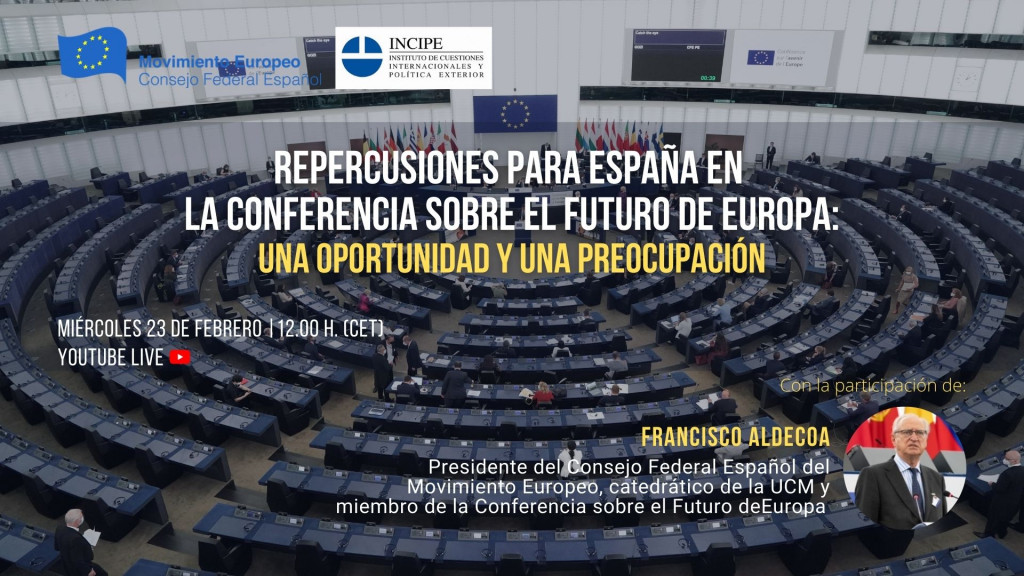
The session was conducted in Spanish and brought together an audience interested in understanding the importance of the conference on the future of Europe. To this end, we had the participation of Francisco Aldecoa, a member of the Spanish Federal Council of the European Movement and a representative in the Conference on the Future of Europe for national events and civil society in Spain. During the session, Francisco Aldecoa presented a detailed analysis of the opportunities arising from the conference, as well as the main concerns about its functioning.
Francisco Aldecoa began his speech by highlighting the main opportunities that emerge from this new political process. According to the speaker, the conference marks a moment of profound change in the European project, as it is an innovative exercise carried out through the participation of representatives of institutions, civil society, and citizens. It takes place in a political cycle that began after the European Parliament elections in May 2019, in which significant changes were introduced to the European political process, mainly due to the unprecedented support received by Ursula von der Leyen’s Commission (70% of the chamber). Furthermore, the 2019 elections were accompanied by an increase in voter turnout, which implies greater legitimacy for the entire process and the institutions.
Aldecoa highlighted how the Commission addressed the challenge posed by the pandemic by presenting the European Parliament with the bold proposal of the recovery plan, which received 60% support from the chamber and aimed to tackle not only health difficulties but also the social, political, and economic consequences of COVID-19. Moreover, it was one of the first federalist measures of the Union, as it established the allocation of funds based on the needs of each member state. This fund was later named ‘Next Generation EU,’ with the clear intention of creating jobs for young people, at least in its early years, given that they will be responsible for repaying the initial debt incurred by the recovery plan funds.
The speaker also mentioned other extraordinary measures promoted by this Commission, all of which serve as proof of its unprecedented legitimacy, such as the doubling of the multiannual budget (to 2%), the European vaccine procurement and distribution plan, or the adoption of the COVID passport in record time.
This new opening of the European process gives rise to the need for the conference. In her inaugural speech, President Von der Leyen committed to promoting it with the aim of receiving proposals and fostering dialogue between institutional representatives, citizens, and civil society, with the process open to treaty changes and active youth participation.
Here, Aldecoa pointed out, is where the first issues arose. Firstly, the proposal could not be launched in 2020, the year it was initially planned. This was partly due to the pandemic but mainly resulted from a lack of communication between institutions and a lack of consensus regarding the presidency of the organization. The latter was not resolved until 2021, when the idea of a co-presidency among the presidents of the Commission, Parliament, and the EU Council was proposed. According to Aldecoa, the co-presidency has led to a lack of leadership, resulting in the institution’s slow functioning.
Furthermore, the composition of the body has not been as equal as originally planned, as it presents a distribution of ¾ to the institutions and ¼ to society and citizens. Additionally, there are more citizen representatives than civil society representatives, a distribution that disregards the central role of civil society in the founding of the EU.
Despite his critical stance, the speaker emphasized the importance of the conference in driving substantive proposals, such as progress in democracy, fiscal union, social policy, health matters, etc. Aldecoa concluded by highlighting that, although the conference goes largely unnoticed, it is a unique opportunity with the potential to shape federal advancements already initiated at the community level.
Following his speech, experts Ricardo Gómez Laorga and Gemma Bedia commented on the points raised by Francisco Aldecoa.
The session concluded with a debate where participants were able to ask questions about the topics discussed. This exchange underscored the relevance of understanding the role of the Conference on the Future of Europe in promoting progress in the EU’s political process.
Lucía Rodríguez
Commnuication Assistant, INCIPE