
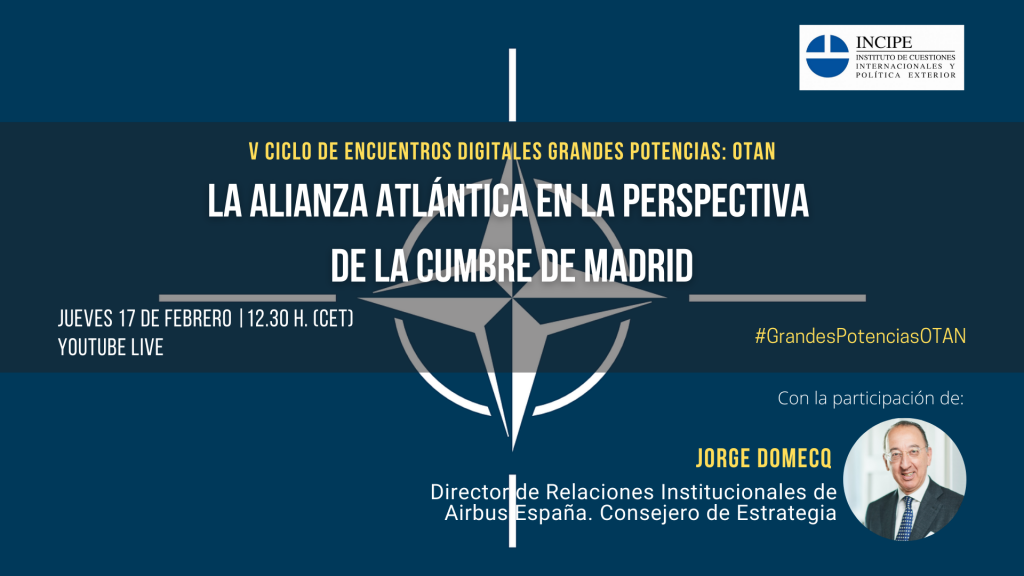
The session was conducted in Spanish and gathered an audience interested in understanding the roots of the key issues to be addressed during the upcoming NATO Summit in Madrid. To do so, we had the participation of Jorge Domecq, director of institutional relations and strategy advisor at Airbus Spain, with extensive experience in defense-related matters, particularly within NATO, the EU, and the Ministry of Foreign Affairs. During the session, Jorge Domecq presented a detailed analysis of NATO’s historical adaptation to various geopolitical changes in its sphere of action. The origins of the key issues that could shape the priorities addressed at the 2022 Madrid Summit were highlighted.
Jorge Domecq begins his intervention by emphasizing the importance of the Atlantic Alliance in ensuring the protection of the European continent. According to the speaker, the current nature of NATO, which is more political than military, has allowed it to adapt to the historical changes experienced during its more than 70 years of existence. The main challenges the Alliance has had to adapt to mainly stem from the disruption of the balance caused by the end of the Cold War, which ended the framework of predictable relations that existed until then.
Domecq highlights three phases of adaptation that NATO has undergone since the end of the Cold War. The first takes place in the period following the fall of the Berlin Wall until the mid-1990s. During this period, NATO had to redefine its relevance in a new Europe, after the end of the Cold War premises, the start of disarmament processes, the reduction of the U.S. presence in Europe, and with the open discussion of Germany’s reunification process. The fall of the Iron Curtain revealed the need to develop the «outstretched hand» policy as an initial step toward including Central and Eastern Europe in the Alliance. All of this was encapsulated in NATO’s first strategic concept, approved in Rome in 1991; a political framework that allowed NATO’s previously purely military strategy to address these new challenges.
The second phase of adaptation highlighted by Domecq covers the administration of Javier Solana, during which NATO underwent an incredible transformation in just 4 years. The Alliance’s strategy during this period was heavily focused on creating a network of relations with an indissoluble unity, whose balance was aimed at preventing a resurgence of distrust in the new Europe. In this way, an open-door policy was applied to countries wishing to join the alliance, leaving room for adaptation to resolve the issues preventing them from contributing immediately to NATO’s political and military framework. At the same time, a clear policy towards Russia was developed with the creation of the NATO-Russia Council, whose goal was to integrate Russia into a new European security order. This body did not rule out the possibility of Russia joining the Alliance, even though the problems Russia faced at that time made its entry impossible in the medium term. On a third level, the Euro-Atlantic Partnership Council was created for European countries wishing to have a relationship with NATO without joining it.
Solana’s administration was also a very important period for the Alliance, as it consolidated NATO as a priority consultation forum on all security matters concerning the Allies. During this period, Europe’s will to create a common identity that would make the EU more responsible for the continent’s defense and security also materialized. This, in turn, remains a long-term project today, requiring progress toward a common foreign policy, but was consistent with the significant steps European integration was taking in the 1990s.
All of this, Domecq points out, took place in a context where the unity and territorial integrity of many countries were beginning to fracture. This is why another development of NATO came from realizing that, to project security in Europe, it had to overcome its role as a defensive alliance with unmovable borders and adopt a less narrow approach to its premises. This idea inspired the interventions in Bosnia and Kosovo.
The third stage explained by the speaker takes place during the administrations of Bush, Trump, and Obama, which, although very different from each other, maintained a similar thread in their approach to the Atlantic link. This period marks key issues such as the pivot to Asia, the breakdown of understandings that had characterized relations with Russia, or the deployment of American ballistic systems in Europe. All of this was tied to the debate that began during the Trump period after the president reneged on the organization.
Focusing on the upcoming Madrid Summit, Domecq points out the 4 main issues that should be addressed. First, the management of rivalry with China should focus on those areas where the Alliance can provide appropriate tools. Next, the management of the relationship with Russia and the Ukraine crisis should recognize the danger it poses to the unity of the Alliance itself, as well as the asymmetric impact of the conflict on NATO members. Third, moving towards a NATO where there is a true technological and industrial partnership between both sides of the Atlantic, a concept responsible for many of the tensions between the U.S. and the EU regarding the so-called ‘strategic autonomy of the EU.’ Domecq concludes by noting that another key point should be to find a way for European defense to fit into NATO, including the area of space. In this regard, the speaker emphasizes the centrality of the choice of the next NATO Secretary General, explaining how the relationship between both sides of the Atlantic would benefit from a Secretary General from an EU country.
The session concluded with a debate where participants could ask questions about the topics discussed. This exchange underscored the importance of understanding how NATO’s historical trajectory could affect its goals in the near future.
Lucía Rodríguez
Communication Assistant, INCIPE