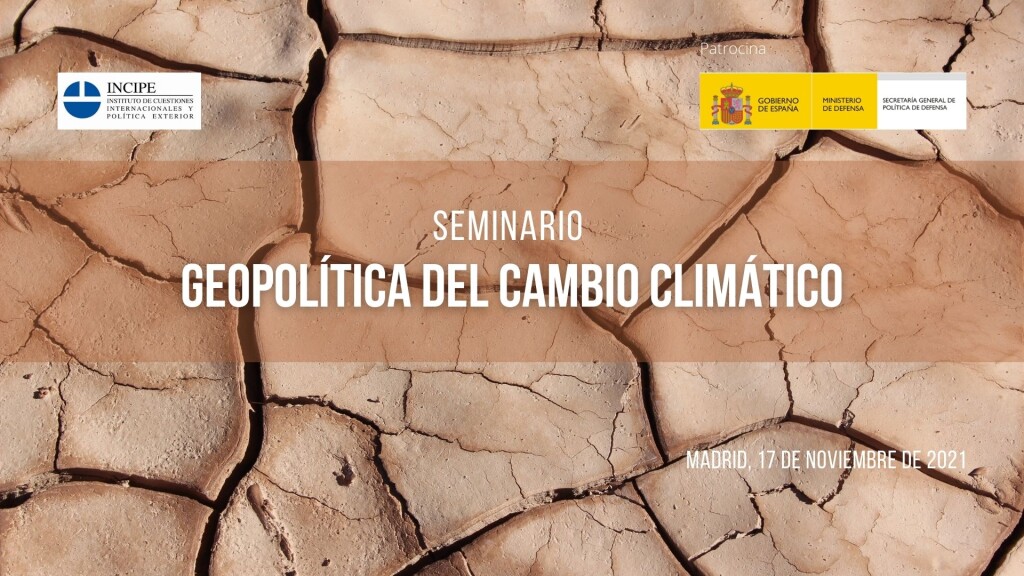
At this conference, we had the opportunity to organize two roundtable discussions. The first, titled Climate Change and Its Implications for International Security, was moderated by Fernando Villena, diplomat and coordinator of the DICOES study area in SEGENPOL, Ministry of Defense. Participants included María del Mar Hidalgo, climate change specialist at the Spanish Institute for Strategic Studies (IEEE), Ministry of Defense; Ricardo Valverde, climate change analyst at the National Security Department, Government Presidency; and Robert Dresen, political planning advisor at the NATO Secretary General’s office.
The second roundtable, titled Challenges and Horizons in the Fight Against Climate Change After COP26, was moderated by Vicente Garrido, Director General of INCIPE. Participants included Valvanera Ulargui, Director of the Spanish Office for Climate Change (OECC) at the Ministry for Ecological Transition and the Demographic Challenge; Pedro Linares, Professor at the Higher Technical School of Engineering and Director of the BP Chair of Energy and Sustainability at the Pontifical University of Comillas-ICAI; and Colonel Alfonso Romero, Head of the Environmental Sustainability Area at DIGENIN/SDG Planning and Environment, Ministry of Defense.
Manuel Alabart, Secretary General of INCIPE, began his speech by reviewing the main objectives and conclusions of COP26 in Glasgow. He highlighted as a key challenge after the conference achieving sustainable economic growth, reducing or, at least, not increasing emissions.
On his part, DIGENPOL, General Fernando López del Pozo, pointed out that climate change is one of the main threats of the 21st century, something that was not recognized decades ago. He emphasized that, if humanity is responsible for climate change, it also has the capacity to mitigate its effects, as shown by the global awareness reflected at the Glasgow conference. López del Pozo highlighted the impacts of climate change on security, as phenomena like droughts and desertification generate conflicts. Furthermore, globalization amplifies these consequences, also affecting Spain. He then explained Spain’s defense policy in relation to climate change, focusing on addressing these challenges.
Climate Change and Its Implications for International Security
During the first roundtable, titled Climate Change and Its Implications for International Security, María del Mar Hidalgo, climate change specialist at the Spanish Institute for Strategic Studies (IEEE), Ministry of Defense, highlighted the complexity of climate change, which has an environmental dimension, an economic one related to the energy transition, and a security dimension that has gained relevance in recent years. She emphasized that the security approach is key to advancing the other dimensions and mitigating the effects of this problem. In her speech, she reviewed some of the repercussions of climate change on security, noting that addressing the issue from this perspective is beneficial for promoting its mitigation.
In his speech, Ricardo Valverde, climate change specialist at the National Security Department, Presidency of the Government, reviewed the role of climate change in Spain’s security policies. He emphasized the strategic advantage these policies can offer to strengthen the country’s global positioning, highlighting Spain’s influence in its international relations. Valverde pointed out that Spain’s climate action could be key on the global stage, particularly in cooperation with other countries.
To conclude the first roundtable session, Robert Dresen, political planning advisor to the NATO Secretary General’s office, emphasized NATO’s role in managing climate change as a security issue. After listing some key factors that make NATO’s role crucial in managing the climate crisis, Dresen summarized the concrete measures taken by the organization regarding this matter.
At the end of the speakers’ interventions, a Q&A session was opened, allowing both in-person and virtual participants to address various aspects discussed during the roundtable. This exchange of ideas and perspectives helped broaden shared knowledge and enrich the discussion on climate change as a security issue before the session concluded.
Challenges and Horizons in the Fight Against Climate Change After COP26
The second roundtable, titled Challenges and Horizons in the Fight Against Climate Change After COP26, was dedicated to highlighting the possible scenarios and emerging challenges following the Glasgow conference. The first speaker was Valvanera Ulargui, director of the Spanish Office for Climate Change (OECC) at the Ministry for Ecological Transition and the Demographic Challenge. In her intervention, she emphasized the division exposed by the Glasgow conference between the countries most affected by the impacts of climate change, who demand more action, and those who have yet to find solutions to avoid inequalities in these effects. This division reflects the persistent North-South gap, with differentiated challenges: large emitters must reduce their emissions, while lesser emitters need support to adapt. Despite this complex context, Ulargui highlighted the positive results of the summit and explained the proposed advances to tackle these challenges.
In his speech, Pedro Linares, professor at the Higher Technical School of Engineering and director of the BP Chair in Energy and Sustainability at the Pontifical University of Comillas-ICAI, acknowledged the progress made at COP26, which has strengthened key commitments. However, he expressed two reasons for dissatisfaction: 1) climate commitments are difficult to apply to immediate policies, especially in developing countries whose growth depends on fossil fuels; 2) some measures agreed upon leave “black holes” in the emissions reduction process, with guidelines that are not strict enough to meet the goals. Key points for the future, according to Linares, included the need to monitor emissions reduction pathways to ensure compatibility with the Paris Agreement, prioritize adaptation over mitigation, pay attention to countries resisting a rapid phase-out of fossil fuels, and monitor the role of technological innovation.
Alfonso Romero, head of the Environmental Sustainability Area of DIGENIN/SDG Planning and Environment at the Ministry of Defence, closed the second roundtable by explaining the measures adopted by the armed forces to mitigate their emissions and adapt to climate change in their operations. He highlighted the key role of the armed forces in supporting the State in managing the effects of the climate crisis, contributing to both emissions mitigation and adaptation to the impacts of climate change.
After the speakers’ interventions, the second debate session began, during which both the in-person participants and those joining virtually asked questions to the speakers of the second roundtable.
To conclude the seminar, we had TG Luis Cebrián, Director-General of Infrastructure (DIGENIN), Ministry of Defence.
Lucía Rodríguez
Communication Assistant, INCIPE