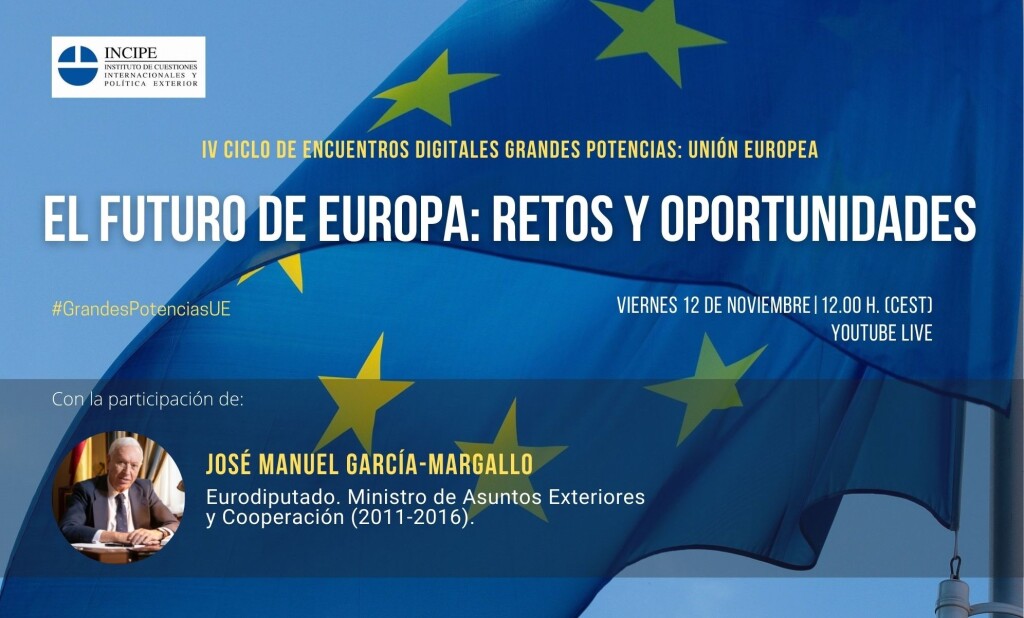
Former Minister García-Margallo divided his presentation into three parts; beginning with a review of the main events of the last decade, followed by an in-depth analysis of the current situation, and finally proposing possible courses of action for the future.
According to numerous global indicators, the past decade has seen a deterioration of human rights and international institutions (favoring protectionism and nationalism), a shift in the global economy toward the Asia-Pacific region, the progressive loss of presence by the European Union, increased global connectivity, and lastly, the COVID-19 health crisis.
Regarding the new decade ahead, there are numerous foresight exercises on the matter. The so-called mega-trends stand out here; trends that are easy to predict with long-term consequences. The most relevant include climate change, aging and uneven population growth, and asymmetric economic growth. Despite this, there are very hopeful indicators, such as the decline in extreme poverty.
The European project was born to address three deficiencies: peace, recovering lost prosperity, and maintaining a hegemonic position in the international framework. It was conceived as a political union to solve politically based problems. Ultimately, a federal union was pursued, but always maintaining the original objectives.
To conclude, former Minister García-Margallo envisions a strategy to move toward that political union that was envisioned in the origins of the European Union. First, it is necessary to define the borders, meaning suspending further enlargements until stability is restored. It could even be considered, paradoxically, that Brexit might be an opportunity, as it has traditionally hindered the political union process. Secondly, it would be advisable to establish a graduated system, starting with concentric circles: a federal core, followed by a confederal ring with states that are not part of the economic and monetary union, and finally, a more novel outer circle containing states that have access to everything except the institutions.
Finally, Margallo pointed out the “pending issues” of the European Union, mainly involving the revision of the Dublin Agreement on immigration and asylum seekers, the establishment of a common immigration strategy, the creation of a real and effective common security policy, and the improvement of the capital markets.
María de Alfonso
Communication Assistant, INCIPE