
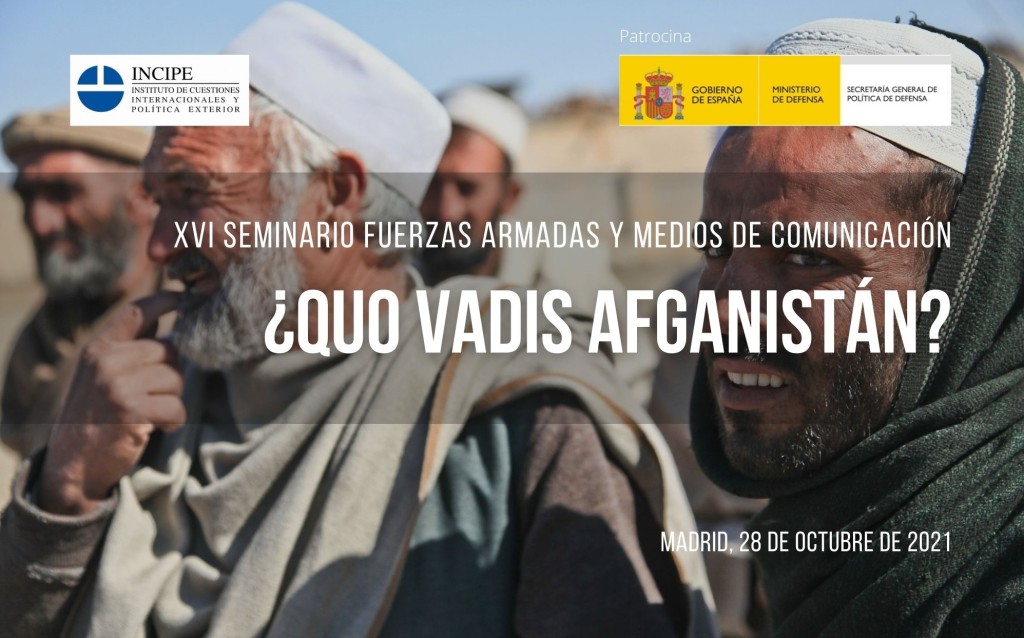
In this conference, we had the opportunity to organize two round tables. The first, titled The Role of the International Community in the Afghanistan Conflict, was moderated by Vicente Garrido, Director General of INCIPE. The participants included Gabriel Ferrán, diplomat and former Ambassador of Spain to Afghanistan; Pilar Requena, director of ‘Documentos TV’ at RTVE and author of the book Afghanistan; and Colonel José Luis Calvo, director of the Division of Coordination and Security and Defense Studies at the Ministry of Defense.
The second round table, titled The Communication of the Afghanistan Conflict, was moderated by Brigadier General Alfonso García-Vaquero, head of the Defense Diplomacy Area at DIGENPOL, Ministry of Defense. The panelists were Mónica Bernabé, special correspondent in Kabul for the newspaper ARA.; Mikel Ayestaran, freelance journalist specializing in the Middle East; and Colonel Joaquín Aguirre, head of the Communication Office at EMAD, Ministry of Defense.
Manuel Alabart, Secretary General of INCIPE, began his speech by reflecting on the situation in Afghanistan and the withdrawal of the international community after 20 years of presence in the country. He highlighted the professionalism and responsibility of the Spanish armed forces in their participation. Alabart emphasized the need for a deep reflection on these two decades of Western intervention in Afghanistan and the adverse conditions under which the mission’s withdrawal took place.
On his part, SEGENPOL, Admiral Juan Francisco Martínez Núñez, stated that public information has ceased to be a complement to military operations and has become an essential factor in their success or failure. In the context of the end of the presence in Afghanistan, he emphasized the importance of the image and public perception of the military’s work. He highlighted the need to combine truthful and honest information with a human and close approach, especially given the increasing role of emotions in communication. Martínez Núñez reflected on the lessons learned from the intervention in Afghanistan and also appreciated the social advancements that the intervention has brought to the country, stressing that public information helps raise awareness among citizens about these aspects.
The role of the International Community in the Afghanistan conflict.
During the first roundtable, titled The Role of the International Community in the Afghanistan Conflict, the diplomat and former Spanish ambassador to Afghanistan, Gabriel Ferrán, focused his intervention on explaining the historical context of the country. He pointed out that Afghanistan entered European history in the 19th century, in the context of colonial rivalries between Russia and England. Ferrán provided a detailed historical overview from the country’s independence, following 20 years of British protectorate, to the Soviet Union’s entry into Kabul in the 1970s and the political triumph of the Taliban in the late 90s.
In her intervention, Pilar Requena, director of RTVE’s Documentos TV and author of the book titled Afganistán, analyzed the development of the 20 years of military presence in the country. She pointed out numerous mistakes made by the mission, particularly in the process of «building the Afghan nation,» where Afghan culture and social norms were not taken into account as a foundation, and instead, society was abruptly transformed according to Western parameters. She also highlighted the lack of transitional justice processes to address the aftermath of the Afghan civil war. Furthermore, she emphasized the loss of credibility of the West as a consequence of the mission’s failure in Afghanistan.
To conclude the interventions of the first roundtable, Col. José Luis Calvo, director of the Division of Coordination and Security and Defense Studies at the Ministry of Defense, analyzed the intervention of the international community from a strategic standpoint. He emphasized that Afghanistan’s strategic importance has historically been negative. Calvo mentioned the use of Afghanistan as a “buffer state” by its neighboring powers throughout history. In the case of the U.S., he underlined that the strategic importance lay in the need to combat Al-Qaeda, driven by public opinion following the 9/11 attacks. He finally pointed out that the manner in which the withdrawal was carried out has left a very bad image of the U.S. as an ally.
After the speakers’ interventions, a Q&A session was held, in which both attendees in the room and those participating virtually could engage, addressing various aspects discussed during the roundtable. This exchange of ideas and perspectives allowed for a broader shared knowledge and enriched the discussion within the context of the end of the intervention in Afghanistan before concluding the session.
The Communication of the Afghanistan Conflict
The second roundtable, titled The Communication of the Afghanistan Conflict, was dedicated to exploring the centrality of public communication in military operations, specifically in the Afghanistan intervention. The first to speak was Joaquín Aguirre, head of the Communications Office of the EMAD (Defence Staff) of the Ministry of Defence, who dedicated his intervention to explaining the evolution of communication on the Afghanistan issue from 2005 to the present day. Initially, news focused on reporting deaths in a context where there were no social media, mobile phones, or instant photos. Aguirre highlighted the shift from a lack of specialization in communication to an era in which everything is connected through social media and there is a specialized role for communication within military missions. This change has been driven by the growing importance of public opinion in supporting operations, which can determine their continuation or termination.
In his intervention, Mikel Ayestaran, a freelance journalist specializing in the Middle East, analyzed two focal points of propaganda and public opinion in communication regarding the end of the operation in Afghanistan. He noted that NATO allies tried to highlight their success in the evacuation, even though the image that prevails after 20 years of intervention is that of a humanitarian crisis triggered by the departure of US troops. On the other hand, he pointed out that the Taliban are also using public opinion in their favor, boasting about having defeated the world’s largest military power and taken Kabul with little direct confrontation. Ayestaran also touched on two crucial points: the lack of safe access routes for journalists to conflict areas and his surprise at the ease of movement for journalists under the Taliban regime in the moments following their takeover.
Mónica Bernabé, special correspondent to Kabul for ARA newspaper, closed the second roundtable by highlighting the lack of coverage by Spanish media of the conflict, despite Spain’s significant contribution in terms of troops and economic resources to the intervention. She reiterated Mikel Ayestaran’s words about the difficulty journalists faced in accessing troops, particularly Spanish military bases; a reality that changed in 2012 when there was a shift in communication policy. Bernabé also shared Ayestaran’s perspective on the ease of movement for journalists under the Taliban regime, although she warned that this communication policy would likely change when international attention moves away from Afghanistan.
At the conclusion of the interventions, the second debate of the session began, during which both in-person participants and those joining us virtually had the opportunity to ask questions to the speakers from this second roundtable.
Closing Remarks
To conclude the seminar, we had Yolanda Rodríguez Vidales, Director of Institutional Communication for Defence at the Ministry of Defence, who explained the institutional communication process related to the evacuation in Afghanistan and how the Ministry of Defence attempted to fill the gap left by the absence of media presence in the country. She pointed out that the lack of media coverage occurred in a context filled with difficulties that prevented journalists from entering places like Kabul airport, due to the inability to guarantee their safety. This led to an information vacuum, which, in many cases, was filled by the military themselves.
Lucía Rodríguez
Communication Assistant, INCIPE