
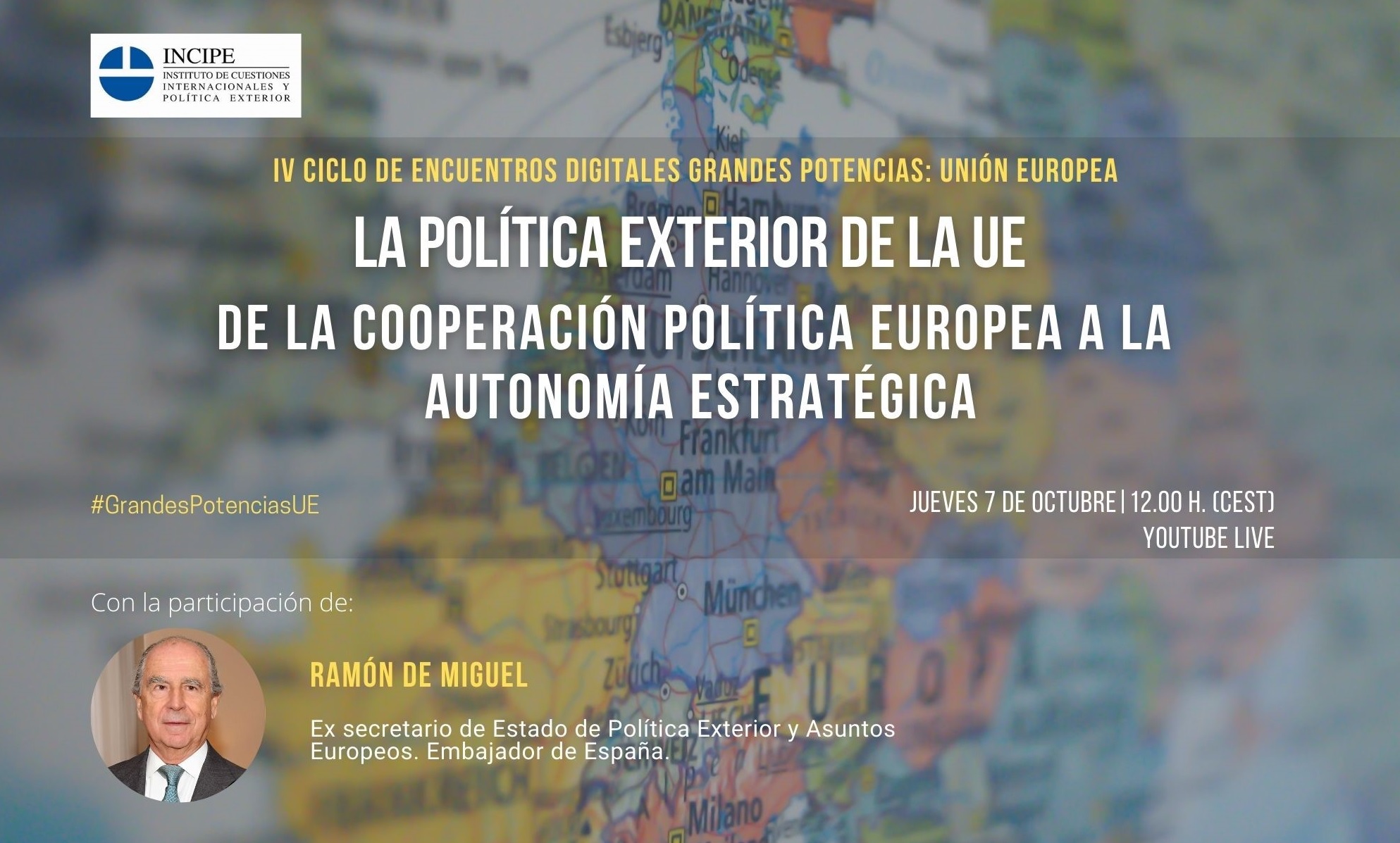
During the early years following the birth of the European Union, foreign policy did not hold much relevance, being discussed in the General Affairs Council, as the common market policy took precedence in the discussions of the time. Although there were successive attempts to increase its importance within European institutions, it wasn’t until the 1990s that the proposals began to yield results.
At the Intergovernmental Conference inaugurated in 1992 in Maastricht, the European Community was structured around three pillars. It is worth noting that the second pillar (separate from the common market) was the Common Foreign and Security Policy (CFSP), which gave the EC political personality. In 1996, the Amsterdam Treaty strengthened the operational character of the CFSP, providing it with more coherent instruments. In addition to unanimity, it introduced qualified majority voting for certain decisions and constructive abstention. From the Lisbon Treaty of 2009, Ramón de Miguel highlights the establishment of the link between the Common Security and Defence Policy (CSDP) and NATO; and emphasizes the importance of Article 42 of the Treaty, which represents the consolidation of community solidarity regarding external attacks.
Ramón de Miguel emphasizes that there is no truly common foreign policy, despite its importance, because it is quite fragmented in its implementation. One factor that crystallizes this is the possibility of opting out, as, for example, Denmark has done. Another challenge for defense policy is that, due to its connection with the core of national sovereignty, it has proven to be a very complex issue to integrate into the common framework.
It has not been possible to create a common system, even for the most basic elements, such as assault rifle ammunition, which differs in brand and caliber depending on the country. Ramón de Miguel asks: «If we are not even able to harmonize infantry weaponry, how are we going to deal with all the complex elements that exist today?»
As an evaluation, there have been effective advancements in the CFSP and the CSDP, but there are still challenges to overcome. First, the weight of the European Union in the global context is steadily diminishing. Second, the profound transformations in international trade rules and economic interdependence, which are becoming highly contentious. In this context, COVID-19 has highlighted the states’ dependence on all kinds of products, from medicines to semiconductors. Third, the severe weakening of the transatlantic relationship, as a result of the United States prioritizing the Asia-Pacific region.
This scenario has crystallized in two recent events affecting the European Union, where its role has been ignored by the United States: the Afghanistan crisis and the AUKUS pact. «In closer conflicts such as Nagorno-Karabakh and Libya, the EU has had almost no protagonism, and its role has been absorbed by the Turkey-Russia duo.»
To conclude, Ramón de Miguel emphasizes the importance of strategic autonomy for the European Union, the goal of which is to reduce its vulnerability, minimize its level of dependence on other powers, act without submitting to external dictates, and increase its sovereignty and ability to exercise its power in the international system. «The European Union must reconsider its foreign policy tools to move toward strategic autonomy, allowing it to act independently, promote its values, and defend itself from threats.»
María de Alfonso
Communication Assistant, INCIPE