
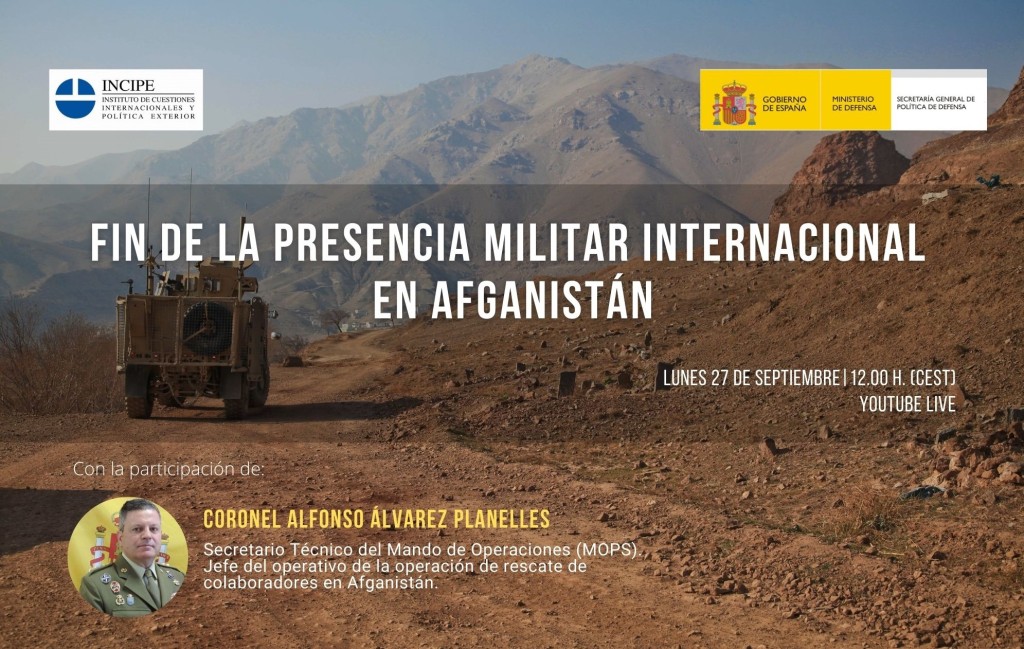
Colonel Planelles began his speech by reviewing the international military presence in Afghanistan over the past 20 years and the recent events triggered by the withdrawal of international troops. The recent international military presence in the country dates back to the September 11, 2001 attacks. In December of that same year, the United Nations Security Council authorized the deployment of the International Security Assistance Force (ISAF) under Resolution 1386, allowing these forces to access Kabul and its surroundings. Eventually, the deployment expanded across the entire country.
Spain joined this United Nations initiative in January 2002 as part of the ISAF operation, deploying 350 military personnel in Kabul and later expanding its presence to the western provinces of Afghanistan. Over two decades, Spain deployed more than 27,000 soldiers, representing a considerable military effort. Likewise, the human cost was high, as Colonel Planelles recalled. Ninety-seven Spanish soldiers, three Civil Guards, and two interpreters lost their lives during the operation.
The objective of the military deployment was to prepare Afghan forces to take full responsibility for security across the country through Train-Advise-Assist (TAA) activities, which provided training, advice, and assistance. The final phase of this mission began in January 2015 with the NATO-led Resolute Support operation. Colonel Planelles stated that they were satisfied with the improvements in Afghan forces, which were significant: «We thought they would be able to assume their responsibilities on their own.»
At the same time, U.S. troops carried out their own combat mission, known as Operation Freedom’s Sentinel, directly fighting Taliban forces and Al Qaeda. During the Trump Administration, secret negotiations with the Taliban began in an attempt to reach a ceasefire, which was ultimately agreed upon in February 2020 between the United States and the Taliban. Colonel Alfonso Álvarez Planelles highlighted four key points of this agreement. First, the Taliban agreed not to attack international forces, ensuring there were no casualties—this condition was met. Second, intra-Afghan talks were to be initiated to establish a ceasefire, though these negotiations started very slowly and late. Third, the withdrawal of U.S. and allied troops was scheduled to take place within 14 months, with May 1, 2021, set as the exit date, contingent on certain conditions imposed by the U.S. Lastly, the agreement included the release of prisoners, a decision that displeased the Afghan government, which was forced to free 5,000 militants.
In December 2020, President Trump reduced the U.S. military presence to 2,500 troops nationwide, laying the groundwork for the end of the military deployment on May 1, 2021. Finally, in April 2021, both the U.S. and NATO agreed to conclude the Resolute Support operation, deeming conditions sufficient to leave the country. The final withdrawal was scheduled for September 11, 2021, coinciding with the 20th anniversary of the attacks.
The withdrawal began immediately under the guidance of General Miller, the head of Resolute Support and Freedom’s Sentinel operations, who repeatedly emphasized, «Speed is our friend». The remaining countries with deployed troops exited in an orderly manner without pressure from the Taliban. It is important to note that Afghan forces were believed to be well-equipped and also had U.S. air support to continue combating the Taliban.
In August 2021, the Taliban launched their anticipated summer offensive. Colonel Planelles recalled watching in surprise as they advanced without any resistance—there was no presence of the Afghan army, police, or even government opposition. As security deteriorated, Western embassies began the immediate evacuation of personnel to Kabul airport. Alongside the departure of foreign diplomatic staff, the urgent challenge of evacuating Afghan collaborators and refugees arose. Hamid Karzai International Airport became the only escape route for thousands of citizens, creating severe security issues and triggering incidents that endangered the rescue operation.
These circumstances required the immediate implementation of a military operation with the primary objective of evacuating Spanish personnel deployed in the country. Additionally, the operation aimed to evacuate the highest possible number of Afghan refugees in an orderly and organized manner.
María de Alfonso
Communication Assistant, INCIPE