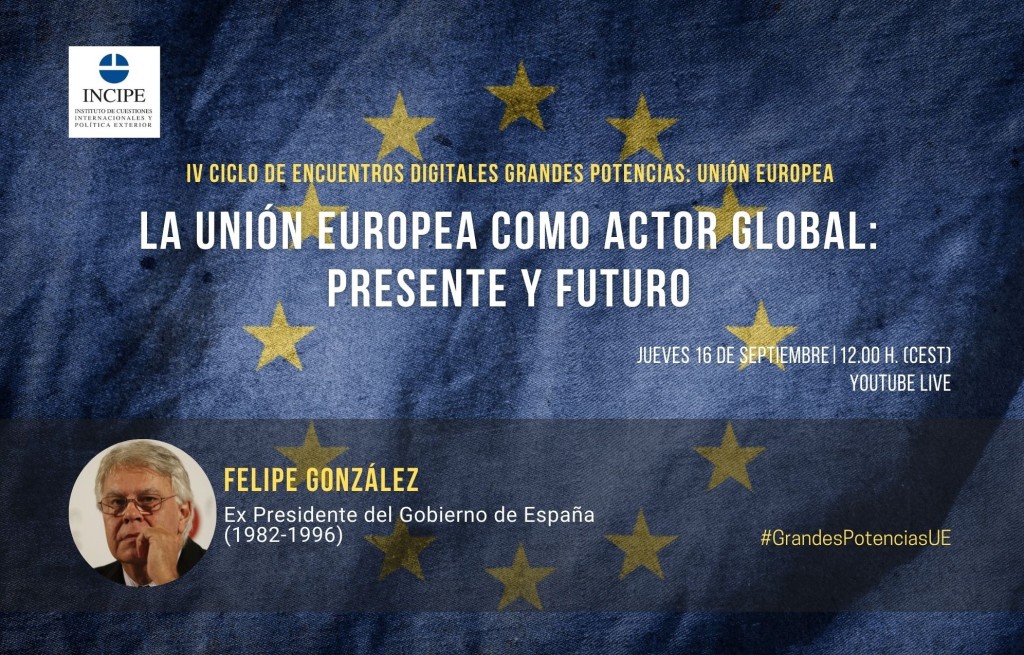
Felipe González began his lecture by recalling Spain’s accession process to the European Union. In this context, he emphasized that the negotiation of Spain’s entry into the EU was approached not only as a necessity but as a vocation, highlighting Spain’s commitment to Europe even before joining the Union, a commitment that transcended national interests. Additionally, he stressed that the transatlantic relationship with the United States would not be limited to the North Atlantic but would foster a triangular relationship, strengthening ties with Latin America.
The former president questioned whether the European Union can truly be considered a great power—referring to the title of this event series—or whether it might be more appropriate to speak of spheres of influence or action. In any case, he warned that if Europe wishes to play a significant global role, it is vital that it acts in a unified manner in foreign policy, especially considering the current roles of China and the United States: “If the European Union does not act in a coordinated manner and with a single external projection (…), the European Union loses significance, and each country on its own is absolutely insignificant.” Felipe González thus emphasized that it is precisely the Union’s collective nature that makes it a relevant global actor, not the individual capabilities of its member states. He demonstrated that, in terms of Europe’s role in the current geopolitical landscape, unity is strength.
Europe’s role in global politics can be strengthened, but this requires learning from history. In this regard, Felipe González pointed out that the European Union’s «coming of age» justifies its need to face emerging challenges. He recalled the financial crisis that began in 2007-2008 as a key turning point, marking a before and after. The initial perception of this crisis as a peripheral issue or one exclusive to the United States led to a weak response from the European Union, even as the crisis spread globally. Similarly, when the EU acts based on national impulses—as seen in the early stages of the global COVID-19 pandemic, with the race to acquire face masks—it is far less effective than when it acts in a coordinated manner based on shared interests, as later demonstrated during the pandemic with the implementation of vaccines.
This need for coordination can be extended to other challenges and areas of action. For instance, in the energy sector, Felipe González noted that there is still no truly unified strategy to address climate change, as each country is currently tackling obstacles individually.
Finally, regarding the possibility of creating a European army—an idea framed within the discourse of strategic autonomy and strongly advocated by figures like Jean-Claude Juncker—Felipe González declared that “Europe will not have a European army.” As an alternative, he highlighted the potential for strategic action units within NATO. As a member of this military alliance, Europe should utilize its existing resources to negotiate the creation of rapid intervention forces when necessary to address specific threats.
María de Alfonso
Communication Assistant, INCIPE