
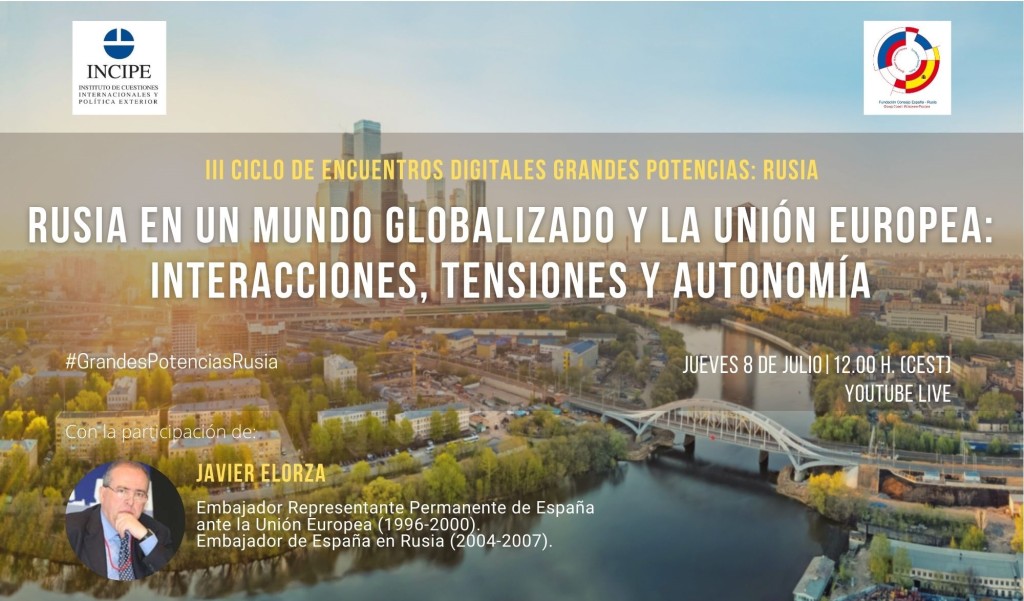
Javier Elorza begins his speech by stating: “The relationship between Russia and the European Union is at its lowest point since the fall of the USSR, with prospects for further deterioration.” Since Russia annexed Crimea in 2014, the only result has been a frozen conflict, driven by Russia’s stance on sanctions, but also by the inertia of both Europe and Ukraine. The conflict has transcended regional issues, and now conditions all economic and political relations between the EU and Russia.
To understand this, Elorza explains that when Putin came to power, he had three main objectives. First, the unity and stability of Russia, which he achieved by changing the legislation to ensure that the power to choose governors ultimately rested with him. He also raised the threshold for political parties to access the Duma to 7%.
Secondly, Putin aimed to restore Russia’s economic power. When he came to power, he revived the Russian GDP, which had suffered a significant decline during Yeltsin’s government. He also completely changed the dynamics of Russia’s economy, leading to an average annual real growth of 7% from 1999 to 2008. This resulted in a major victory in the 2004 elections. At this point, Putin halted economic reforms and began a nationalist operation, undoing the privatizations initiated by Yeltsin. It wasn’t until 2018 that he introduced more substantial economic reforms, such as national programs and infrastructure development.
The third objective was to make Russia financially solvent by transforming the economy to implement more orthodox rules. This strategy was successful, and today Russia ranks fourth in the world in terms of reserves. With this financial power, and a National Welfare Fund generated from oil revenues, Russia has been able to withstand a three-year-long blockade of Russian gas by Europe.
However, once Putin achieved these three goals, the situation began to worsen. Elorza highlights two failures in the relationship between Russia and the EU. The first stemmed from an attempt to form a free trade zone between Russia and the EU, in which Elorza himself was involved, but it failed because “the most important public sectors of the country judged it a dangerous maneuver for their independence and sovereignty, which would reduce their decision-making capacity and freedom of action.” The second failure related to the idea of abolishing visas to “increase the osmotic exchange between Russian and European society,” but this idea did not gain the qualified majority needed for approval.
Regarding foreign policy, Elorza believes that “Russia has self-affirmed with Putin,” who aimed not only to regain political power but also to restore Russia’s strength and influence. To achieve this, Russia developed a strategy that, although not focused on territorial expansion, was oriented toward controlling what it considered its sphere of influence—primarily the triangle formed by Russia, Ukraine, and Belarus. The EU rejected this approach, as it did not accept that Russia maintain this sphere of influence nor apply the USSR’s rules to preserve it, as Putin had proposed. Thus, Elorza concludes at the end of his speech: “This is where the conflict over Crimea comes from, which is nothing more than a new confrontation between a nuanced USSR and the Western world, where all parties have tried to maintain their position without making concessions.”
Sofía Alfayate
Communication Assistant, INCIPE