
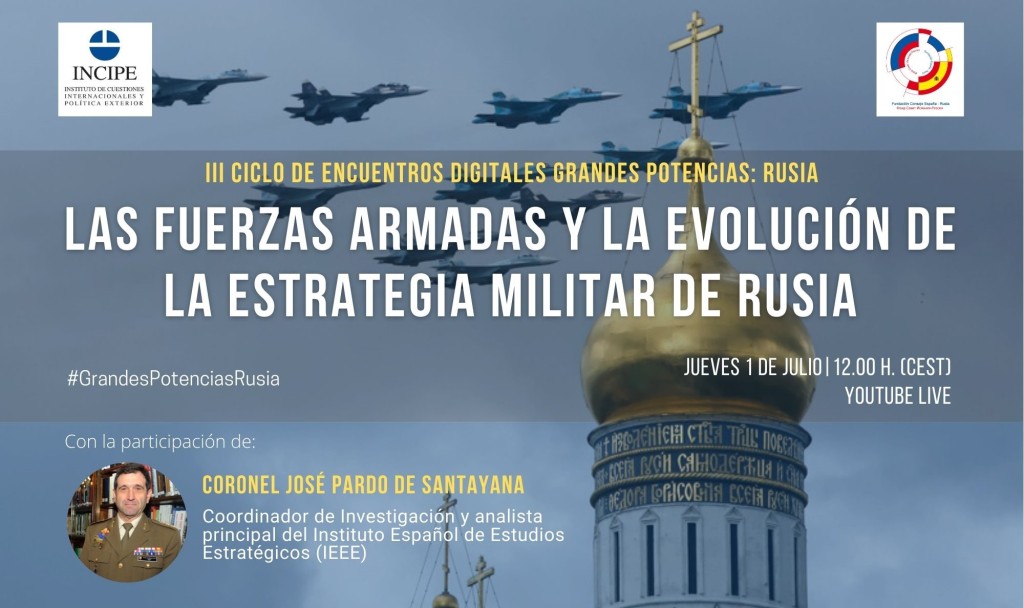
The importance of evaluating Russia from a military perspective, according to Colonel Pardo de Santayana, is due to several factors. On one hand, current International Relations are marked by rivalry between the great powers, which forces them to be particularly cautious with strategic issues and also complicates the task of adequately addressing global problems. Furthermore, the differences in strategic culture that already exist between the West and Russia are growing even larger in this friction-filled environment. On the other hand, the urgency of addressing strategic issues is due to the fact that we are in a period of geopolitical transformations that are negatively affecting the power balance of the great powers, which is detrimental to the West.
In this context, the Colonel reminds us that, despite the uncertainty surrounding the future of the Russian Federation as a military power, the country is currently in a phase of expansion, a status it could maintain for at least another decade.
Colonel Pardo de Santayana states that «in strategic terms, the Russian Federation is a great power. This is due, not exclusively, but necessarily, to its military capability to assert that role.» Russia is the sixth-largest economy in the world according to its GDP in purchasing power parity. Applied to the country’s defense spending, this positions Russia alongside Saudi Arabia, with the difference being that Russia produces its military capabilities within its own borders, operating in Rubles. As a result, Russia’s Armed Forces have a military capacity three times higher than if we were evaluating Russia based on military capabilities in dollars, making it the second military power, after the US. This is further enhanced by the successful reform of Russia’s Armed Forces carried out in the last decade.
Regarding the relationship between NATO and Russia, the Colonel recalls that during the two decades after the Cold War, a productive strategic dialogue was established between both parties. This dialogue was broken after a crisis in 2008 due to the war in Georgia, and again in 2014, leading to the current situation where the relationship between NATO and Russia is worse than at the end of the Cold War. The reason for this breakdown in dialogue must be traced to NATO’s expansion eastward beginning in 2004. Russia feels threatened by this expansion, while NATO believes it is justified as the new members are sovereign states with the right to join. Moreover, NATO considered Russia to be a weak actor and believed it would not have the capacity to oppose this expansion strategy. As a result, Colonel Pardo de Santayana argues that Russia has become a global power by defining a military strategy aimed at demonstrating its strength to NATO.
In this sense, Russia’s military strategy has traditionally been influenced by three fundamental interests. The defense of its territorial unity and power structure, the defense of its borders (which are the largest in the world), and access to the world’s great oceans, with the commercial opportunities that this entails. Around these three considerations, especially the latter, Russia established itself as an expansionist power. However, it currently focuses its strategy on defense, aiming to prevent NATO from encircling it and denying it access to the world’s great oceans. This defensive strategy sometimes turns highly aggressive, which is why both NATO and Russia feel mutually threatened.
In concluding his speech, Colonel Pardo de Santayana recalls Russia’s position in the context of the rivalry between great powers, which could lead to a rapprochement between the West and the Russian Federation to counterbalance the rise of China.
Sofía Alfayate
Communication Assistant, INCIPE