
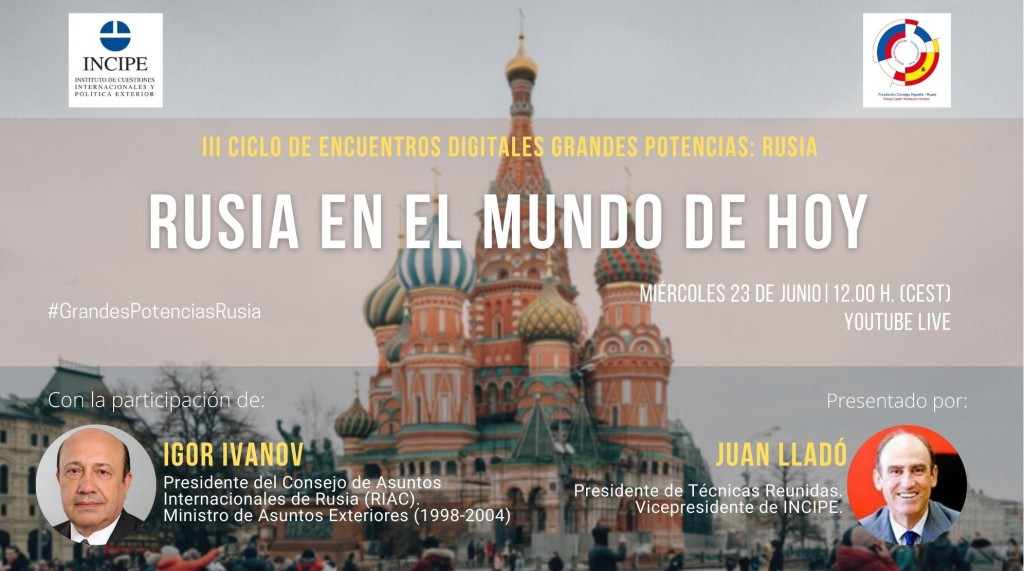
Igor Ivanov begins his speech by outlining three stages that have shaped Russian Foreign Policy since the dissolution of the USSR. When the USSR collapsed at the beginning of the 1990s, the Russian Federation faced the task of constructing its Foreign Policy in a context in which, as Minister Ivanov recalls, «the danger was no longer the disintegration of the USSR but the disintegration of the Russian Federation.»
These problems stemmed, internally, from the simultaneous collapse of the political, economic, and social structures of the Soviet Union, and externally, from the need to transform all of the country’s diplomatic relations, which until that point had been more aligned with the interests and needs of the Communist Party than with those of the state. Ivanov adds his perspective, having served as Russia’s Ambassador to Spain from 1991 to 1995, recalling the great uncertainty surrounding the creation of a medium-term strategy for Russian Foreign Policy: «We didn’t know that Russia was going to get out of this crisis. In the 90s, Russian politics began to search for its place in the world, which is why, at times, it wasn’t a very clear policy.»
By the late 90s, the direction of Foreign Policy began to be marked by clearer objectives, centered around the need to create a favorable environment for the country’s reconstruction, independent of the USSR’s goals and interests, and positioning Russia within the international context.
This period was characterized by smooth dialogue with key international players. Annual summits were held between Russia and the United States, a strategy was set for the development of relations between Russia and the EU based on four common pillars: trade, security, education, and technology, which laid the legal foundations for creating a mutually beneficial strategic cooperation network, and efforts were made to foster closer ties between Russia and NATO. In this regard, Igor Ivanov believes that Russia showed a willingness to align positions, despite its opposition to NATO expansion, but did not observe any reciprocity from Western partners, such as the United States.
This brings us to the current stage, marked by a distance and great difficulty in understanding between Russia and the West. However, the assessment Igor Ivanov offers of the meeting between Presidents Putin and Biden in Geneva is very positive. He believes that the approval of a joint declaration between the two countries, no matter how brief, shows great willingness and political maturity, as it sets aside their differences and takes the first step towards establishing predictable bilateral relations based on dialogue.
To conclude his intervention, Ivanov, regarding relations between Russia and Europe, recalls that «this is a crucial moment for our relations, and we must work to rediscover those common goals because we have much in common, and this is what we must focus on.» To this end, he considers it essential, in order to formalize stable relations based on clear common objectives with the EU, to create a strategy similar to the one that existed before, which, in the words of the Minister, «for different reasons, both sides started losing long-term common goals,» which could have prevented or resolved crises like the one in Ukraine.
Sofía Alfayate
Communication Assistant, INCIPE