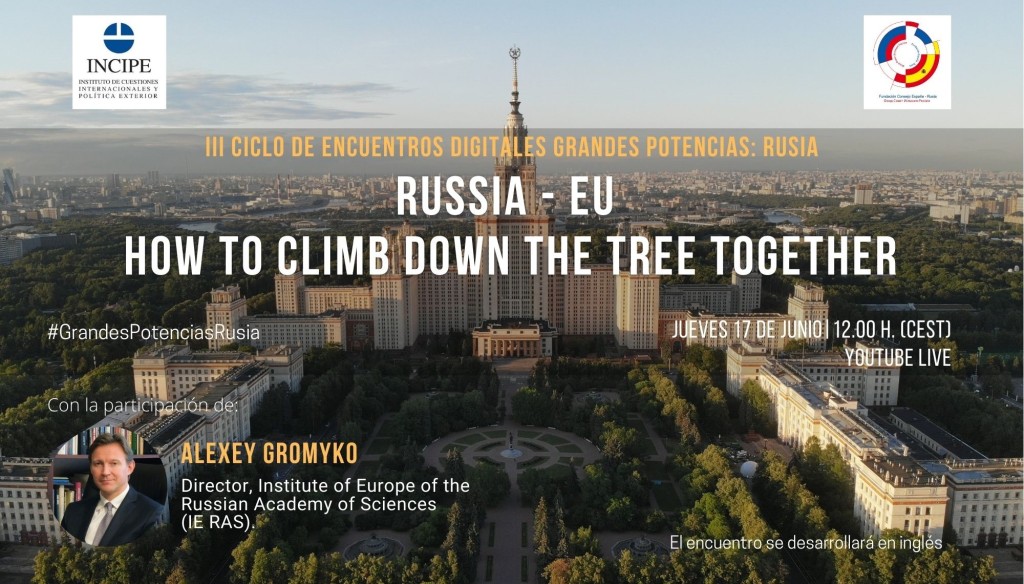
Alexey Gromyko begins his speech by providing an overview of the current context in which Russia-EU relations are developing, with issues inherited from the 2008 crisis, which have only been exacerbated by the demand and supply crisis caused by the COVID-19 pandemic. Additionally, there is an increase in strategic rivalry between the United States and China, which, according to him, «will continue to rise regardless of who occupies the White House,» as well as a series of strategic decoupling processes, the main reason for which is China. Overall, there is a global order in which it is impossible to predict, even five or ten years ahead, what the power balance will be or which countries will dominate the international system.
In this context, Gromyko asserts that Russia, as a global actor, must engage in international affairs while maintaining its autonomy in decision-making processes, staying clear of the bipolar narrative between the US and China. He also acknowledges that relations between Russia and the EU are not at their best. However, he believes that there are fewer fundamental divisions between them than many people think today, and in fact, for a long period, Russia and the EU pursued a strategic engagement policy. Unfortunately, that trend is not the case now, and neither common threats like terrorism or COVID-19 have helped reduce the distance; instead, the relationship is increasingly deteriorating.
From his perspective, this is due to three main factors. First, global politics now focuses more on the divergences than the convergences between international and regional actors. Second, there is the expansion of strategic decoupling processes, and third, the way the European Union applies the principle of solidarity. Gromyko believes that applying the principle of solidarity to form a common European front when a member state makes allegations against Russia «for domestic or other issues» is a way of weakening this principle rather than strengthening it.
Regarding Josep Borrell’s visit to Moscow, Gromyko considers that, despite favorable diplomatic talks, «the media focused only on the press conference, which was interpreted by European media in many negative ways» and blames «European states that do not want to improve EU-Russia relations under any circumstances.»
Thus, the responsibility to improve interactions between Russia and the EU lies with those countries that are willing to improve them, the speaker suggests. «At this moment, there is nothing indicating that there is potential for improving relations from within, but there are signs of hope from the outside.» In this regard, he emphasizes that, although much remains to be done before normal bilateral relations between the US and Russia can be discussed, the meeting in Geneva on June 16 between Biden and Putin may be «the first steps in the right direction.» Although the meeting was held in bilateral terms, Gromyko believes it can have a positive effect on the upcoming summit between Russia and the European Union and on the possibility of a meeting between the five permanent members of the UN Security Council. To conclude his speech, he points out what the possible paths for reactivating relations between Russia and the EU could be, marked by dialogue, diplomacy, and the shared responsibility of EU and NATO member states.
Sofía Alfayate
Communication Assistant, INCIPE