
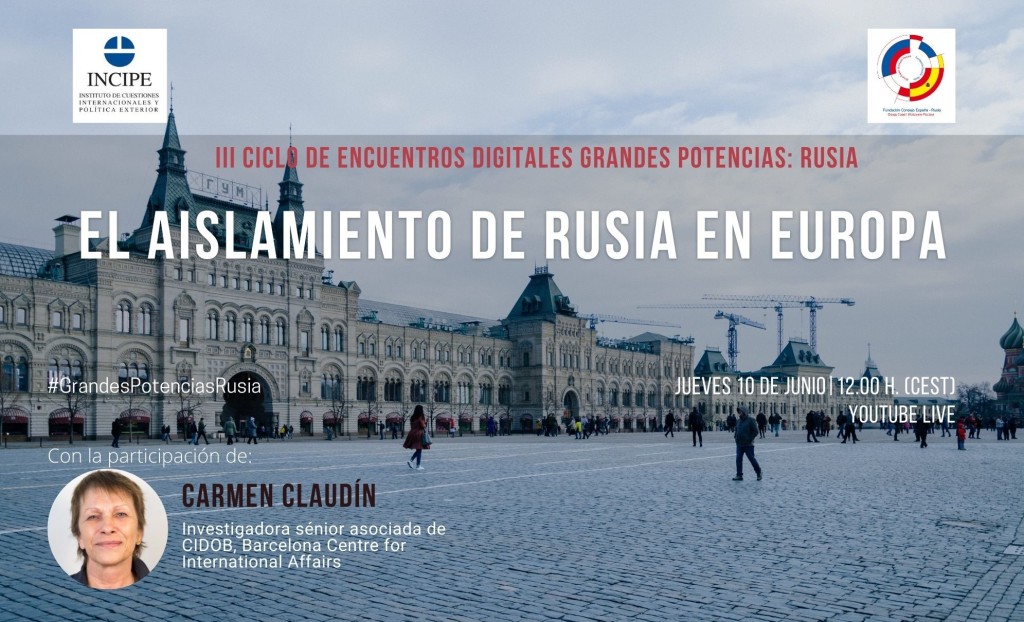
Carmen Claudín begins her presentation by analyzing the relationship between Russia and the European countries that, during the Cold War, were part of the Soviet sphere of influence. Countries such as Belarus, Moldova, Georgia, Ukraine, Armenia, and Azerbaijan, which face internal or regional problems in which Russia plays a leading role.
For Carmen Claudín, «the problem for all these independent states is that they form the strip of European territory considered by Russia as its security belt against the West in general and against the European Union in particular.» Moscow justifies the need for this security belt due to the expansion of the European Union and NATO eastward and, therefore, because the West does not take its security interests into account. In this way, the Kremlin believes, in the words of the speaker, «that the rapprochement between these countries and the European Union is not part of the sovereign will of these states, but the result of Western maneuvers to bring them into their fold and weaken Russia.»
As the speaker explains, Russia legitimizes its intervention in Soviet European countries with the promise of protecting and defending the interests and rights of Russian-speaking minorities in the region, which, when put into perspective with the mass issuance of Russian passports since 2002, has led to what experts call the ‘passportization’ of Russian politics through the «creation of new citizens to protect.»
Claudin also points out that since Putin returned to the presidency in 2012, he has developed a policy around the post-Soviet European countries based on rewards and punishments. In such a way that if these countries «behaved well» and did not question the Russia-favorable Status Quo, they received from the Kremlin the right to develop domestic policies with some autonomy. However, countries like Georgia, Moldova, or Ukraine, which have signed cooperation agreements with the European Union, have paid for this with trade and energy blockades, among others.
Furthermore, Claudín recalls, in line with the above, that the popularity of the Eurasian Economic Union, Putin’s flagship project, is minor – only 29% – compared to the acceptance of the European Union – which registers 60% – or the UN and NATO, which have 48% and 42%, respectively.
Regarding the relations between Russia and the European Union, Carmen Claudín points out that the policies developed by the European Union over the past two decades, aimed at establishing peaceful relations and cooperation with Russia, have conditioned the European countries of the post-Soviet space. According to the speaker, this is because «when designing this policy, Brussels and some member states have always kept in mind the factor of not upsetting Russia.»
However, as the analyst concludes, «experience shows that this effort has not only led to a deadlock in relations between the European Union and Russia, but also leaves the countries of a supposedly shared neighborhood with the rest of Europe very exposed,» holding the Kremlin responsible for Russia’s isolation in Europe and reminding the member states of their responsibility toward the interests and rights of the countries within that Russian security belt.
Sofía Alfayate
Communication Assistant, INCIPE