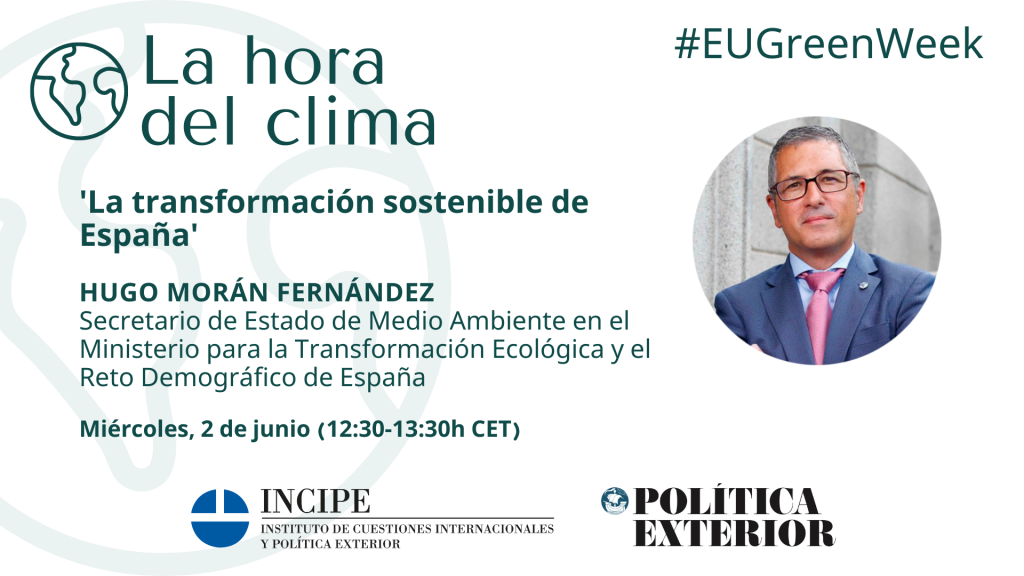
«The impacts of climate change are already evident across the globe, and Spain is not immune to this reality,» stated Hugo Morán at the beginning of his speech, in which he highlighted the recent publication of the Report on the State of the Climate in Spain in 2020. This report includes data such as 2020 being, along with 2016, the warmest year globally since records began, or that the average temperature in Spain has increased by 1.7°C compared to pre-industrial levels.
Morán describes the situation as alarming: «At this rate, by 2050, we would need up to three Earths to meet global demand, and in the case of our country, the current ecological deficit would require us to allocate two and a half times the surface area of Spain to maintain the current standard of living.» To avoid reaching an irreversible situation, since 2015, the international community has developed climate action strategies through the 2030 Agenda and the Paris Agreements, aimed at achieving neutrality in pollutant gas emissions.
«Spain committed to this from the very beginning,» says Morán. In this regard, the Climate Change and Energy Transition Law has just been approved, which aims to achieve emission neutrality before 2050. A National Climate Change Adaptation Plan for 2021-2030 has also been approved as an essential tool to improve response capacity. Both instruments form a long-term strategy for a modern, competitive, and climate-neutral economy by 2050.
Regarding production and consumption, Spain Circular 2030 was launched in June 2020, a strategy aimed at promoting the circular economy to replace the current model, which involves unlimited consumption of finite natural resources. Additionally, the first Circular Economy Action Plan for 2021-2023 has been approved by the Council of Ministers, with a budget of more than 1.5 billion euros.
The Secretary of State also emphasizes the importance of utilizing water resources. In this sense, as part of the new hydrological planning cycle, the third-cycle hydrological plans, which will assess the risks of climate change for water resources and ecosystems, as well as the restoration of damaged ecosystems through the national green infrastructure and connectivity strategy, are expected to come into effect in the spring of 2022.
In conclusion, as Hugo Morán states, «We don’t have those two and a half Spains we need to produce as we do. Therefore, we must increase our resilience and continue the transition to new development models that guarantee the conservation and sustainable use of materials, and prioritize the protection and restoration of nature as a driving force for the economy. Because a healthy environment is essential for health and for economic and social prosperity.»
Sofía Alfayate
Communication Assistant, INCIPE