
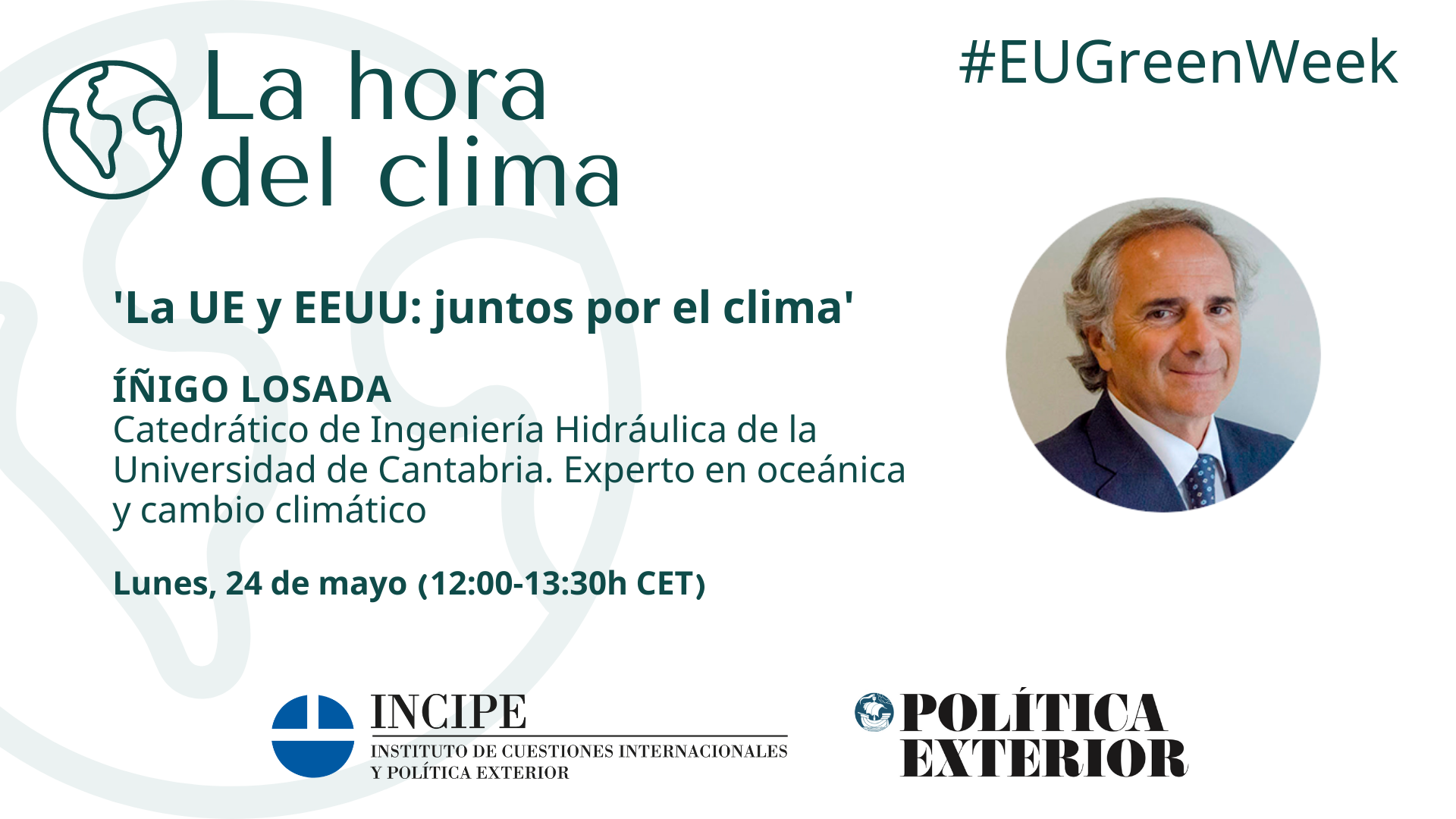
Iñigo Losada frames his presentation within the changing global landscape of greenhouse gas emissions. Neither the US nor the EU are his primary concerns, given their significant decline in emissions between 2017 and 2019 and the downward trend in per capita emissions over the past two decades. Instead, he focuses on China, which not only shows an increasing emissions trend but also surpassed the combined emissions of the entire developed world in 2019.
These figures are crucial in the context of the Paris Agreement, whose main goal is to achieve a global reduction in emissions to prevent the average global temperature from rising by 2°C—preferably 1.5°C—before the end of the century. Losada emphasizes the urgent need for immediate and decisive action to avoid reaching the 1.5°C threshold and the resulting environmental, economic, and social consequences. To achieve this, he specifies, current policies and commitments from various countries are insufficient. Instead, a real and global commitment is needed to achieve a much greater reduction—well beyond 50%—in emissions.
In this context, on February 19, shortly after Joe Biden took office as President, the United States rejoined the Paris Agreement, marking the beginning of a series of presidential actions related to environmental commitment. According to Losada, Biden’s Climate Plan is inspired by the Green New Deal, which was introduced and rejected in Congress by the Democratic Party in 2019. The new president’s climate policy addresses the climate crisis primarily from a domestic perspective but also incorporates foreign policy and national security dimensions. “It proposes a comprehensive approach, urging the alignment of government procurement management, property and asset management, as well as financing programs with robust climate action,” Losada highlights.
There is also a shift in the US stance within international climate forums, as the country seeks, in Losada’s words, “to reclaim the climate leadership lost during the Trump administration, while also fostering multilateralism and bilateral international cooperation.”
The speaker also highlights the shared leadership responsibility between the US and the EU in climate action, pointing out the common elements between Biden’s Climate Plan and the EU’s strategy. Both focus on transforming growth strategies to achieve a fair and prosperous societal transformation within a framework of drastically reducing polluting emissions. Additionally, in both strategies, the circular economy plays a fundamental role in enhancing resilience against climate change.
There is still a long way to go before global environmental efficiency can be achieved. However, considering that in just three months, the Biden-Harris administration has completely reshaped the US stance on climate action—and given the shared responsibility, ambition, and leadership between US and EU climate policies—Losada concludes that this presents a valuable opportunity to transform the economy, generate employment, and move toward a just transition to a zero-emissions economic system.
Sofía Alfayate
Communication Assistant, INCIPE