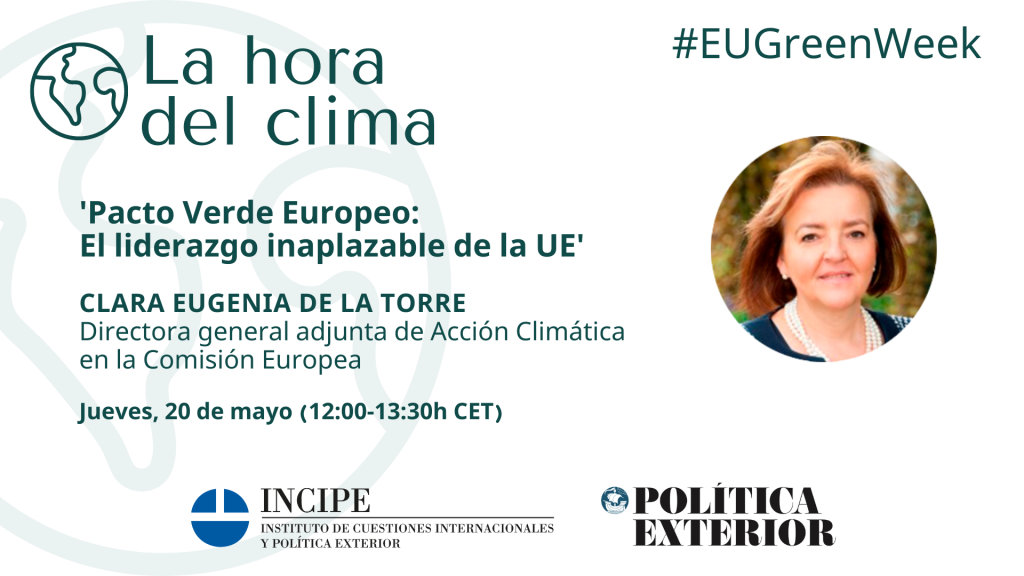
«The science has shown us that we have a problem with climate change. It is not too late to address it, although we have very little time.» With this strong statement, Clara Eugenia de la Torre began her speech at the event held as part of European Green Week, which focused on the European Union’s Climate Action strategy. In this regard, de la Torre emphasized that decoupling economic growth from greenhouse gas emissions is possible, and the European Union is clear evidence of this: «Since the 1990s, the EU economy has grown by 60% while greenhouse gas emissions have decreased by 25%.»
The European Union’s leadership in Climate Action is undeniable—it is the only region in the world with legislation aimed at reducing emissions. However, this is not enough, as the EU currently accounts for «less than 10% of all global greenhouse gas emissions.» Clara Eugenia de la Torre asserts that the path to achieving the green transition relies on legislation, investment, and societal engagement—the three fundamental pillars of the European strategy, which aims for the EU economy to become climate-neutral by 2050.
To reach this ambitious long-term goal, the European Commission has set a short-term target of reducing greenhouse gas emissions by 55% by 2030—a goal that, according to de la Torre, presents «a tough but achievable path, both technologically and economically.»
«If we want to achieve climate neutrality,» de la Torre states, «we must support innovation. We are very strong in R&D, but we are weaker in innovation (…) and this must become embedded in our productive fabric.» The search for new production methods, greater energy efficiency—“75% of EU buildings are energy inefficient”—and higher recycling rates are some of the key focus areas of the Climate Action initiative. Furthermore, it aims to include all economic and social stakeholders through the Climate Pact, a program that allows any citizen to enroll and become a climate ambassador in their community while also fostering grassroots initiatives to contribute to the fight against climate change.
So far, one of the greatest achievements of European Climate Action has been legislative, with the agreement between the European Parliament and the European Council on the Climate Law. This law sets the EU’s emissions reduction and neutrality targets and establishes the legal framework for both mitigating and adapting to climate change. However, de la Torre reminds us that «this transition needs funding, and it must be fair.»
To achieve this, the Green Deal Investment Plan will mobilize at least one trillion euros in investments over the next decade, coming from the EU and member states, combining public and private investment to promote the green economy and boost sustainable projects. Clara Eugenia de la Torre also calls for a positive outlook, as much as possible, on the economic reconstruction needed after the pandemic, encouraging us to «seize the opportunity presented by this vast amount of public and private funds to rebuild our economy in the best possible way.»
Ultimately, the European Green Deal is committed to both environmental sustainability and economic development while ensuring citizens’ well-being. Although there is still much work to be done to achieve climate neutrality, it lays the foundation for establishing a shared global vision ahead of COP26 in Glasgow in November, where the European Union will undoubtedly play a leadership role.
Sofía Alfayate
Communication Assistant, INCIPE