
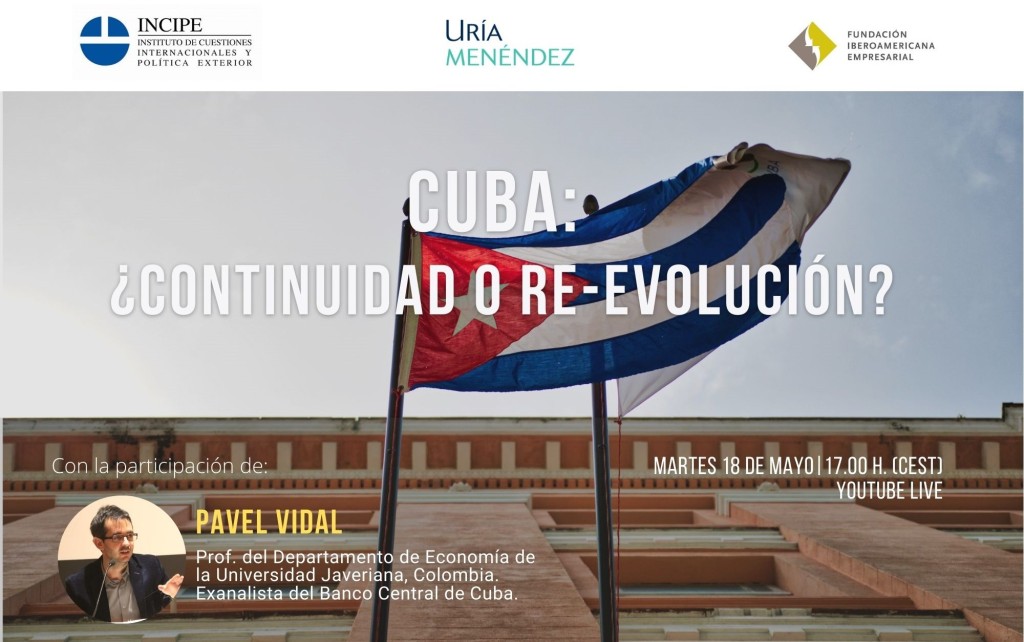
At the beginning of 2021, Cuba began implementing a series of economic reforms after more than five years without changes in the country’s economic policy. This is being done in the context of a global economic recession, which, as Pavel Vidal clarifies, “began before the pandemic, in the second quarter of 2019,” and a political change, as, since October 2019, for the first time in 60 years, the positions of President of Cuba and Secretary General of the Communist Party of the country are not held by a member of the Castro family but by Miguel Díaz-Canel.
The economic reform is based on two pillars. On the one hand, the opening of the non-state economic sector, which goes from allowing around a hundred professional activities to over two thousand, which would have a positive impact on job creation in the country and stimulate private entrepreneurship through the establishment of a legal framework that recognizes them as legal entities. On the other hand, a reform of the monetary system that ends the dual currency and the convertible peso, resulting in a 24-point devaluation of the Cuban peso.
In this scenario, Pavel Vidal believes that “while the economic reforms can be considered structural, they will not move Cuba toward a market economy model,” but the country will remain “trapped” between socialism and capitalism, not benefiting from aid from the Soviet Union during the Cold War, nor from Venezuela afterwards, but also not from the advantages of the free market, and additionally suffering from sanctions imposed by the United States, which, in Vidal’s words, “suffocate the Cuban economy.”
The situation, therefore, leads him to question whether the current economic reforms reflect those undertaken during the Castro family’s government or if, in this case, we can speak of real changes that will impact the country’s economy and its economic relations with the rest of the world.
When assessing the balance between continuity and change in Cuba, Vidal notes aspects that remind him of previous reforms, such as the fragmentation of the reforms, applied to fewer sectors than would be needed for favorable results, and the strategic ambiguity of the government, which does not establish the final goal they are pursuing, showing a lack of political consensus and hindering foreign investment.
In any case, Pavel Vidal highlights two novel aspects that, applied to future decisions, could have a real impact on improving the Cuban economy and reducing inequality. On the one hand, the devaluation of the national currency is an irreversible reform, has a cross-cutting application for the entire Cuban economy, and lays the foundation for more efficient decision-making. On the other hand, the political situation in the country, arising from the change of leaders, who, lacking the historical legitimacy that the Castro family had, must seek legitimacy through results. Additionally, the Cuban Constitution of 2019 establishes that no leader can remain in office for more than two terms, so Vidal considers that this temporary membership in the country’s elites may lead the new president to achieve real change that can benefit them when they are no longer part of the Cuban political elite.
For now, the monetary policy reform has caused what Pavel Vidal defines as a transparency shock, showing that the state sector is not economically viable in Cuba. This leads him to predict that almost half of the Cuban public enterprises will end 2021 with losses, partly due to their high dependence on low wages and subsidies to continue operating.
Therefore, it will be necessary to wait to observe the real effect of the economic reforms in the country, which largely depends on the evolution of the pandemic and whether Cuba reaches a level of immunity that allows economic and tourism activities to resume with relative normality.
Sofía Alfayate
Communication Assistant, INCIPE