
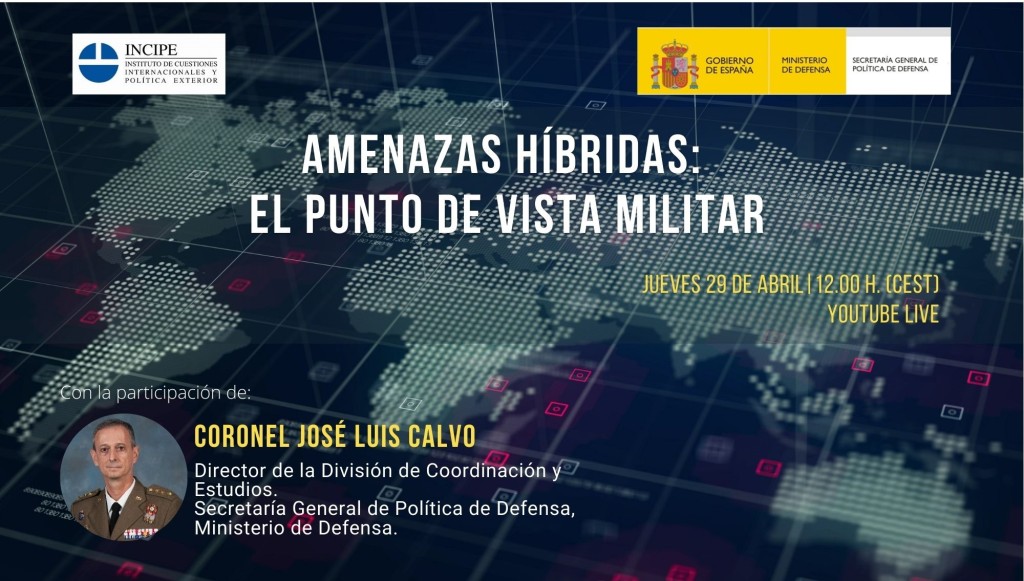
Colonel Calvo began his presentation by discussing the evolution of hybrid threats, a concept that began to be discussed in the 1990s within the U.S. Marines Corps, specifically in the Chechen and Hezbollah-Israel conflicts in southern Lebanon. «There was an important issue in understanding the evolution of hybridity, which was the emphasis placed on information, which was given a lot of importance, and in some cases was heavily exploited, as in the case of the Zapatista guerrilla conflicts in Mexico, which had global repercussions due to the media and informational tactics used to promote their movement.»
Colonel Calvo continued his lecture by pointing out that U.S. troops deployed in Iraq and Afghanistan encountered a similar situation, where the narrative took on increasing importance. Similarly, during the 2006 Israel-Hezbollah conflict, hybrid warfare began to be used in a very prominent way, with the use of narrative by each side gaining relevance. Later, we find other examples in the conceptual evolution of hybrid warfare, such as the cyberattacks on Estonia in 2007 and the war between Georgia and Russia, which marked the first time that cyberattacks were combined with massive disinformation campaigns, where hybrid warfare began to materialize. At the same time, the widespread use of smartphones and social media occurred within the context of a global economic crisis, paving the way for the type of hybrid conflicts that are so common today.
Colonel Calvo mentioned propaganda, disinformation, diplomacy, the economy, subversion, sabotage, and espionage as factors that were put into practice, for example, during the Crimea conflict, combined with cyberattacks on the phones of the combatants themselves to create confusion, panic, disorganization, and terror; a paradigm of hybrid warfare. «From here, another evolution develops, with non-military incidents, such as the Russian intervention in the 2016 U.S. elections. Cyberattacks become widespread with the goal of obtaining information, and the concept of hybrid warfare evolves into hybrid threats, since the aggressions are generally directed at the population, creating a climate of uncertainty and disinformation.» For Colonel Calvo, the response should not be to seek confrontation, but to integrate all security and military instruments, communication, political influence in armed conflicts, and resilience.
During the subsequent debate, questions were raised regarding how countries are preparing to face hybrid threats. In response, the colonel stated, «We have learned a lot during the pandemic, but there is still much work to be done.» On the other hand, the discussion touched on how citizens are being trained to face hybrid threats in a complementary way to the Armed Forces. «One of the most important aspects is education. However, we are still vulnerable, even highly prepared people can fall victim to disinformation. Encouraging critical thinking and a contrasting attitude is important, and it should be one of the fundamentals of education,» the Colonel Calvo emphasized.
It is vital to communicate better by providing information to citizens that restores the credibility that has been eroded towards institutions. Therefore, success lies in education and communication; teaching people to think in terms of contrasting diverse opinions and communicating with transparency are two key factors in making the population more resilient, helping them to trust the system more.
To conclude, Colonel Calvo highlighted the situation of Spain in the face of hybrid threats: «What many Western countries are experiencing is not a hybrid threat but a probing with cyberattacks and political disinformation campaigns, the goal of which is to detect weaknesses according to the reaction, and, in the future, if the opportunity arises, it would be used against us. We are constantly being probed.»
Javier Ubrí
Communication Assistant, INCIPE