
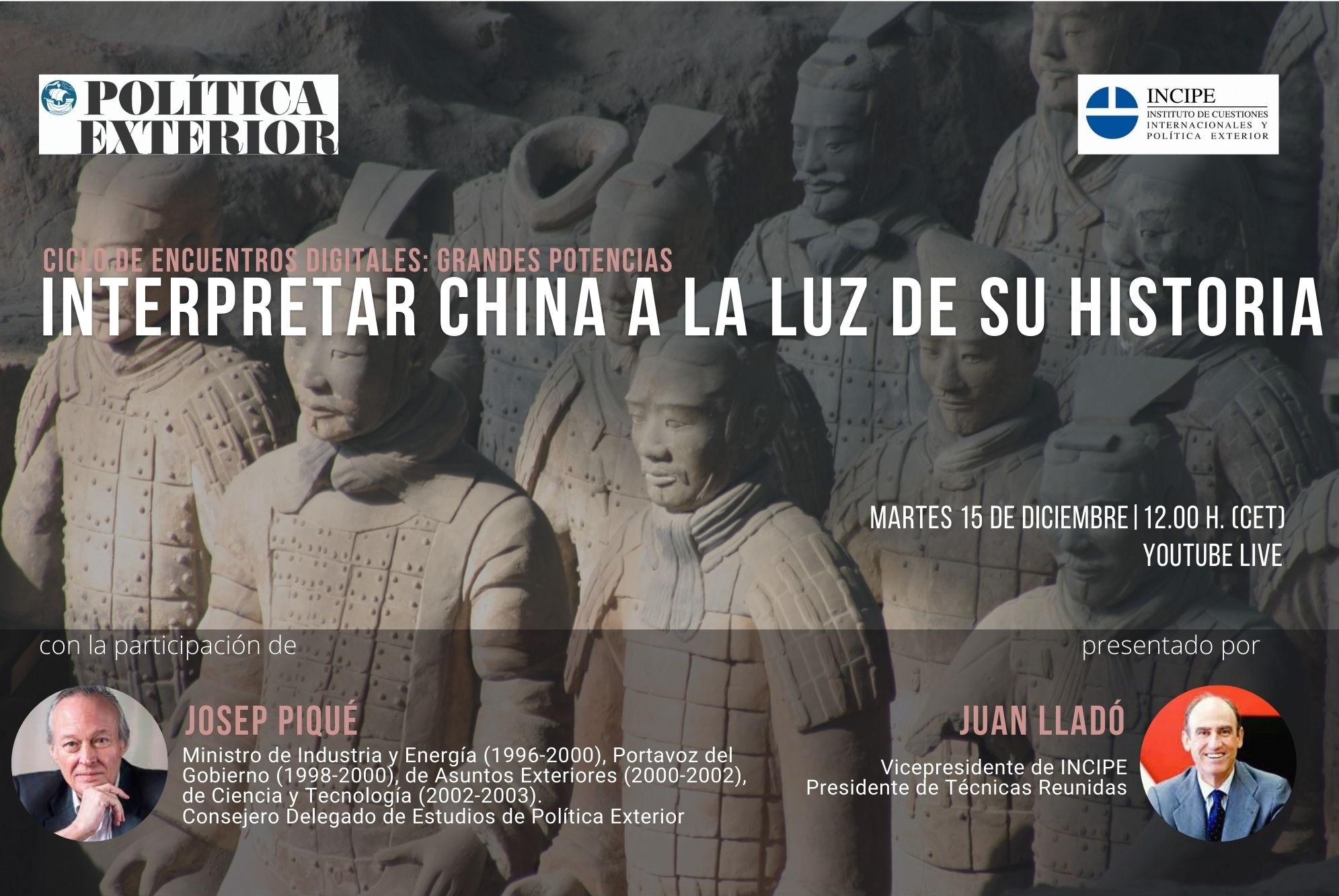
Minister Josep Piqué establishes, from the outset of his speech, a clear connection between the foreign policy of states and their history and geography. «The more secular the history, the more it weighs, and the more demanding the geography, the greater the challenges it poses.» And China’s history, as President Xi Jinping reminded Donald Trump in their early meetings, dates back five thousand years. For Piqué, this reminder was no coincidence; Xi Jinping was conveying that, regardless of the political and economic situation, China is, above all, an ancient culture.
In this context, Josep Piqué closes the cycle of digital lectures on the Asian giant by offering a historical perspective on the challenge that current China represents for the West. To do so, he invites us not to analyze Chinese history from a Western perspective. «Its history is different, China considered itself—and in many ways, was—the center of the world. And it simply wants to be that again,» states the minister.
From its birth as an empire to the Opium Wars, China was militarily defeated—indeed, the Yuan Dynasty (1271-1368) was founded by Mongol invaders—but Chinese culture had always prevailed from a political, institutional, and cultural point of view. However, with the arrival of Europeans in the 19th century and their attempt to impose Western institutions and «rules of the game» on China, and the emperor’s refusal to submit to what he considered barbarians, what is known as «the century of humiliation» began in the Chinese empire. This period marked the dominance of the West over Chinese sovereignty ever since, points out Piqué.
The reforms undertaken in China since the days of Deng Xiaoping were not aimed at democratizing the country, but at recovering its economic power, and for this, the support of the United States was essential. «China wanted to join the West to recover its prosperity but at the same time, it did not want to become Western,» says Josep Piqué, and the return to Confucian values, which is seen in the official discourse of the government with an increasingly nationalist tone, proves this.
China is aware that the strategic sector that underpins global hegemony is the technological one. That is why the country is undergoing a technological revolution centered around Artificial Intelligence, while simultaneously proposing a multilateralism based on its own rules, taking advantage of the United States’ retreat from international affairs during the Trump administration. This Foreign Policy is beginning, in the words of the minister, to «awaken awareness,» leading the world order into a struggle between two superpowers: the United States, which seeks to maintain its influence, and China, which aims to impose its own rules of the game. In this context, the restrictions on investments, trade protectionism, and alliances to contain China, driven by the United States, are explained by Piqué.
Europe must establish clear dialogue with the new U.S. administration. Because, in the words of Minister Josep Piqué, «Whether China becomes the hegemonic power economically and globally by 2049, according to its plan, depends on how the United States, the European Union, and the entire West respond.»
Sofía Alfayate
Communication Assistant, INCIPE