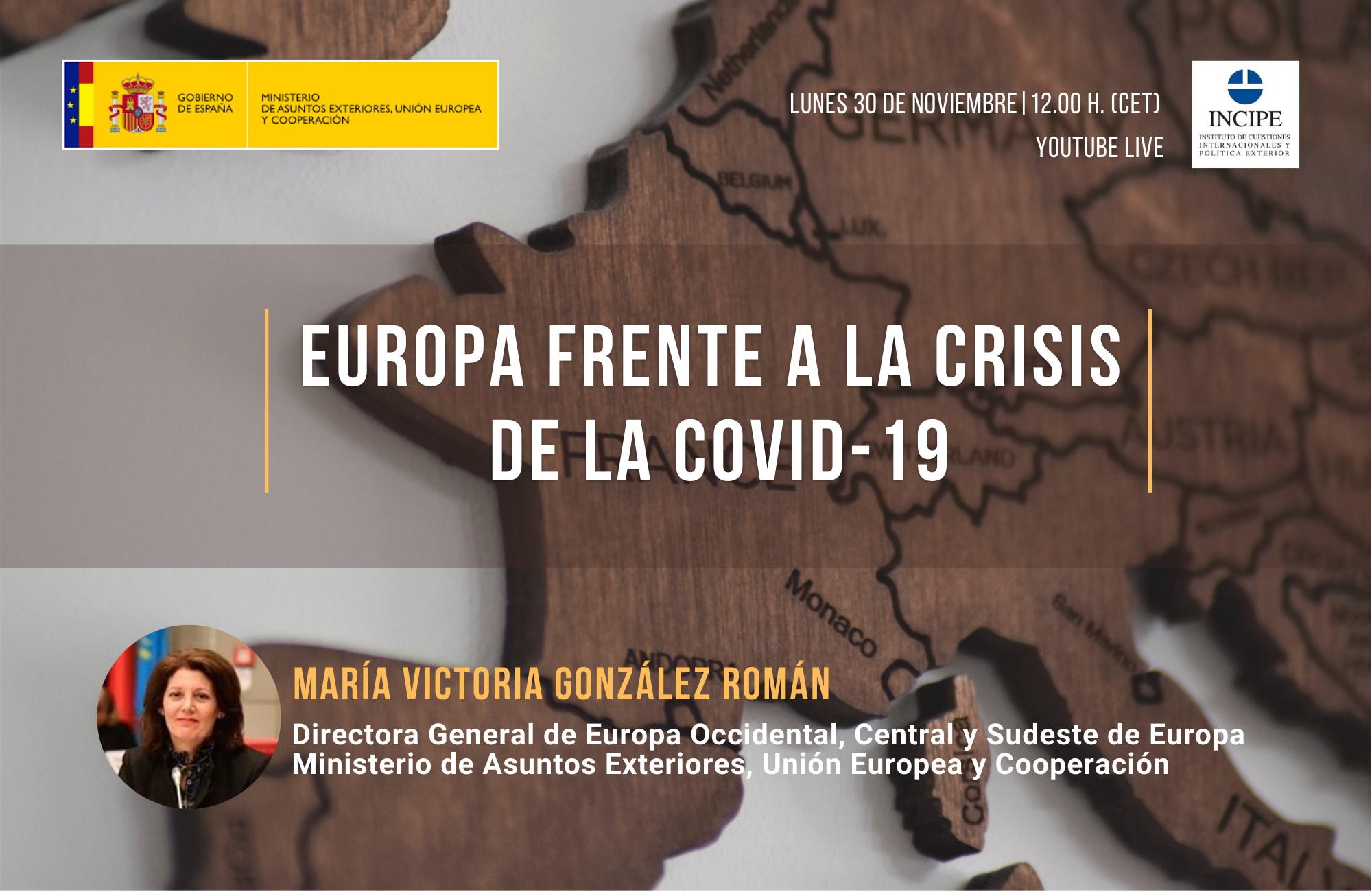
Neither the COVID-19 pandemic nor its consequences are problems that affect Europe exclusively. Like most threats to the stability of the European Union, they have a global character. However, as María Victoria González Román stated at the beginning of her speech, with seventeen million detected cases and 400,000 deaths, «it is having a greater impact, in some respects, than in other parts of the world.»
The economic impact is also enormous—according to German Chancellor Angela Merkel, the greatest since World War II—with GDP declines ranging from 10.5% in Italy to 5% in countries like Germany or Poland compared to the previous year. In this context, where COVID-19 acts as a geopolitical accelerator, the European Union has had to respond with the objective of establishing common lines of action.
The Director General described the initial European and Member State actions as «a mix of successes and shortcomings.» At the start of the pandemic, a «my country first» mentality prevailed, leading Member States to focus on solving their own problems regarding citizen mobility, the security of their healthcare systems, and border closures. At the same time, the entire European Union coordinated efforts to repatriate European citizens who had been «trapped» in other countries.
During this period of border reinstatement—marked by the difficulty of mobilizing shared resources and growing skepticism about the EU’s ability to act when needed—negotiations were underway for the next seven-year budget framework. González Román described these negotiations as «very tough, with Spain and Italy—two of the European countries most affected by the pandemic—playing a leading role.» The outcome was the creation of a €750.000 millions recovery fund and the EU’s commitment to take on debt in capital markets on behalf of the Union.
The Director General also highlighted the Next Generation EU instrument, which is based on grants and long-term loans, prioritizing distribution to countries facing the greatest difficulties. She considers this initiative not only a major act of solidarity within the Union but also a significant asset for its foreign policy and a shift in the EU’s global positioning.
Now, the time has come for the European Union to resume the Conference on the Future of Europe, initially scheduled for spring 2020. The pandemic will provide this initiative with a new context and a new approach to tackling pre-existing challenges, such as the crisis of multilateralism, inequality, and the technological revolution—global issues that, now more than ever, require a unified commitment from the Union and its Member States.
Sofía Alfayate
Communication Assistant, INCIPE