
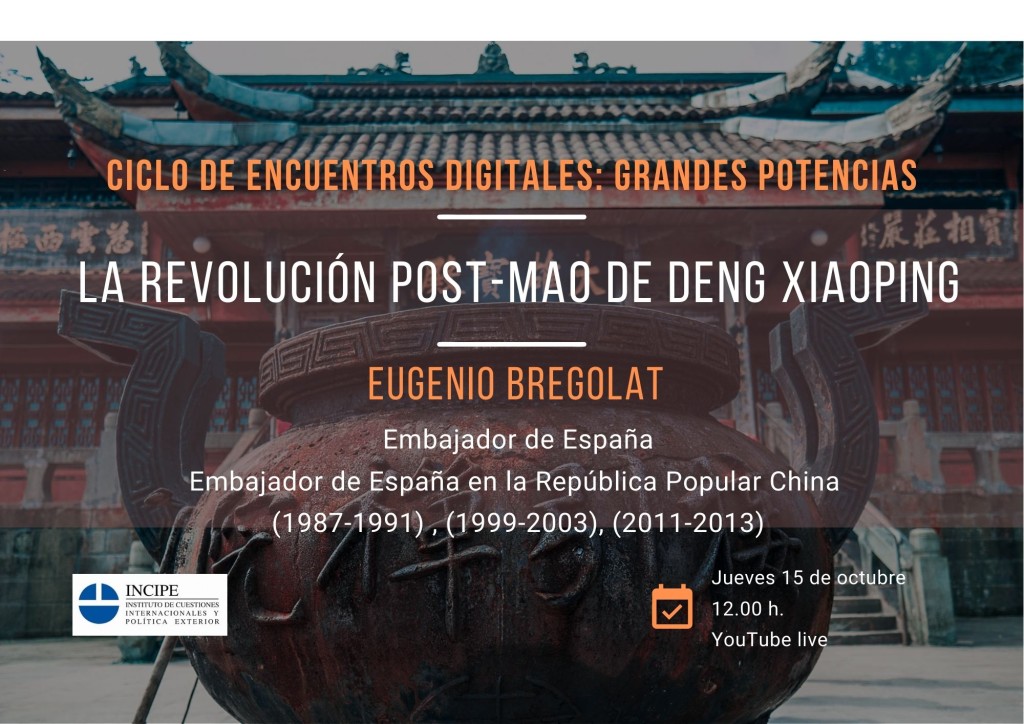
Ambassador Bregolat begins his lecture with an observation: «No matter how rigid a dictatorship is, and no matter how brutal it may be—as Mao’s was—there are always people in the upper echelons of power who think for themselves, draw their own conclusions, and, if the opportunity arises, change everything.» For Bregolat, in the Chinese context, that person is Deng Xiaoping. Deng recognized the need to introduce market mechanisms into China’s economy as a way to prevent the Chinese Communist Party from losing its legitimacy among the population on the one hand, and to avoid being subjected to another century of humiliation by Western powers on the other. Thus, instead of continuing with Mao’s attempt to build an egalitarian utopia, he focused on building a hybrid economy between the market and the state, where the balance of power between the two main actors has been a subject of debate since its formulation. According to one of the greatest economists, this system is based on «the dominance of public ownership, coexisting with other forms of ownership, with full market play and the plan as a guide.»
Today, Bregolat recalls, «the public sector consists of about a hundred large state-owned enterprises, which produce one-third of the GDP, while the other two-thirds are in the hands of the private sector.» This situation still has detractors, advocates of a greater role for the state sector.
In any case, the result of these economic reforms has been unprecedented success. China has marked a historic milestone in economic development, going from representing 6% of the U.S. GDP to two-thirds today, not considering the more favorable 2020 figures for the Asian giant, making it a threat to the rest of the world in general, and especially to the United States.
However, China also faces problems that affect its economy. An aging population, economic inequalities, rising public debt, political corruption, and environmental degradation are some of them. In this context, and around the recommendation not to underestimate the capacity of the mandarinate, Bregolat wonders if perhaps the increase in social complexity, arising from its own success as a state, may diminish the party’s ability to respond, as it falls behind.
As early as 1986, an attempt was made to separate the leadership of the Communist Party from the Chinese state. This separation, after the events in Tiananmen Square, was frozen, thus halting, from the Western perspective, political reform in the country. In this regard, Bregolat recalls, «Looking at China through Western lenses is a mistake» and that political reforms have indeed occurred in the country, but around what they call the improvement of socialist democracy. In any case, the ambassador concludes, China and the West are forced to accommodate each other, as «cooperation, not confrontation, between the two is what is needed for the world to improve.»
Sofía Alfayate
Communication Assistant, INCIPE